

Circle’s wrapped Bitcoin product cirBTC launched with many of the elements institutions typically want: segregated reserves, custody through a federally regulated trust institution, direct mint and redemption rails for qualified businesses, and a distribution stack built on the company’s experience with USDC. Even so, about 11 weeks after going live on Ethereum, disclosed Circle data showed just 40.02450077 cirBTC in circulation.
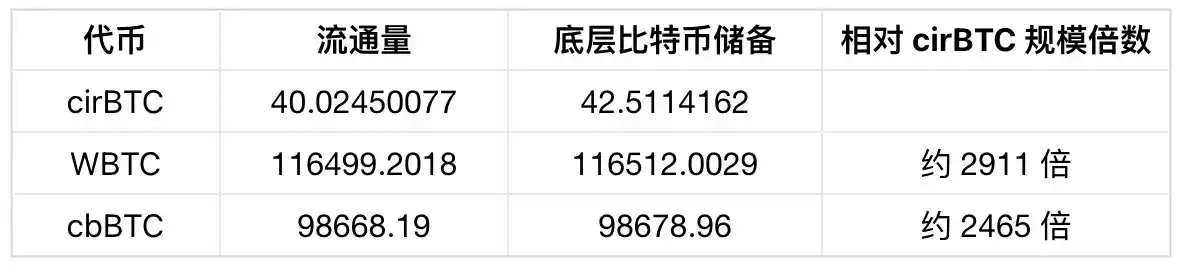
The same dashboard showed 42.5114162 BTC in the reserve pool, putting reserve coverage at about 106.2%. It also showed a 2.48691543 BTC reserve buffer spread across 14 disclosed Bitcoin addresses. The gap is hard to miss: Circle built a high-trust, institution-oriented wrapped Bitcoin structure, but it has yet to build a visible market ecosystem around it.
That leaves cirBTC as a real-world test of Circle’s broader platform story. In Circle’s second-quarter earnings report, Jeremy Allaire said the company had built an “internet financial system platform.” In this context, that description points to Circle’s wider business stack, including its trust charter, USDC, and the upcoming Arc network. cirBTC now needs to show whether that infrastructure can produce enough liquidity and protocol integrations for wrapped Bitcoin to function as usable collateral.
A 40-BTC float in a market measured in the hundreds of thousands
cirBTC is Circle’s tokenized Bitcoin product on Ethereum. BitGo-backed Wrapped Bitcoin (WBTC) and Coinbase’s cbBTC serve the same basic purpose, allowing Bitcoin to move across smart contract networks, but cirBTC sits far below both in scale.
The cirBTC figures cited in the report were taken from Aug. 27. Transparency data for WBTC and cbBTC was checked on Aug. 29. For cbBTC, the tally combined issuance across Ethereum, Base, Solana, and Arbitrum to avoid double counting.
Circulating supply is only one way to measure the usefulness of a wrapped token, but it also says a lot about distribution. Every token in circulation reflects actual demand from users who minted it, bought it, or deployed it somewhere. Products with supply in the 100,000-token range give exchanges and DeFi protocols a much larger asset base from which to build trading and lending markets.
Public on-chain data makes the difference in scale even more obvious. As of Aug. 29, DefiLlama data showed WBTC had reached a historical peak lending exposure of $3.12 billion, while cbBTC had reached $2.817 billion. The report noted that these numbers were historical peaks recorded by DefiLlama, not real-time lending balances or live market share figures.
CoinGecko data showed no trackable 24-hour trading volume, liquidity, or on-chain transaction record for cirBTC. CoinGecko only counts publicly traceable activity, so private over-the-counter trades would not appear there. Still, a blank public market record is enough to show that cirBTC has not established visible liquidity in mainstream public markets.
The community has already submitted a public proposal to add cirBTC to Aave. That proposal remains pending, however, and formal collateral support, borrowing demand, and risk parameters have not been put in place. For institutions, protocol integration has limited value unless positions can actually be opened, financed, and closed in functioning markets.
Strong trust framing, but key control points stay within the Circle structure
The operating structure behind cirBTC is formal and tightly organized, which is part of why its low adoption stands out.
According to the cirBTC white paper, the issuer is Bermuda-based Circle International Limited. The underlying Bitcoin is held by Circle National Trust, while Circle Internet Financial, LLC provides Circle Mint services and related distribution channels. On Ethereum, cirBTC is an ERC-20 token with 8 decimal places. Its contract address is 0x72DFB2E44f59C5AD2bAFE84314E5b99a7cd5075E, and that address can also be checked on Etherscan.
Circle National Trust received final charter approval from the U.S. Office of the Comptroller of the Currency, or OCC, in July. The approval applies to the national trust bank itself; cirBTC did not receive separate approval as a financial product. What the charter does provide is a custody credential with federal standing: the underlying Bitcoin is held by a federally chartered trust bank, the issuer publishes a reserve dashboard, and qualified clients can mint and redeem directly.
Circle Mint is open to eligible institutions, not retail users. Secondary-market users can freely transfer the ERC-20 token, but direct minting and redemption are restricted by institutional qualification, jurisdiction, and Circle’s compliance process.
That model may appeal to regulated funds and companies that want a clear redemption counterparty. It also raises the bar for primary market access. WBTC and cbBTC are already deeply embedded across exchange, wallet, and lending protocol networks. For cirBTC to turn its trust advantages into usage, dealers, market makers, protocols, and custody platforms still need to connect to it.
Circle does have distribution experience at scale. In its second-quarter earnings report, the company said USDC circulation stood at $73.3 billion, while total on-chain transaction volume for the quarter reached $14.8 trillion. Those figures show Circle knows how to operate a large token network. Whether cirBTC can attract demand depends on whether major platforms and clients see practical value in using this Bitcoin-derived token.
Circle has argued that wrapped Bitcoin should be “strategically neutral.” In an official blog post, the company said conflicts of interest can arise if the operator of a wrapped asset also runs an exchange, decentralized exchange, or lending protocol. Under that framing, Circle could distribute cirBTC broadly without steering users toward affiliated trading or lending venues.
But that neutrality applies at the commercial level, not the architectural one. Issuance, custody, direct redemption, and distribution for cirBTC are all controlled by Circle-affiliated entities. USDC can serve as the dollar-side liquidity pair for cirBTC, and Arc, the network Circle is building, could become another place where the token is used.
So Circle may be commercially neutral toward third-party platforms while still running a highly integrated business stack. Some institutions may view that concentration as a strength because lines of responsibility are clear. Others may worry about platform dependence. Which view carries more weight will be decided by adoption, not positioning.
For now, the data suggests that trust credentials alone are not enough to dislodge the network effects established by older products. A reserve dashboard can prove assets are there. It cannot, by itself, create broad acceptance, borrowing demand, deep trading markets, or low-friction redemption routes.
Arc may become the next major checkpoint
Arc could bring Circle’s custody business, stablecoin operations, and wrapped Bitcoin product into the same settlement environment. Circle said the Arc mainnet is scheduled to launch on Sept. 16, has already gathered more than 100 builders, and counts several large financial and payments institutions among its validator group.
The data used in this report runs through Aug. 29, which is before Arc’s planned launch. cirBTC documentation says the token will support the Arc testnet, but support for the mainnet has not been confirmed.
That makes Arc a future checkpoint rather than a current distribution achievement. Only if cirBTC becomes usable on Arc mainnet, with USDC trading markets, institutional participants, and lending and trading integrations in place, will the distance between minting and actual deployment start to narrow.
If cirBTC supply is still hovering around 40 tokens after Arc goes live, the “early-stage launch” explanation will become much harder to sustain. At that point, the gap between Circle’s infrastructure and actual user adoption would be harder to ignore.
At the moment, Circle’s reserve dashboard supports two conclusions at once: cirBTC has more Bitcoin in reserve than tokens issued, and compared with leading rivals, almost no users have actually minted and used it.
Circle has already built the institutional-grade infrastructure. cirBTC still has to show that users, trading venues, and DeFi protocols are willing to plug into it.