

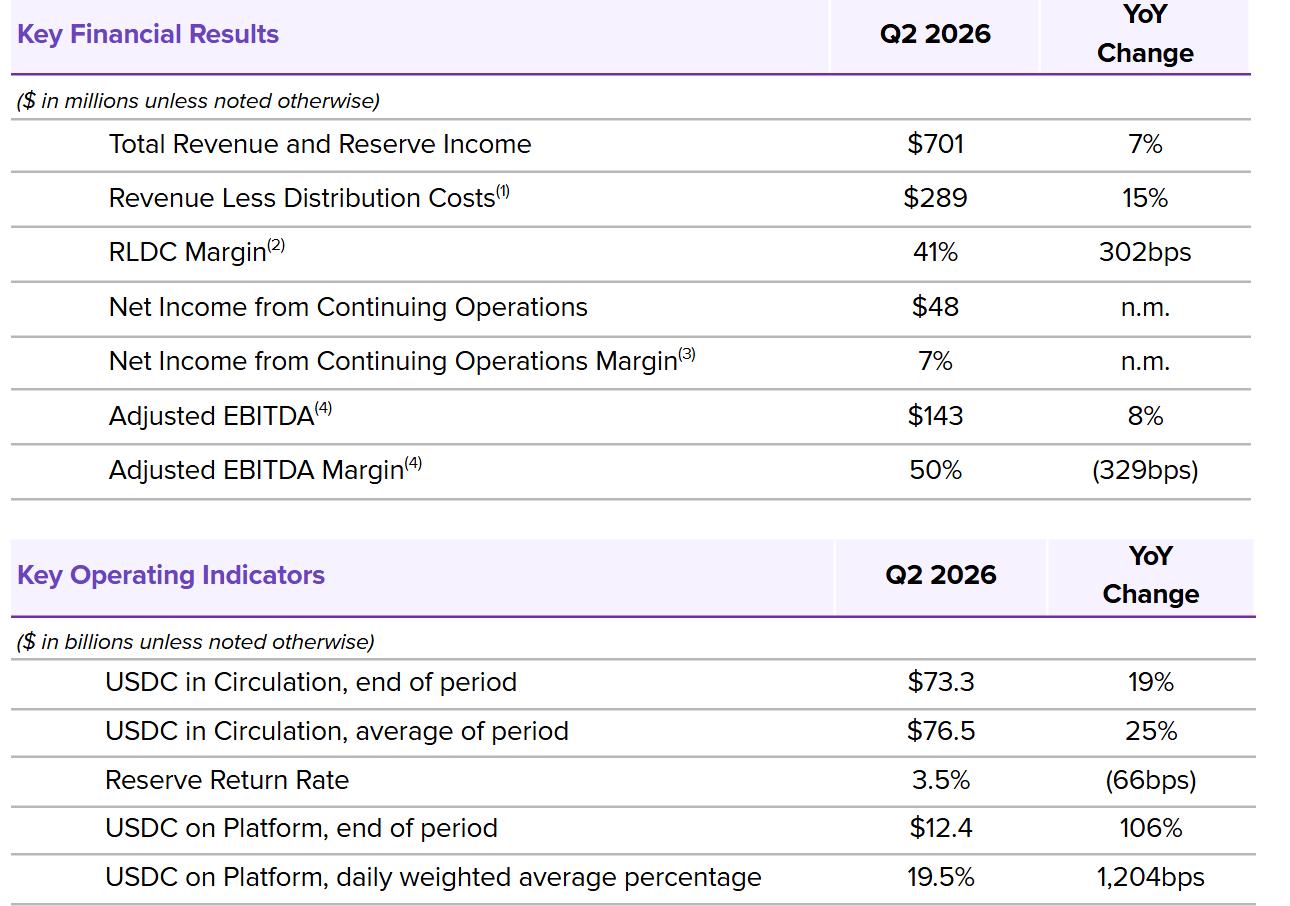
Circle Internet Group (NYSE: CRCL) reported second-quarter revenue and reserve income of $701 million on Aug. 5, up 7% from a year earlier. Net income from continuing operations came in at $48 million, reversing a loss in the prior-year period, while adjusted EBITDA rose 8% to $143 million. At quarter-end, USDC circulation stood at $73.3 billion, up 19% year over year, and on-chain transaction volume reached $14.8 trillion, up 151%.
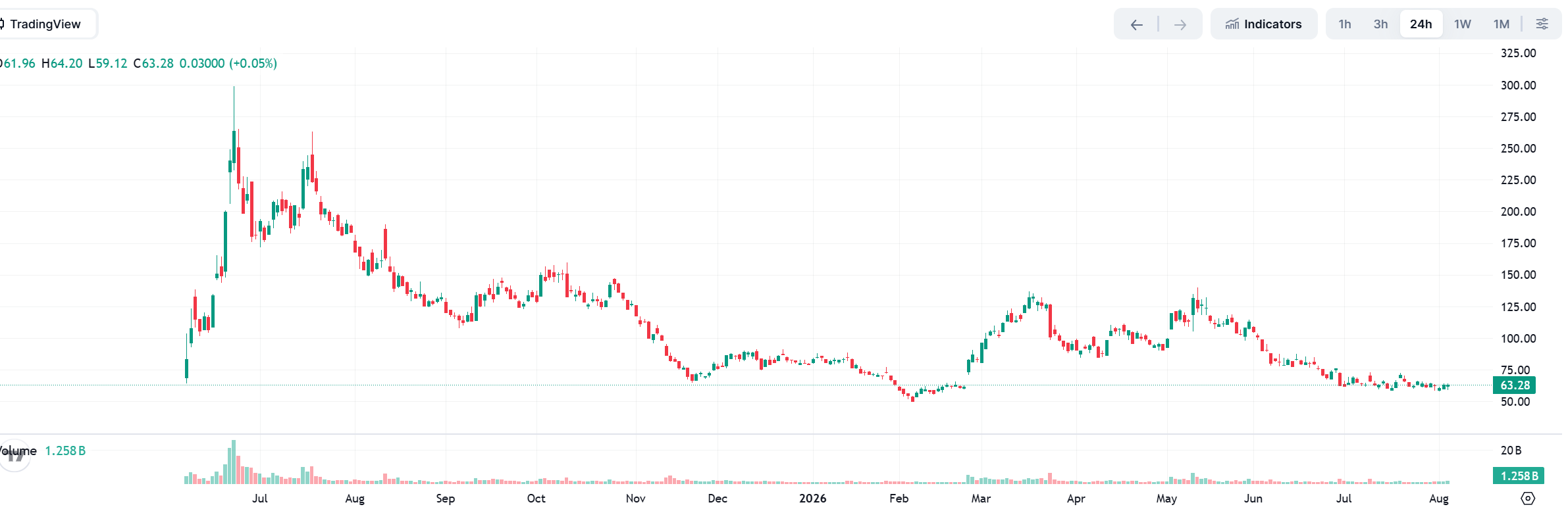
After the results were released, CRCL jumped in premarket trading before giving back ground and slipping about 3%. The stock closed at $63.28 early today, up 0.05% from the previous session. Shares have fallen more than 78.5% from the record high of $298 set last year.
The article argues that the headline figures were not especially surprising in a quarter when the broader crypto market slowed and reserve yields came under pressure across the stablecoin sector. The more revealing part of the report was structural: Circle still draws most of its earnings power from USDC supply and interest rates, yet it is trying to move beyond a model centered on reserve income by leaning on regulatory licenses, institutional-grade infrastructure and programmable finance.
Revenue mix shows continuing dependence on USDC and rates
Circle said reserve income in the second quarter reached $668 million, up 5% year over year. USDC circulation during the period was $76.5 billion, up 25%, but reserve yield fell to 3.5%, down 66 basis points from a year earlier. Other revenue rose 41% to $34 million, mainly from subscription and services activity.
Distribution, transaction and other costs totaled $412 million, up just 1%. Operating expenses fell 56% to $254 million, largely because the comparison period in the second quarter of 2025 included elevated IPO-related stock-based compensation. On an adjusted basis, operating expenses increased 23% to $146 million, reflecting higher spending on products, infrastructure and AI capabilities.
Revenue less distribution and transaction costs, or RLDC, was $289 million, up 15%, with margin at 41%, an improvement of 302 basis points from a year earlier. Adjusted EBITDA margin was 50%, though that was 329 basis points lower than the year-ago level. The article says the swing back to net profit was driven to a large extent by the absence of stock-based compensation pressure rather than a sharp breakout in the core business.
Sequential trends also drew attention. According to the article, various datasets and analyses show USDC circulation pulled back from its first-quarter high to $73.3 billion, while on-chain transaction volume also contracted noticeably from the previous quarter. Minting totaled $83 billion and redemptions reached $87 billion, leaving net outflows of about $4 billion. USDC’s stablecoin market share was 27%, down 66 basis points year over year.
At the same time, effective holding addresses climbed to 7 million, up 24% from a year earlier. USDC held on platforms doubled to $12.4 billion, and the daily weighted average share rose to 19.5%. Taken together, the figures suggest that usage intensity is still increasing, with transaction volume growing far faster than circulation, but absolute supply growth is losing momentum and earnings remain highly sensitive to the interest-rate backdrop. Circle itself said the quarter reflected the current rate environment and a slower crypto market.
Tether comparison highlights the gap in scale and balance sheet positioning
The article contrasts Circle with Tether, another stablecoin company. Based on the latest report issued by audit firm BDO, Tether generated $1.5 billion in operating net profit in the second quarter of 2026. It reported total assets of $187.75 billion and total liabilities of $183.64 billion.
USDT still accounts for more than 60% of the global stablecoin market, according to the article. As of the end of the second quarter, Tether held about $18.84 billion in gold and $5.8 billion in bitcoin. Combined, those two positions totaled $24.6 billion, or about 13% of total assets.
Arc mainnet set for Sept. 16 with a roster of institutional validators
The business update, rather than the income statement alone, carried more of the forward-looking detail in the report. Circle said the Arc blockchain already has more than 100 ecosystem and institutional builders.
Arc mainnet is scheduled to go live on Sept. 16, alongside the release of privacy features, an Agent Stack built for programmable finance and support for real-world assets. Circle also named its founding third-party validators: BlackRock, DTCC, Galaxy, Global Payments, ICE, Mastercard, MoneyGram, SBI Group, Standard Chartered, Sumitomo Corporation and Visa.
The article describes these as more than ordinary nodes. They are global financial institutions that depend on network integrity in their own businesses and are now also taking part in maintaining that security.
Institutional deployment is moving ahead in parallel. BlackRock plans to bring its BUIDL fund onto Arc. DTCC will support tokenization of DTC-custodied assets on Arc. BNY and Standard Chartered, among others, are exploring tokenized settlement, custody, stablecoin access, foreign exchange and repo infrastructure.
Trust-bank approvals, payments growth and Agent Stack form the next layer
On the regulatory side, Circle received final approval from the Office of the Comptroller of the Currency to establish Circle National Trust. The article says that makes it one of the first stablecoin issuers to hold a federal banking license. The approval allows federally regulated digital asset custody and could eventually give Circle a path to manage USDC reserves directly. The New York State Department of Financial Services also approved Circle New York Trust.
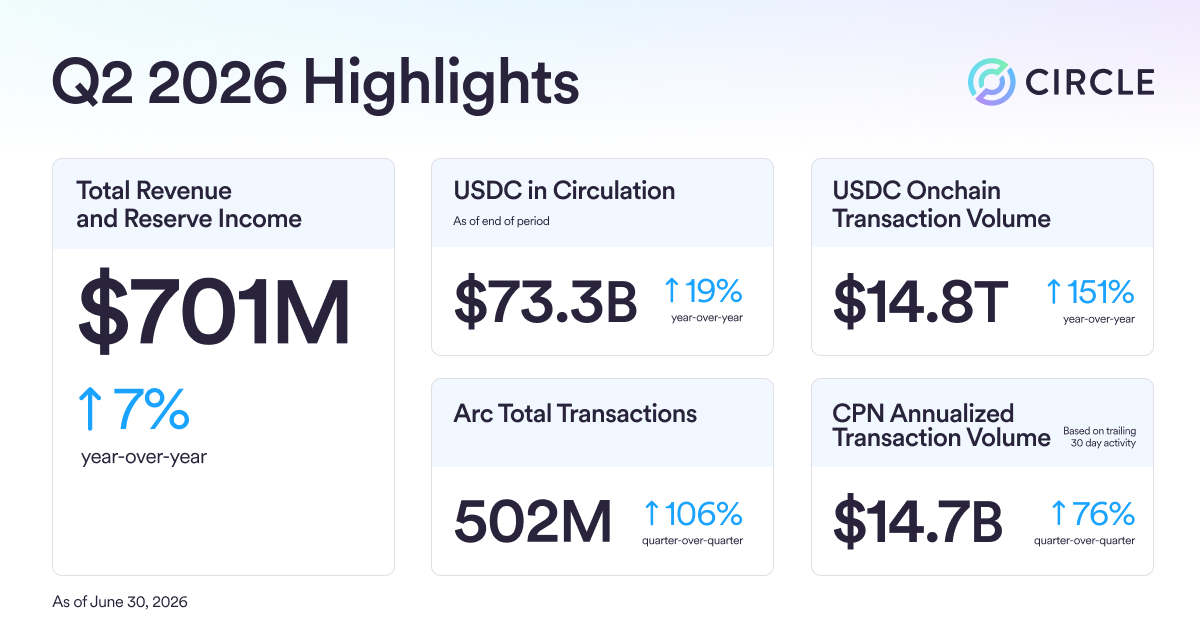
Circle Payments Network, or CPN, reached $14.7 billion in annualized transaction volume over the last 30 days, up 76% from the previous quarter. The number of financial institutions on the network rose 29% quarter over quarter to 175.
Agent Stack, launched in May, already has more than 900 paid services. Of x402 agent payment volume, 99.3% was settled in USDC. According to the article, Circle plans to push a more complete agent product roadmap in the second half of the year, including tools aimed at letting agents earn money.
Partnership updates were spread across several markets. BNY added direct USDC minting and redemption to its digital asset custody platform. Grupo Bind integrated USDC for institutional use cases in Argentina. JCB is focused on cross-border and in-store use in Japan. Kakao Group is exploring opportunities in South Korea. Marex completed its first regulated derivatives clearing transaction using USDC as initial margin. Nium connected payment and settlement rails across more than 190 countries. Standard Chartered launched what the article called a bank-led one-stop minting and redemption experience.
Put together, those pieces sketch a broader shift. The article argues that Circle is moving from being primarily a stablecoin issuer toward becoming an infrastructure provider for an internet-based financial system. USDC remains the core business today, but Arc, trust-bank licenses, Agent Stack and institutional validators are laying the groundwork for a different revenue mix over time.
Circle CEO Jeremy Allaire said in the earnings report that the financial numbers reflect external conditions, while recent business actions — the federal trust-bank license, Arc mainnet, Agent Stack and institutional expansion — tell a different story. He said the company spent more than a decade building trust to reach its current platform position.
Can investors still buy CRCL?
The article frames the post-earnings volatility in CRCL as a debate between two forces. One is near-term pressure on reserve income from both interest rates and stablecoin circulation. The other is the longer-term value of regulatory barriers and financial infrastructure.
It says the earnings report did not deliver a story of explosive growth, but it did clarify where Circle stands. The core business is still tied to macro rates and the crypto cycle, and growth has slowed. At the same time, the company is building a moat around its next phase through regulation, an institutional public blockchain and programmable finance tools.
On Aug. 3, Morgan Stanley downgraded Circle to underweight from equal weight and cut its price target to $38 from $106. The bank cited slower USDC growth, rising competition from tokenized money market funds and higher costs tied to maintaining distribution. TD Cowen, by contrast, initiated coverage with a buy rating and an $82 price target.
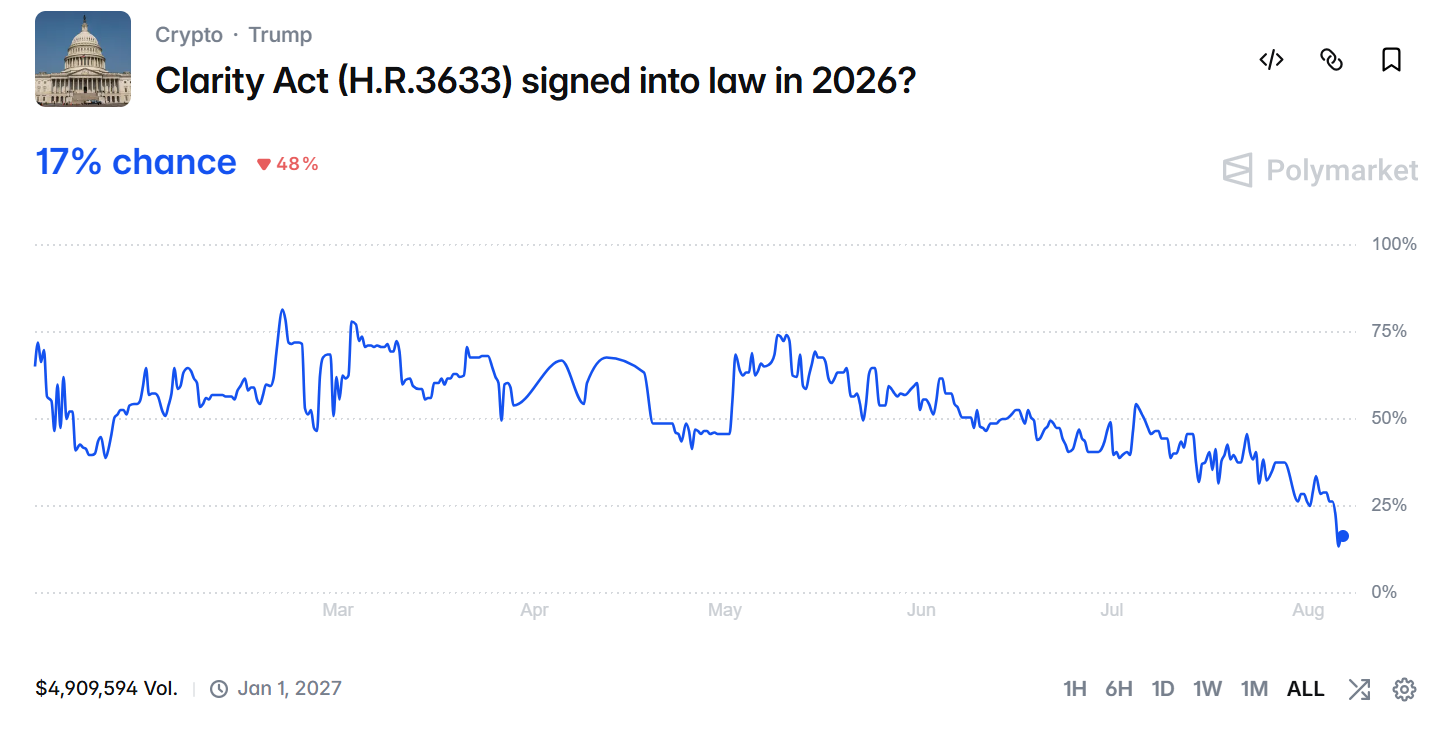
The article also says the market broadly views the CLARITY Act as a key catalyst for the next stage of stablecoin development. If enacted, the bill would provide a clearer regulatory framework for stablecoin issuance, trading and related financial services. U.S. Senator Cynthia Lummis said she expects the Senate to vote on the CLARITY Act before the August recess.
Latest Polymarket data showed the implied probability of the CLARITY Act being signed into law this year had fallen to 17%.
Twitter user Kay Capital said in July while discussing CRCL: "There is only one phase to buy a crypto stock, and that is when the token’s main uptrend begins but the stock has not moved in sync yet. You are capturing a different stage of the rally, similar to what altcoins once offered."
NDV founder Jason Huang said after the earnings release: "Whether the news on CRCL is good or bad, $60 is quite a solid support level. Even when bad news came out, the price did not fall. I actually think that is a good sign. You just need to stay patient with this stock."
The article ends by pointing to two potential turning points for CRCL: the Sept. 16 launch of Arc mainnet and the Federal Reserve’s interest-rate decision.