
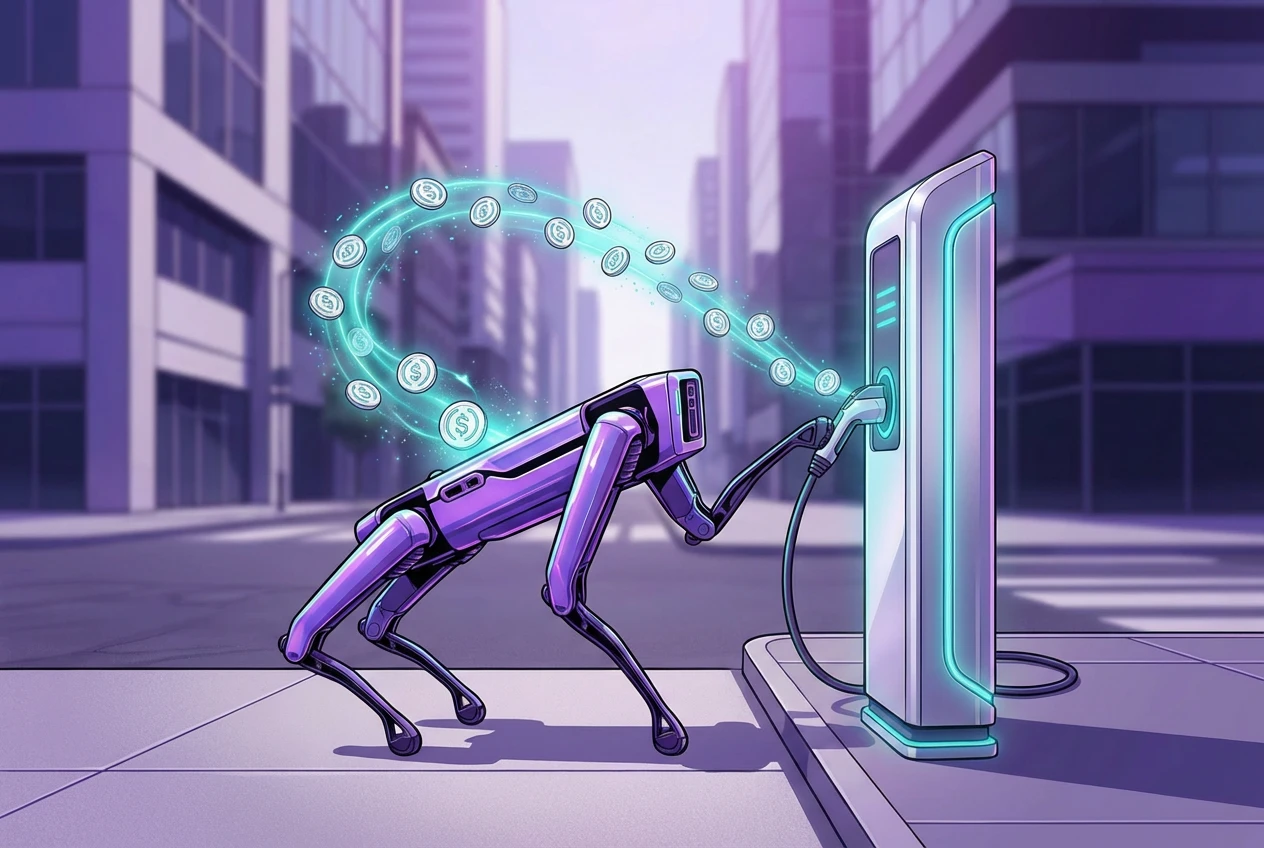
A robot dog running low on battery autonomously paid for a charge with USDC — no human intervention. That's the real-world demo Circle showed on the day it launched its Nanopayments testnet. Built in collaboration with open-source robotics software firm OpenMind, the demonstration had an autonomous robot dog complete a USDC payment and charging cycle, serving as the first public example of agent-driven payments.
The transaction behind the demo addresses a glaring problem: traditional payment systems don't handle ultra-small micropayments. Even low-cost on-chain transactions can see fees eat up 1,000% of a $0.0001 transfer. Nanopayments aims to break that barrier.
Off-Chain Aggregation + Batch Settlement: Zero Gas Micropayments
The technical core is an off-chain aggregation and delayed batch settlement architecture driven by Circle Gateway. An AI agent signs an EIP-3009 authorization (a signed token transfer message), the Nanopayments API validates the signature and instantly adjusts internal account balances; merchants receive immediate confirmation and can deliver service without waiting for on-chain finality. Actual USDC settlements are batch-uploaded to chain periodically, splitting gas costs across many transactions. The result: agents can transfer as little as 0.000001 USDC without holding ETH or any gas token, while merchants see funds confirmed in real time.
x402 Standard: Agents "Swipe Directly" Without Accounts
Nanopayments follows the x402 standard, co-driven by Coinbase and Cloudflare, which is emerging as an industry protocol for agent commerce. The core design enables any AI agent to pay any merchant directly, without creating an account or linking a credit card. When an agent calls a paid API, uses instant compute, or crawls a paywalled dataset, the entire payment flow can be automated with no human approving each transaction.
The testnet is currently live on 12 chains: Arbitrum, Arc, Avalanche, Base, Ethereum, HyperEVM, Optimism, Polygon PoS, Sei, Sonic, Unichain, and World Chain.
Four Scenarios Target Machine-to-Machine Economy
Circle outlined four commercial scenarios Nanopayments directly serves, all revolving around high-frequency low-value machine-to-machine payments:
- Pay-per-call APIs: agents pay per API endpoint call, no subscription needed
- Instant compute billing: AI training or inference billed by actual usage at second granularity
- Pay-per-crawl: agents pay per data record when scraping datasets
- Autonomous service markets: agents exchange services and settle instantly
Credit card minimum fees, cross-border charges, and account setup costs have made per-transaction amounts like $0.001 infeasible under traditional frameworks. Nanopayments uses off-chain aggregation and batch settlement to bridge that gap.
Race to Build Agent Economy Infrastructure
In the same lane, Coinbase has integrated x402 via Agentic Wallets, and Google launched AP2 (Agent Payment Protocol) supporting stablecoins. All are racing to outfit billions of future AI agents with the ability to spend money. Circle positions Nanopayments as a "core primitive" for agent economic activity — implying it's not just a payment tool but a foundational component of agent infrastructure. Whether this Lego brick can support large-scale agent-to-agent transaction networks will be tested when the mainnet goes live.