
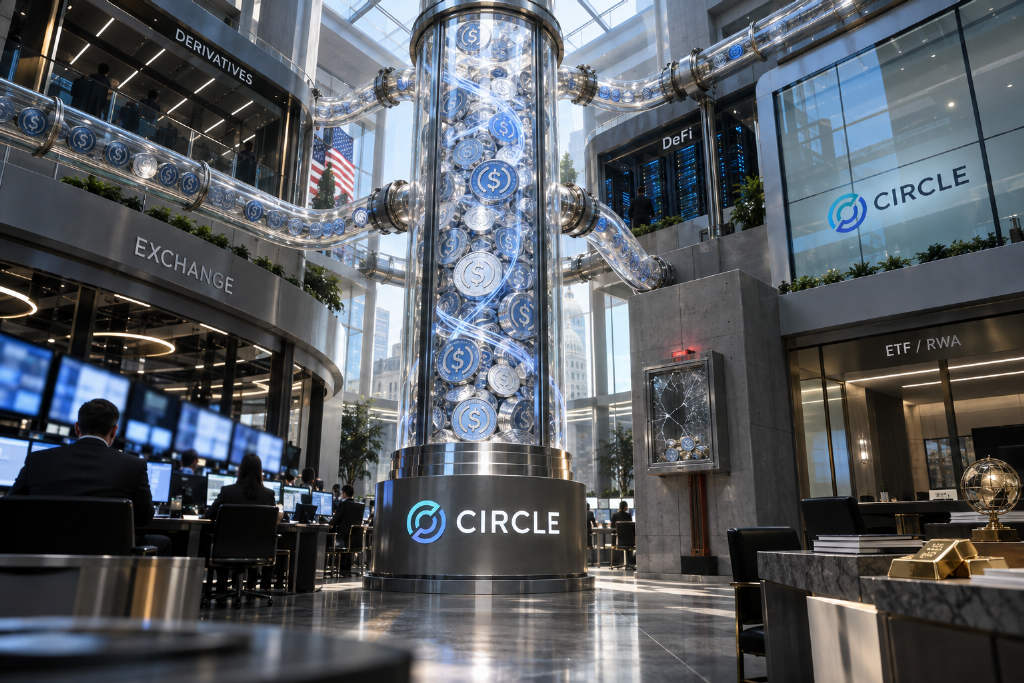
Circle’s large distribution bill looks less strange once crypto is framed as a market for moving money, not just issuing tokens.
In the second quarter of 2026, Circle reported about $701.3 million in revenue and reserve income. Distribution, transaction and other costs came to roughly $412.5 million, equal to 58.8% of that total. Circle issues USDC, collects income from reserve assets behind the stablecoin, and then shares a sizable portion of that economics with partners that put USDC in front of end users. Results released on Aug. 5 showed revenue and reserve income rose 7% year over year, while that cost line increased 1%. USDC circulation stood at about $73.3 billion at the end of June.
Seen from the payer’s side, the bill can look hard to justify. Seen from the recipient’s side, it reflects a business worth studying closely. Issuing a compliant stablecoin and assembling reserves is only the start. Exchanges still need to support it, users need to hold it, and counterparties in trading or payments need to accept it for settlement. Only then does money stay inside the system long enough for reserves to keep generating income.
That is why the article focuses less on sector labels and more on the path of funds: where money enters, whose hands it passes through, and where it ends up. Look at crypto as a supply chain. Upstream, someone brings capital. In the middle, someone converts, moves and distributes it. In trading venues, someone else must still be willing to use the asset. Viewed that way, the value of many projects, and the right to charge along the route, becomes easier to understand.
By that lens, the industry’s history from Bitcoin to smart contracts, DeFi and then real-world assets can be read as a long effort to make it easier for more money to participate in trading. Some of that is fresh external capital. Some is existing money being reassigned. Sometimes it is the same money moving faster.
Liquidity starts with one basic question: who brings the cash
Mining creates coins and token issuance creates supply, but neither creates a buyer by itself. A token may print at $100 in its last trade, yet that does not mean the rest of the supply can be sold at $100. Market capitalization can be marked from that price. Realizable value depends on bids lower down the book.
That was the original job of exchanges: gathering scattered people and scattered money in one place. Rather than finding counterparties manually, negotiating price and worrying about delivery, users could deposit cash and coins into the same venue and trade there. The easier trading became, the easier it was to attract the next wave of users and retain balances on platform. What exchanges gradually accumulated was not just listings. It was a population of accounts holding funds and capable of placing orders at any time.
That also explains why projects care so much about listings. A token existing on-chain is not the same as a token appearing where large numbers of users can buy it directly. A listing connects the asset to purchasing power and willingness to buy sitting inside user accounts.
Not all exchange businesses, however, are equal in terms of the money they attract or keep. Coinbase’s second-quarter 2026 results make the point clearly. Consumer trading produced roughly three-quarters of transaction revenue, which is unsurprising. Stablecoin revenue, though, was about $292 million, above roughly $100 million from institutional trading. Retained stablecoin balances can generate shared economics with the issuer and become a major earnings line. That helps explain why exchanges compete not only for order flow, but also for deposits that remain parked on the platform long enough to earn meaningful channel payments.
Token fundraising can shift old money without bringing in new dollars
In 2014, Ethereum’s public sale raised about 31,000 BTC, worth around $18 million at the time. Participants handed over Bitcoin they already owned in exchange for future ether, while the team gained funding to continue development. It was a financing event for a new project, but also a redistribution of existing crypto wealth between holders.
Later token fundraising grew far louder, especially during the 2017-2018 ICO boom. Yet a project announcing a large raise does not mean the same amount of new dollars has entered crypto. The money may come from selling other tokens. It may come from holders allocating existing BTC or ETH. After the raise, teams still need to pay staff and vendors, and some of that capital may be converted back into fiat.
So when reading any token raise, the amount is only the first layer. What asset was raised, who supplied it, and how the proceeds are later spent matter just as much.
Stablecoins solved the problem of moving value between markets
Suppose a trader sells Bitcoin because they expect short-term weakness but do not intend to leave crypto entirely. They may want to hold dollars for a few days, buy back later, or move to another exchange for arbitrage. Repeatedly withdrawing to a bank and then sending money back in introduces delays, channel constraints and geographic friction. USDT and USDC let users hold a dollar-denominated asset in between and move it to the next venue without leaving the crypto rails every time.
That shift was especially visible in Asia. In a 2019 study, Chainalysis tracked trading structures on venues including Huobi and OKCoin before and after the 2017 crackdown on mainland Chinese exchanges. As activity returned, pricing moved sharply from renminbi pairs toward USDT. The firm’s sample of 10 over-the-counter brokers received about $877 million in crypto assets from September 2018 to September 2019, versus $577 million in the prior year, an increase of about 52%. The numbers point to a migration in entry channels.
Users had once brought fiat directly to exchanges. Later, to work around policy restrictions, the path gained an extra step: first convert through an OTC merchant, then move into trading venues. Merchants could accept local payments and deliver stablecoins that global platforms were willing to take. That connection became a business in its own right. Stablecoin value accumulated through those specific use cases.
Once scale arrived, issuer economics became significant. Tether said in its second-quarter 2026 announcement that net operating profit for the quarter was about $1.5 billion, mainly from U.S. Treasuries and repo business. Users hold stablecoins while waiting for the next opportunity; during that time, reserve assets keep earning. The business is tied directly to how long the money stays put.
As of Sept. 27, 2026, DefiLlama showed total stablecoin market capitalization at about $306.6 billion. USDT accounted for roughly $183.8 billion, USDC for about $75.4 billion, and USDT’s share stood at 59.93%. Aggregate supply increased by about $1.679 billion over the previous seven days, or around 0.55%.
Even so, those balances should not automatically be treated as the next wave of buying power for risk assets. Stablecoins can sit inside different collateral and hedging structures. Holders may use them for remittances, payments or savings. Even if the money remains on exchanges, it only becomes a bid when the owner decides to buy something risky. Money entering the system and money preparing to buy coins are not the same event.
Perpetual futures gave capital another reason to participate
In 2016, BitMEX introduced Bitcoin perpetual futures, combining contracts with no fixed expiry and a funding-rate mechanism. The market impact went beyond making it easier to go long or short. It also opened the door to capital that was not interested in making a directional call.
If funding is positive and high enough to cover costs, for example, a trader can buy spot and short the perpetual to collect the funding payment. Belief in the long-term story of the coin is not the key variable. The spot leg adds buying interest, the derivatives leg adds selling pressure, and the position is held because the package may be profitable. Market makers can also use futures to hedge inventory and keep quoting more consistently.
That does not remove risk. Funding can flip, basis can move, margin has to be managed, and the trading venue itself can fail. Direction may be hedged while other risks remain. Still, the structure lets markets attract capital with different motives. Those participants do not need to buy into the same narrative to trade against one another. Perpetuals lowered some of the friction and created a new commercial reason to enter the market.
Traditional derivatives markets show the same broadening. Data released by CME on Sept. 2 showed average daily volume in crypto products reached 175,000 contracts in August 2026. CoinGecko estimated that the top 10 centralized perpetual exchanges recorded around $12.7 trillion in volume in the second quarter of 2026.
DeFi pushed market making out to a wider set of capital providers
Around 2020, DeFi moved the question of who funds liquidity one step further outward. On Uniswap, users could deposit two assets into an automated market maker pool and let smart contracts execute swaps according to preset rules. In the classic constant-product design, prices move with reserve ratios, and arbitrageurs then pull those prices back toward the broader market.
That meant ordinary token holders could provide liquidity, earn fees, and bear inventory value changes, adverse selection and contract risk at the same time. For projects, the change was substantial as well. Reaching users no longer always required winning an exchange listing first. A team could create its own pool, seed assets and let trading begin.
Uniswap’s 2020 review said annual volume exceeded $58 billion, versus about $390 million in 2019. By the end of 2020, more than 68,000 addresses were providing liquidity. Whether that represented entirely new capital is harder to prove. What is clear is that capital had one more way to organize itself into a market.
That led naturally to the next idea: if capital chases returns, can higher rewards pull it in?
At the end of August 2020, SushiSwap launched and offered SUSHI rewards to Uniswap liquidity providers who deposited their LP receipts. CoinGecko’s report from the period recorded more than $800 million in liquidity migrating from Uniswap to SushiSwap by Sept. 9. After the 10x reward phase ended on Sept. 12, funds started leaving again, much of it returning to Uniswap.
The lesson was simple. Liquidity providers do the math. Money can arrive quickly and leave just as quickly. Uniswap later launched UNI and allocated 20 million tokens to an initial liquidity mining program. When mining started on Sept. 18, total value locked rose above $2 billion.
The so-called vampire attack made one point impossible to miss: code can be copied, capital can move, and rewards can pull funds out of a rival pool, but the reverse can happen just as fast. For the industry as a whole, however, $800 million changing staking venues did not mean $800 million of fresh cash had entered crypto. For any individual project, the real test comes after incentives fade. Does the capital stay?
Subsidizing liquidity with token emissions has its own cost. Existing holders take dilution. Those who earn rewards still need someone else to buy the token if they want to cash out. If the underlying trading activity does not generate enough fees, the liquidity has to keep being paid for.
Lending extended the chain one step further. Assets are posted as collateral, stablecoins are borrowed, and those stablecoins are then deployed into another protocol. The same base asset supports more activity while also creating extra layers of liabilities. That is why total value locked across protocols cannot simply be added together as if it all represented independent principal. Original collateral, borrowed funds and derivative receipts may appear repeatedly in different venues and form circular credit loops.
When everyone wants cash back, the differences become obvious
That distinction matters most when markets shift into redemption mode.
FTX collapsed in 2022 because customer assets had been misused. In its 2024 sentencing announcement, the U.S. Department of Justice said Sam Bankman-Fried stole more than $8 billion in customer funds. Users saw balances in their accounts and assumed withdrawals were available on demand. In reality, the assets supporting those balances had been deployed into risks users never authorized. A number on screen is not the same as money that can be paid out.
The damage can spread well beyond one venue. In its late-2023 review, Kaiko said the 1% market depth it tracked remained about 50% below the level seen before FTX and Alameda collapsed. Prices and volume had recovered to some extent, but part of the market-making capital had not returned. The report attributed part of that gap to institutional losses, exits and reduced risk deployment.
That is a reminder that order books are supported by real principal. If a market maker loses money or its financing gets tighter, quotes can shrink across multiple venues at once. Even if prices rebound, the underlying capital does not necessarily come back with them. More trading pairs and more marketing cannot replace missing balance sheet.
USDC offered another reminder in March 2023. After Silicon Valley Bank failed, Circle said $3.3 billion of reserve deposits had been affected, equal to about 8% of reserves at the time, and USDC lost its peg. Conditions stabilized only after U.S. authorities said depositors would be protected.
Transfers on-chain can run around the clock. Whether dollars can be retrieved from the banking system is another question entirely. Banks never disappeared from the stablecoin business; they moved behind it. The market is willing to take a stablecoin at $1 because it expects redemption at $1. If that path breaks, trading activity further up the chain is affected as well.
As liquidity pools multiply, order distribution becomes a business too
Once the market contains many pools and many market makers, another question follows: where should a user’s order actually go?
Most users are not going to compare every pool by price, depth and fees. Aggregators perform that search for them. Jupiter, for example, routes across liquidity sources in the Solana ecosystem to find a trading path. Capital may be provided by many pools and market makers, while the user keeps returning to the same front-end entry point.
At that point, supplying liquidity and distributing liquidity become easier to separate. One side provides the capital and the quote. The other brings the user and the order flow. Both matter. Bargaining power depends on which side is harder to replace. If funding sources are interchangeable, the gateway gains leverage. If a certain market’s pricing and depth cannot easily be replicated, that venue has more room to keep revenue.
Hyperliquid’s Builder Codes provide another example. Third-party applications can charge extra fees on orders submitted through them, within the scope of user authorization. Products can be built on top of an existing trading backbone without each app having to recreate the whole market from scratch. Users see the front-end interface, while execution may rely on the same underlying infrastructure and liquidity pool.
Read Circle’s distribution expense through that lens
Viewed through the full chain, Circle’s distribution cost no longer looks irrational. A stablecoin issuer may produce the asset, but other platforms control users, balances and use cases. Entering that network means negotiating how the economics are split. Technical convenience does not replace distribution power. Often, it has to be purchased.
Wall Street’s arrival in crypto follows the same logic.
On Jan. 10, 2024, the U.S. Securities and Exchange Commission approved the listing and trading of multiple spot Bitcoin exchange-traded products. For some investors, getting Bitcoin exposure had previously meant opening crypto accounts and learning wallets and private keys. Now they could buy exposure inside a brokerage account. The asset did not change. The access route did. Money that had stayed out because of friction or internal process constraints gained a new entry channel.
Farside data for Sept. 21 through Sept. 25, 2026 showed U.S. spot Bitcoin ETFs recorded a combined net inflow of $2.3858 billion, with net inflows on all five trading days. On Sept. 25 alone, net inflow reached $134.5 million. That is a concrete expression of what people usually call institutional participation.
Real-world assets connect the system in a different direction. In March 2024, BlackRock launched BUIDL, tokenizing a fund that invests in cash, short-term U.S. Treasuries and repurchase agreements for qualified investors. At launch, the minimum investment was $5 million, and the tokens could be transferred among approved investors. By Sept. 27, 2026, BUIDL’s total asset value had reached about $2.24 billion.
The significance is that traditional assets gained an on-chain format for distribution and use. But managing $2.24 billion of assets does not mean there is $2.24 billion of secondary-market buying power available at any moment. Money on-chain that moves into a Treasury product may simply be money that used to sit in USDC and is now earning interest somewhere else. That is new capital for the fund, but not necessarily new demand for crypto risk assets. So each time traditional finance is said to be entering crypto, the next question matters: is outside money coming in to buy coins, or is crypto-native money moving out to buy traditional assets?
Following the money clarifies what a project really does
Put all these layers together and the economics of the crypto market become easier to parse. None of the pieces fully replaces the others. A single trade may start in a bank account, move into a stablecoin, reach the market through a wallet or aggregator, get absorbed by a market maker, and end up hedged in perpetual futures. Fees, spreads, reserve income and distribution payments are then divided along that path.
That is why the more useful question for any project is where it sits on this chain. How much money can it actually bring in? How much is merely relocated from somewhere else? If subsidies stop, do users stay? When the business earns fees, do they accrue to the company, to liquidity providers, or through some mechanism to token holders? A project having revenue and a token holder sharing in that value are not the same thing.
Over the past decade and more, crypto has steadily created more reasons for capital to come on-chain. Some participants want asset exposure. Some want funding payments. Some need a hedge. Some just need to move money somewhere else. Markets become more durable when people with different motives can meet with lower friction.
Technology can improve further and the menu of assets can keep growing. Yet every sell order still requires someone willing to meet it with real money. The businesses worth tracking are the ones that can keep finding that money, convince capital providers the math works, and bring trading activity onto their rails.