

Citi’s latest quantitative cross-asset work says the market may still be waiting for the peak in U.S. Treasury yields, and oil is central to that call. The bank argues that a decline in oil prices has been close to a necessary condition for the 10-year Treasury yield to top out. With geopolitical tensions keeping crude supported, that condition has yet to appear.
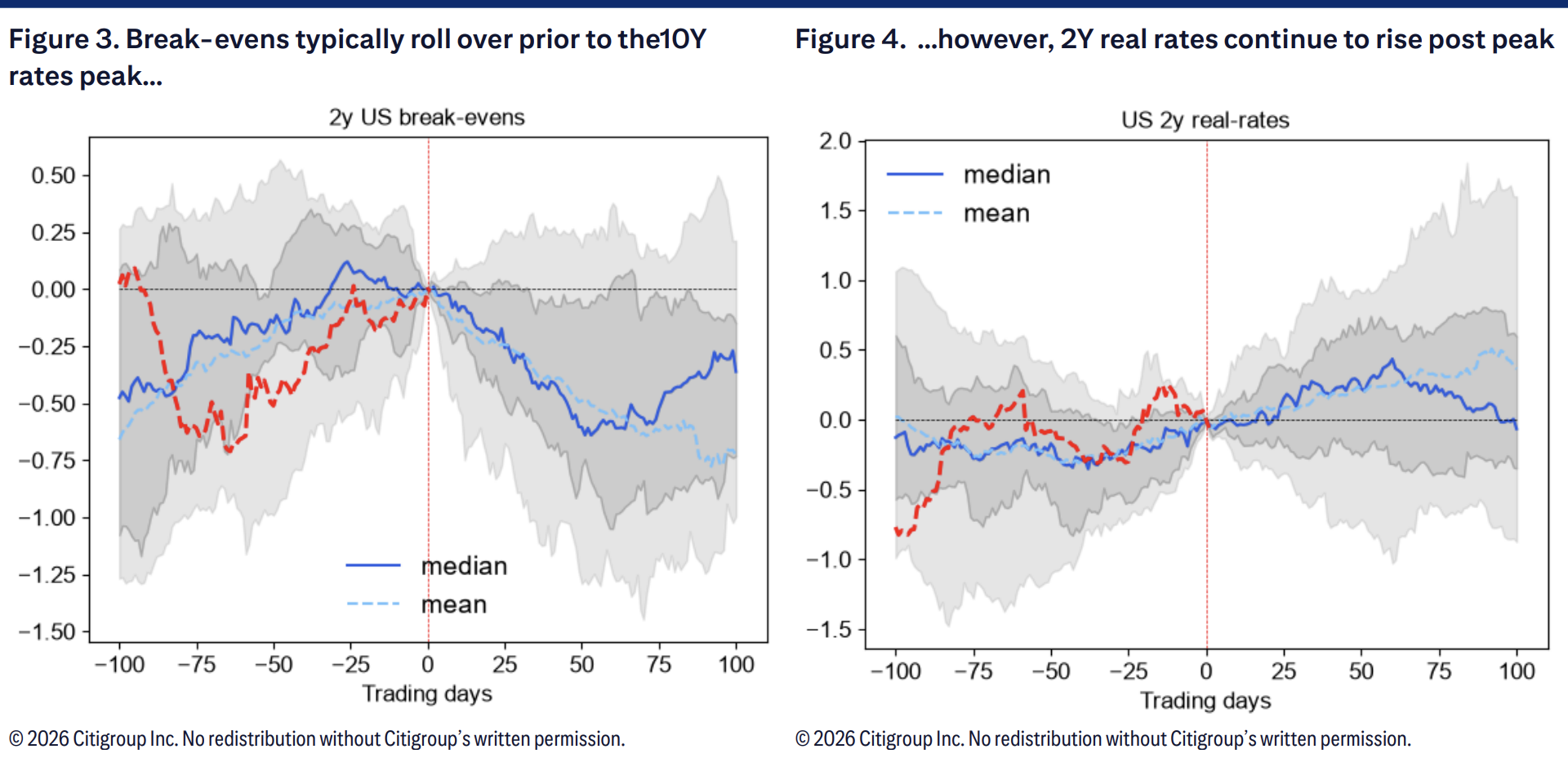
According to a Citi report cited by Wallstreetcn, the most reliable leading signals ahead of a peak in 10-year Treasury yields have historically been a pullback in front-end breakeven inflation and a retreat in oil prices. Right now, breakevens are still strengthening rather than rolling over, while the U.S. Dollar Index, or DXY, has resumed its rise. Both signals suggest the yield peak has not been confirmed. At the same time, widening high-yield spreads and weaker performance from cyclical stocks relative to defensive names look more consistent with the pattern usually seen around a peak, leaving the market with conflicting evidence.
Oil remains the key condition in Citi’s framework
Citi quantitative global macro strategists Alex Saunders and Vinh Vo reiterated their cross-asset framework in the report and added three rate selloff episodes of more than 70 basis points. The core conclusion stayed broadly the same.
Historically, cross-asset performance has shown a clear lead-lag pattern before the 10-year Treasury yield reaches its high. Front-end breakeven inflation usually starts to fall one to two months before the yield peak. Oil topping out has been close to a necessary precondition. By contrast, the 2-year real rate often keeps rising even after the peak in nominal yields, making it a lagging indicator rather than a useful turning-point signal.
For now, the strengthening trend in breakevens is visible, but the crucial rollover has not happened. Citi said persistent geopolitical uncertainty has kept crude prices elevated, making the timing of an oil peak difficult to judge. In that setting, any forecast for the peak in yields has to be pushed further out.
Which signals matter and which do not
Citi also reviewed a range of indicators commonly used by the market and separated those with leading value from those that tend to mislead or arrive too late.
Among the more useful signals, flattening in the 5s30s Treasury curve usually appears about one month before the peak in yields. But that trend has reversed over the past 25 trading days, making the message less clear. Wider high-yield spreads and outperformance by lower-default-risk stocks also fit the historical pattern seen around yield peaks.
The report added that quality stocks tend to perform well in the 200-day window around a yield peak, and some of that pattern has already started to show up. Growth stocks, by contrast, often peak before Treasury yields do and then continue to lag afterward.
On the less useful side, Citi said both core CPI and headline CPI year-on-year readings are lagging indicators. A hot CPI print does not rule out the possibility that yields have already peaked. The 2-year real rate also does not usually reverse at the turning point in yields. The VIX offers little help in timing the peak, though it has often drifted lower after the peak is confirmed.
Conflicting signals are driving the uncertainty
Citi said a comparison between current market action and historical patterns produces an obvious conflict in signals, making a clean directional call difficult.
On one side, cyclical stocks have underperformed defensive names for the past two to three months, and high-yield spreads have widened. Both are consistent with the kind of market behavior often seen after yields peak. On the other side, breakeven inflation is still rising, DXY has turned higher again, and oil remains supported by geopolitical factors. Taken together, those three signals suggest the final peak in yields may still lie ahead.
Citi said a positive turn in geopolitical conditions, especially after the midterm elections, would materially raise the odds that oil has topped out and could then open the way for a sustained decline in Treasury yields. Until then, the near-term path for yields is likely to remain highly uncertain.
Asset allocation stays in a late-cycle posture
Within that framework, Citi’s cyclical model has shifted into a late-cycle stance. The model is underweight equities and credit, overweight bonds excluding U.S. Treasuries and commodities, and has recently cut equities further to an underweight position.
Citi’s global macro strategy team remains neutral on duration overall. In rates, it prefers receiving the European Central Bank versus Federal Reserve spread. Between equities and credit, it favors equity exposure. The logic is straightforward: with no decisive rollover yet in oil or breakeven inflation, and with the peak signal in yields still unresolved, a neutral stance on U.S. Treasuries is more prudent than an outright bullish one.



