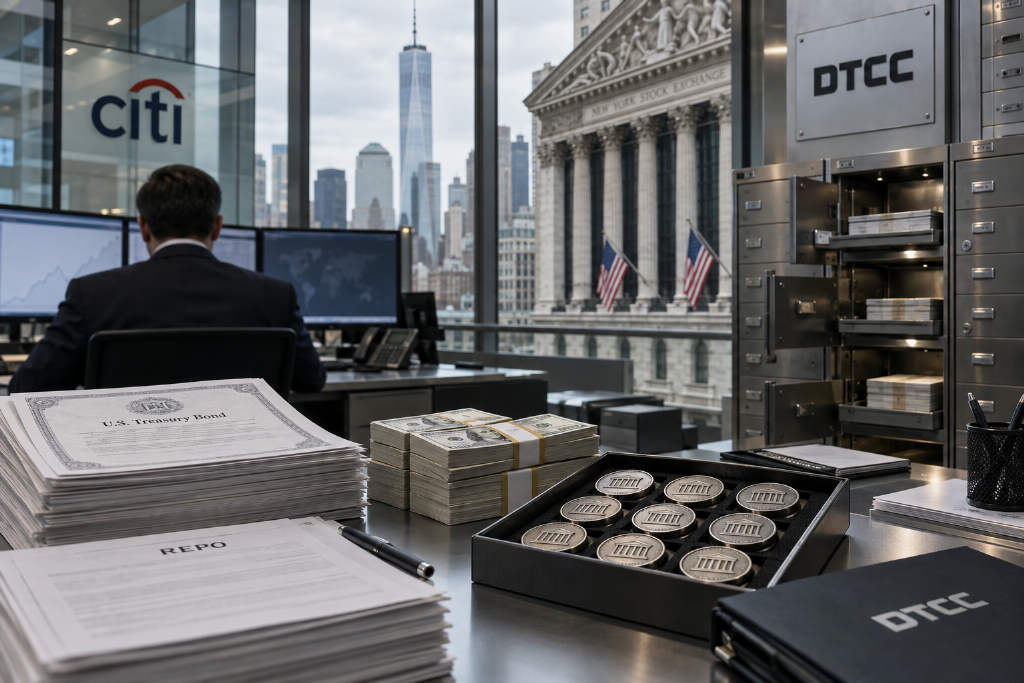
Citi Group and The ValueExchange said in a joint report that tokenized collateral is moving beyond pilot programs and into practical use, with as many as 77% of institutions expecting to use some form of tokenized collateral by 2026. The report said the main assets under consideration include cash, money market funds, and government bonds. It also pointed to early market traction, noting that about 5% of repo trading volume is already transacted each month in tokenized form. In another milestone cited by the report, U.S. Treasuries are expected to become available in tokenized form through the Depository Trust & Clearing Corporation, or DTCC, in October 2026. Citi argued that tokenization could improve collateral mobility across time zones and outside banking hours, making margin management closer to a 24/7 model. The bank added that settlement frictions currently leave about 25% of collateral idle, producing almost no return. For an average Tier 1 capital institution, Citi said that inefficiency is equal to roughly $15 billion in underused assets and about $346 million in potential annual revenue loss.
Techub News reported that Citi Group and The ValueExchange said in a joint report that tokenized collateral is shifting from the pilot stage into practical use. The report said as many as 77% of institutions expect to use some form of tokenized collateral by 2026, mainly cash, money market funds, and government bonds.
Adoption signals cited in the report
According to the report, about 5% of repo trading volume is already transacted each month in tokenized form. It also said U.S. Treasuries are expected to be made available in tokenized form through the Depository Trust & Clearing Corporation (DTCC) in October 2026.
Collateral inefficiency and settlement friction
The report said global systemically important banks on average need to deploy $74 billion of collateral each day across about 65 custody locations. Existing settlement friction leaves about 25% of that collateral idle, with almost no yield generated.
Citi said tokenization can improve collateral mobility across time zones and outside normal banking hours, while also supporting margin management that moves closer to a 24/7 model. For the average Tier 1 capital institution, that amounts to about $15 billion in inefficient assets and roughly $346 million in potential lost revenue each year.
This article was originally published by Bit.Fan. For more cryptocurrency news and market insights, visit www.bit.fan. Disclaimer:
The market information, project data, and third-party content displayed on this platform are for industry information sharing only and do not constitute any form of investment advice or return commitment.
Cryptocurrency trading carries high risks. Users should fully assess their risk tolerance and make independent decisions. All profits, losses, and legal responsibilities are borne by the users themselves.