

Derive’s token, DRV, moved into sharper focus after Citrini Research published its report, "Breaking The Wall." The report did not make a simple bullish case for crypto as a whole. It asked a narrower question: if AI agents start managing capital around the clock and real-world assets (RWA) such as stocks and bonds keep moving onchain, which parts of the stack will collect recurring revenue from trading, lending, clearing and risk management?
In Citrini’s disclosed model portfolio, Derive (DRV), Lighter (LIT) and Ether.fi (ETHFI) were each assigned about 10% target weight, the highest tier in the model. The source article notes that these are target allocations in a model portfolio, not proof that Citrini has already built positions of that size.
After the report came out, DRV quickly became a focal point in the secondary market. On Oct. 9, the token’s 24-hour gain at one point reached about 25%. As of Oct. 10, CoinMarketCap data showed DRV at about $0.55, with more than $100 million in 24-hour trading volume. The article says the rally cannot be fully attributed to Citrini alone, but attention on onchain derivatives clearly picked up.
Why AI agents and RWA expansion could lift demand for onchain derivatives
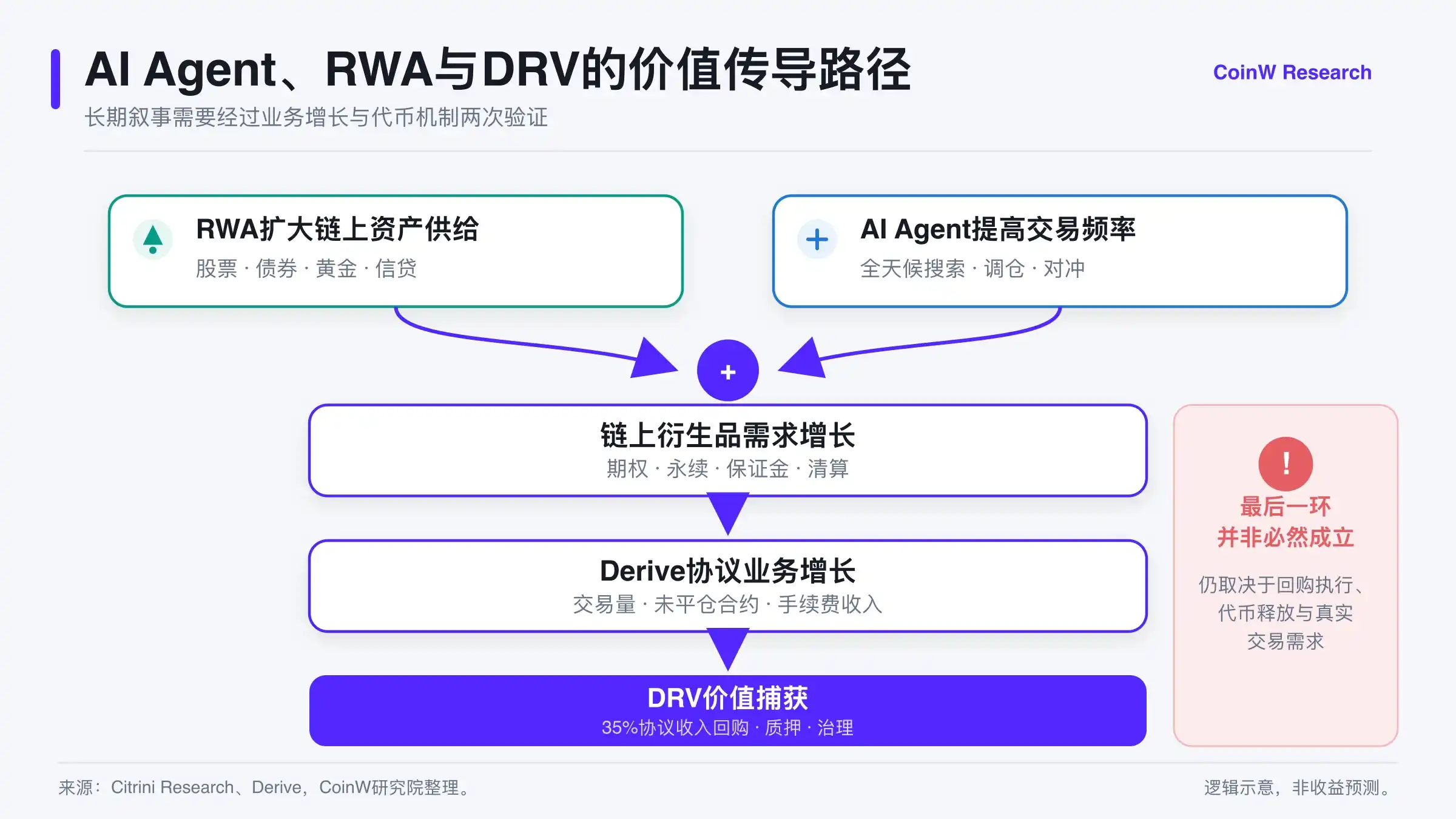
The article says Citrini’s thesis rests on two trends. One is that real-world assets including stocks, bonds, gold and credit are gradually moving onchain, broadening the range of tradable assets. The other is that AI agents are beginning to search for information, compare prices and execute trades on their own, potentially becoming always-on market participants that adjust positions automatically.
Once more assets trade onchain, demand does not stop at simple buying and selling. Investors also need tools to hedge volatility, lock in future costs or control risk without selling existing holdings. That is where options and perpetual contracts gain relevance. AI agents may also execute trading and hedging strategies automatically based on volatility, account risk and price changes.
Under that logic, RWA increases asset supply, AI agents may lift trading frequency, and derivatives protocols absorb the resulting demand for pricing, margining, hedging and liquidation. These services can generate continuous fee income. The article frames this as a potential fee gateway for onchain finance: the platforms that offer deeper liquidity, sounder risk controls and easier execution may be best placed to capture recurring revenue.
Still, the source article also stresses the constraints. Options involve different strikes, expiries and volatility assumptions, making market making and risk management more complex than spot trading. Retail participation also faces a higher barrier. So while the addressable market may be expanding, whether it reaches meaningful scale depends on real demand and product strength.
What Derive is and where it stands in onchain options
Derive started life as Lyra, an onchain options protocol launched in 2021. Over time, it expanded from a single-product options venue into a broader derivatives protocol covering options, perpetuals and spot trading.
Its defining feature remains onchain options. Compared with perpetual contracts, which are often used to express directional long and short positions, options offer more flexible risk management. The article gives a simple example: an investor holding ETH but worried about a short-term decline may buy a put option for a premium instead of selling the position outright. Derive also supports portfolio margin, cross margin and multi-asset collateral, allowing users to assess risk across positions and improve capital efficiency.
On the technical side, Derive runs on Derive Chain, which is built on the OP Stack. It uses an offchain matching and onchain settlement model. Orders are matched offchain for speed, while margin management, liquidation and final settlement are handled onchain. That structure improves trading efficiency while letting users retain control of assets, though the protocol still depends on the stable operation of the offchain matching system, oracles and market makers.
Leading onchain, but still much smaller than centralized options venues
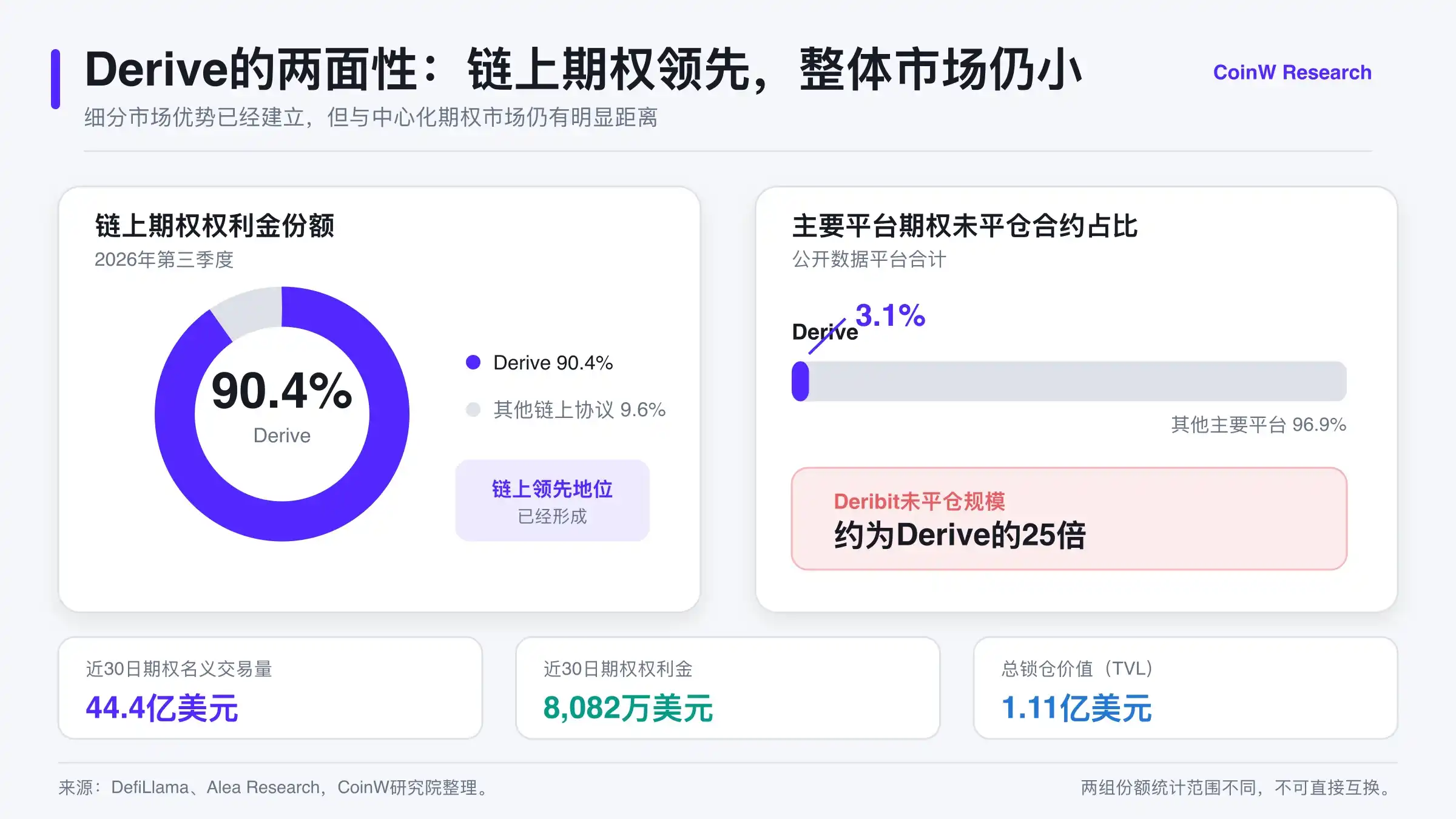
By the business metrics cited in the article, Derive has already taken a leading position in the onchain options market. As of Oct. 10, DefiLlama data showed about $4.44 billion in 30-day notional options volume, around $80.82 million in options premium volume and roughly $111 million in total value locked. In the third quarter of 2026, Derive accounted for about 90.4% of onchain options premium volume, a sign of its strength within that niche.
But the article makes a clear distinction between leading onchain and matching the scale of centralized giants. Based on data compiled by Alea Research across Deribit, OKX, Bybit, Binance and Derive, Derive represented only about 3.1% of options open interest, while Deribit was still about 25 times larger.
That leaves Derive with a mixed profile. Its edge lies in self-custody, transparent settlement and composability with DeFi protocols. Its weakness is that liquidity depth and market-making scale still trail mature centralized platforms. Whether it can keep expanding depends not only on growth in the onchain derivatives segment, but also on how much ground it can make up against centralized competitors.
How much support can DRV get from protocol revenue and buybacks?
The article argues that business growth at Derive does not automatically translate into higher value for DRV. To judge the token, it looks at protocol revenue, the buyback mechanism and token supply together.
As of Oct. 10, DefiLlama data showed about $714,000 in total fees over the previous 30 days, including around $574,000 in protocol revenue. The article says Derive’s business scale in 2026 had clearly expanded from 2025, but options volumes can be heavily influenced by volatility and large institutional trades, so short bursts of activity may not last. In that context, realized protocol revenue and user activity after incentives decline matter more than notional volume alone.
DRV is used for staking, governance and ecosystem incentives. Holders can stake DRV into stDRV to participate in governance and receive rewards. In April 2026, Derive DAO approved changes that increased the share of protocol revenue used for DRV buybacks from 25% to 35%, reduced weekly staking rewards from 250,000 tokens to 100,000 tokens, and shortened the unstaking waiting period from 28 days to 7 days.
That creates a clearer value path on paper. If trading grows, protocol revenue rises, and 35% of that amount can be used to buy DRV in the market. But the article also asks how large that buyback pool really is at current revenue levels.
Using the recent 30-day protocol revenue of about $574,000 and annualizing it in a simple way, the article arrives at roughly $6.888 million in annual revenue. At a 35% buyback allocation, that implies theoretical annual buybacks of about $2.41 million. Against a circulating market cap of about $400 million, that comes to only around 0.6%. In other words, the mechanism exists, but at the current revenue run rate it is not enough on its own to support the token’s valuation.
The article adds two more caveats. First, buybacks are not the same as burns, nor are they the same as direct cash distributions. Repurchased DRV may be held or later reused for incentives under governance decisions. Second, Derive still distributes about 100,000 DRV in weekly staking rewards, or roughly 5.2 million tokens a year. So the market needs to watch not only the amount spent on buybacks, but also what happens to the bought-back tokens and whether repurchase demand can offset new supply entering circulation.
Supply expansion and valuation remain part of the story
DRV originally inherited LYRA’s total supply of 1 billion tokens. In 2025, governance approved an additional 500 million tokens for contributor incentives, institutional partnerships, market making and ecosystem development, bringing total supply to 1.5 billion. The article uses that point to argue that DRV supply is not fully fixed and may still be shaped by future governance decisions.
As of Oct. 10, CoinMarketCap data showed a circulating supply of about 738 million DRV, equal to 49.2% of total supply. Circulating market capitalization stood at about $404 million, while fully diluted valuation was about $821 million. Since less than half of the supply is currently circulating, future unlocks tied to contributors, the foundation and ecosystem incentives could add selling pressure. The article also notes that circulating supply figures differ across platforms and should be checked against official unlock schedules and onchain wallet movements.
Short term: flows and positioning. Long term: whether fee capture holds up
The source article concludes that the Citrini report has clearly brought fresh attention to DRV, but price action has moved faster than protocol fundamentals. At the time of writing, 24-hour trading volume was equal to about 27% of circulating market cap, a sign of active capital rotation and also a reminder that prices can be more sensitive to news, sentiment and leverage.
If DRV’s rise is driven mainly by report distribution while options volume, open interest and protocol revenue at Derive do not improve in parallel, the market is mostly trading future expectations. If business metrics keep improving, that would suggest the new attention is turning into real demand.
Over a longer horizon, the article says Derive could benefit from the expansion of onchain assets and the development of automated trading. But it still faces the liquidity advantage of centralized venues, competition from similar protocols and pressure from token supply. The four indicators it highlights are actual trading demand, protocol revenue, buyback execution size and new circulating supply.
The original article closes with a disclaimer that it is for market research and information analysis only and does not constitute investment or trading advice.



