
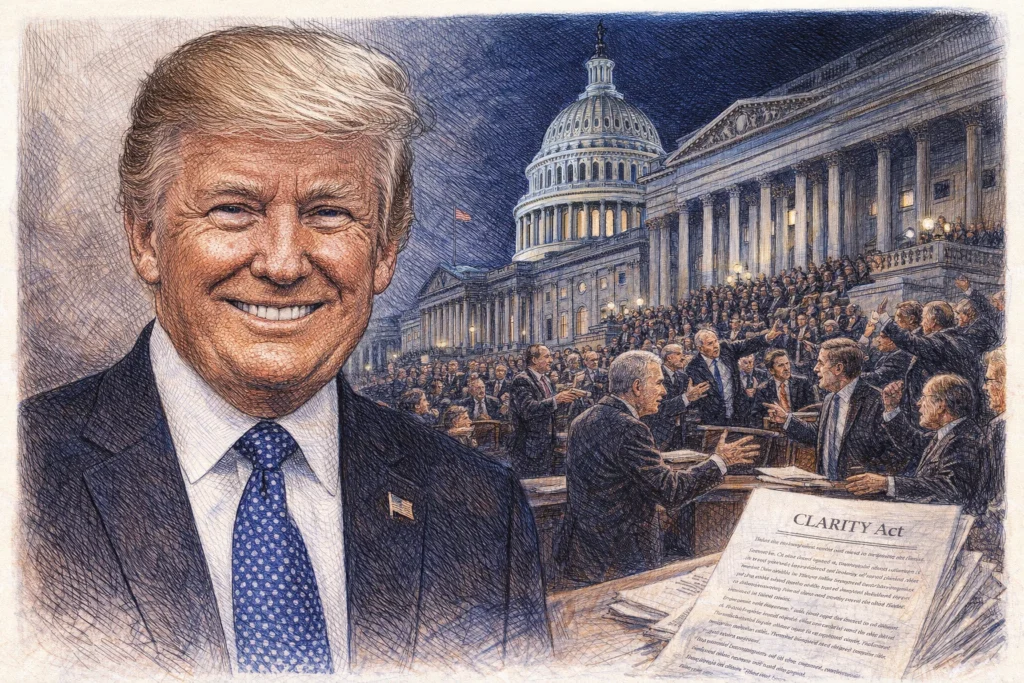
The CLARITY Act has entered a decisive stretch before Congress leaves for its August recess. On July 13, Donald Trump posted on Truth Social urging senators to pass the bill quickly, saying China and other countries are trying to take the lead in crypto finance and artificial intelligence.
That message added White House-side pressure to a bill that still has not reached a final text. Lawmakers now have roughly four weeks before the recess begins.
Lummis says executive rules cannot solve the core jurisdiction issue
On July 14, Senator Cynthia Lummis wrote on X that no executive rule can give the Commodity Futures Trading Commission, or CFTC, authority over digital asset spot markets. She also said executive action cannot create new sanctions powers or protect developers from improper prosecution.
According to Lummis, those issues can only be resolved by Congress, and the CLARITY Act is the only workable path. Lummis is one of the bill’s main sponsors.
A second federal law enforcement group backs the bill, with changes
Federal law enforcement voices have also joined the debate. The ASBA publicly backed the CLARITY Act on July 14 after sending a letter to the Senate Banking Committee on July 10. In that letter, the group supported the bill while asking lawmakers to revise accountability provisions tied to decentralized finance, or DeFi.
Its requests focused on three points:
- narrowing the scope of DeFi protections,
- changing the bill’s “specific intent” wording to make liability easier to establish, and
- stating clearly that the act would not limit existing federal investigative powers.
Together with earlier public support from the National Black Organization of Law Enforcement Executives Association, or NABOEA, there are now two separate letters supporting the bill. The report said those letters push back against claims that the legislation would weaken the government’s ability to fight crypto-related crime.
Two major disputes remain unresolved in the final four-week window
A key moment is expected this week, when an updated draft combining versions from the Senate Banking Committee and the Agriculture Committee is set to appear.
Two central sticking points remain. One is whether non-custodial software developers could be classified as money transmitters. The other is a conflict-of-interest provision tied to Trump’s more than $1 billion in crypto income, which has not yet been aligned with the White House.
The vote count has also become less forgiving. The report said Senator Graham has died and Senator McConnell remains absent, leaving less room for error on a bill that already needs 60 votes to pass. That raises the value of Democratic support.
Research groups split on the odds
Views on the bill’s path are mixed. Kristin Smith, president of the Solana Policy Institute, said there is a realistic route to passage and that momentum is building for a full Senate vote.
Alex Thorn, head of research at Galaxy Digital, was more cautious. He lowered his estimated odds of passage to 50% and warned that priorities such as the National Defense Authorization Act are competing for legislative time. He said that if the bill stalls this year, crypto innovation will continue to move out of the United States.