
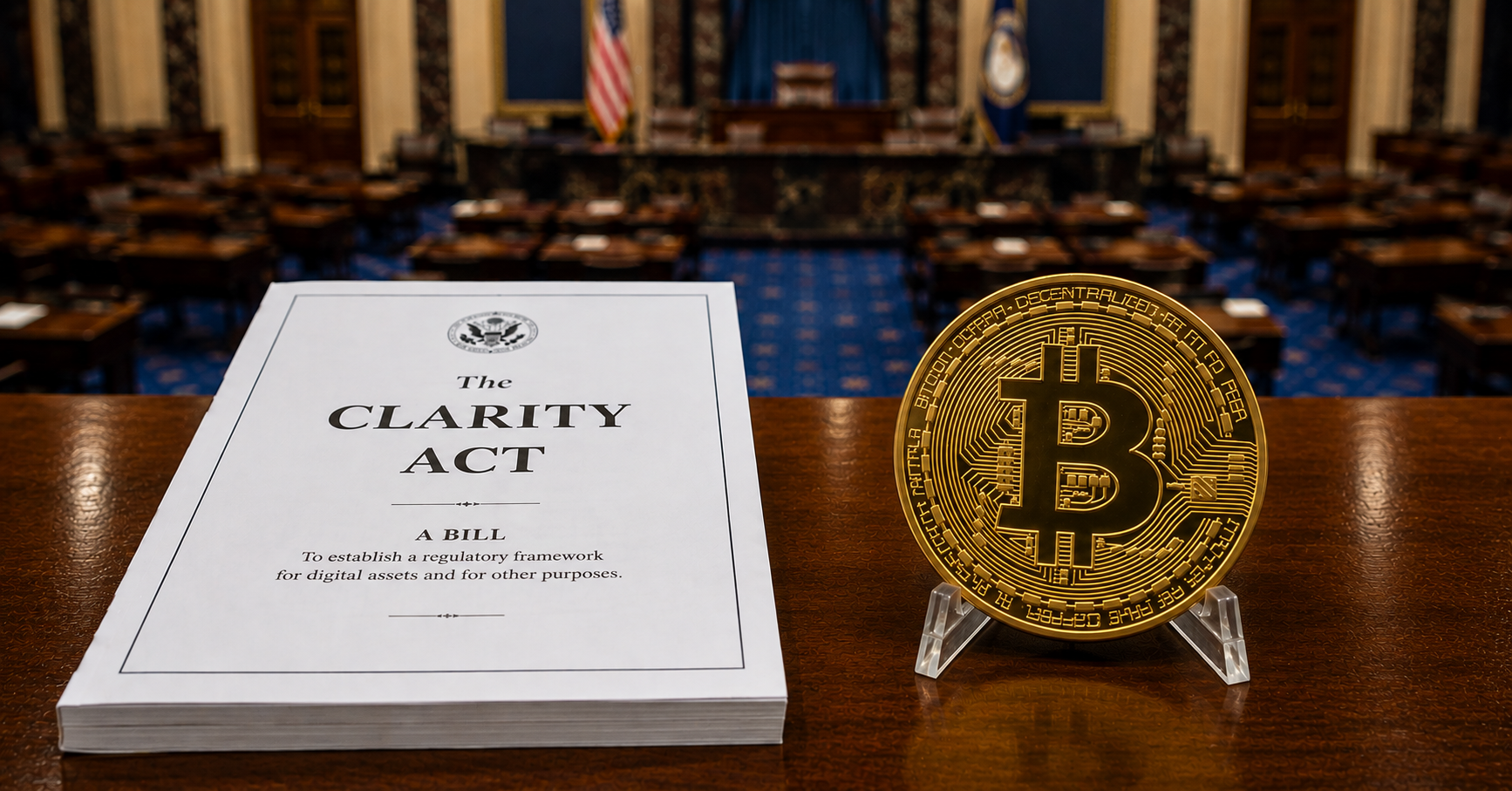
Bitcoin Magazine says the CLARITY Act needs a fresh reading after the Senate rewrote it almost in full, changing what it would and would not do for Bitcoin.
In the article, Isaiah Austin traces the bill back to July 2025, when House Republicans pushed what they called “Crypto Week,” moving the GENIUS Act, the CLARITY Act and the Anti-CBDC Surveillance State Act within the same five-day span. The GENIUS Act was signed into law within 24 hours, establishing a regulatory framework for dollar-backed stablecoins.
The other two bills took a different path. The Anti-CBDC Surveillance State Act passed the House by a very slim margin and then stalled in the Senate for more than a year without a floor vote. After the House passed the CLARITY Act with bipartisan support, that bill went to the Senate Banking Committee and remained there for nearly a year as well.
When the CLARITY Act finally came out of committee, Austin says its cover page carried the instruction, “Strike out all after the enacting clause and insert the part printed in italic,” which he interprets as meaning the bill had been rewritten in full. He writes that the official text on Congress’ website still shows the first 256 pages — the entire House-passed bill — struck through line by line, with the Senate version beginning on page 257. He adds that a newer draft has circulated since then, but it has not been formally filed as an amendment.
What the bill does for Bitcoin
Self-custody would gain explicit statutory protection
Austin points to Section 605, the “Keep Your Coins Act,” which would prohibit federal regulators from restricting or impairing a person’s ability to self-custody for any lawful purpose. He argues that self-custody does not currently rest on direct statutory backing, and that putting it into law would create a defense against future attempts to force users through custodial intermediaries.
He links that concern to a recent example. In 2020, then-Treasury Secretary Steven Mnuchin directed the Financial Crimes Enforcement Network, or FinCEN, to propose a rule aimed at “unhosted wallets.” Under that proposal, exchanges would have had to collect the names and home addresses of anyone moving more than $3,000 per day into a private wallet, and file reports with FinCEN for transfers above $10,000 per day.
Although that rule lost momentum, Austin says it stayed on the books without being withdrawn for almost four years. During that period, he writes, any Treasury secretary could have revived and finalized it without new legislation. In his reading, Section 605 is designed to stop that kind of scenario from happening again.
Developers, node operators and non-custodial wallet builders would get a clearer shield
The article says Section 604, the Blockchain Regulatory Certainty Act, states that a non-controlling developer or provider cannot be classified as a money transmitting business merely for doing that work. Austin frames this as explicit protection for Bitcoin developers, node operators and makers of non-custodial wallets.
He cites Samourai Wallet and Tornado Cash as examples. Both, he says, were open-source and non-custodial projects, yet their developers were criminally prosecuted under the theory that publishing the code made them unlicensed money transmitters. According to the article, Samourai’s founders pleaded guilty in April 2026, while Tornado Cash developer Roman Storm was convicted on the same charge in August 2025.
Austin notes that Section 604 would not reverse either case. His point is narrower: it would draw a line so that the next open-source developer would not have to discover that boundary first in federal court.
Bank-level access for Bitcoin would widen
Austin calls Section 401, “Permissibility of Digital Asset Activities,” the only part of the CLARITY Act that is plainly bullish for Bitcoin’s price. In his view, the provision would let banks, brokerages and institutions treat Bitcoin as a real asset class and open the door to new capital.
As described in the piece, Section 401 would allow financial holding companies, national banks, state banks and credit unions to custody digital assets, lend against them as collateral, run nodes, provide brokerage and clearing services, and act as market makers or dealers, all without seeking prior approval beyond what banking law already requires.
The article stresses that this section uses the term “digital asset,” a category broadly defined through the already enacted GENIUS Act. Unlike “digital commodity” or “ancillary asset,” terms used elsewhere in the bill, Austin says Bitcoin clearly qualifies here without ambiguity.
He also argues that the market this could open is large. US commercial banks alone hold $25.7 trillion in total assets, compared with Bitcoin’s roughly $1.3 trillion market capitalization. The piece also says custody firms State Street and Northern Trust each oversee custody books that individually exceed the entire Bitcoin market by several multiples. In Austin’s telling, that capital would not need to move far, or take much risk, to affect the price of an asset of Bitcoin’s size. It would need a statutory opening such as Section 401.
What the bill does not do for Bitcoin
It does not yet lock Bitcoin’s commodity status into federal statute
The article says Bitcoin is currently treated as a commodity because the Commodity Futures Trading Commission, or CFTC, says it is, and courts have agreed in enforcement cases. Austin argues that this is precedent, not statute, and that no current framework stops future regulators from taking a different view.
He says the House-passed CLARITY Act would have closed that gap, but the language was removed when the Senate rewrote the bill on June 1. For weeks, nothing replaced it. Austin then points to a July 22 draft of the CLARITY Act that merges in the Senate Agriculture Committee’s CFTC framework and adds the missing definition, while stressing that the draft is not law and has not been formally filed as an amendment.
It does not ban a retail Federal Reserve CBDC
Austin says the House-passed bill contained a section called the “Anti-CBDC Surveillance State Act,” which would have barred the Federal Reserve from issuing a retail CBDC. That section was part of the 256 pages struck by the Senate Banking Committee, and the current version contains no operative provision on the matter.
It would not produce immediate working rules
The article also pushes back on the idea that a signed CLARITY Act would instantly create a crypto supercycle. Austin writes that a bill becoming law does not come with a functioning regulatory structure attached, and that the CFTC would have to build much of that framework nearly from scratch.
He compares that challenge with the GENIUS Act, which he says missed its full one-year rulemaking deadline after becoming law last year. As of mid-2026, he writes, six federal agencies had produced zero final rules under that process. He adds that CLARITY would hand the CFTC the largest new mandate in the bill at a time when the agency has one sitting commissioner and a staff count that has fallen 21% in a year.
Austin’s conclusion: CLARITY is not a Bitcoin bill
Austin’s bottom line is that the CLARITY Act is broadly bullish for crypto, but only narrowly bullish for Bitcoin. Most of the bill, he argues, is meant to give altcoins a path out of securities-law uncertainty, which is not the most acute legal problem facing Bitcoin.
Even so, he does not dismiss it as irrelevant. He says the bill contains specific provisions that are favorable to Bitcoin on their own terms, including protection for self-custody, clearer boundaries for open-source and non-custodial developers, and bank-level permission to conduct digital asset activities.
The piece closes by saying that whether CLARITY passes or fades in the legislative process, Bitcoin’s core principles remain unchanged: a decentralized protocol governed by mathematical certainty, and the world’s first digital commodity, with a market capitalization above $1.3 trillion.
The article is a guest post by Isaiah Austin. Bitcoin Magazine notes that the views are the author’s alone and do not necessarily reflect those of BTC Inc or the publication.