
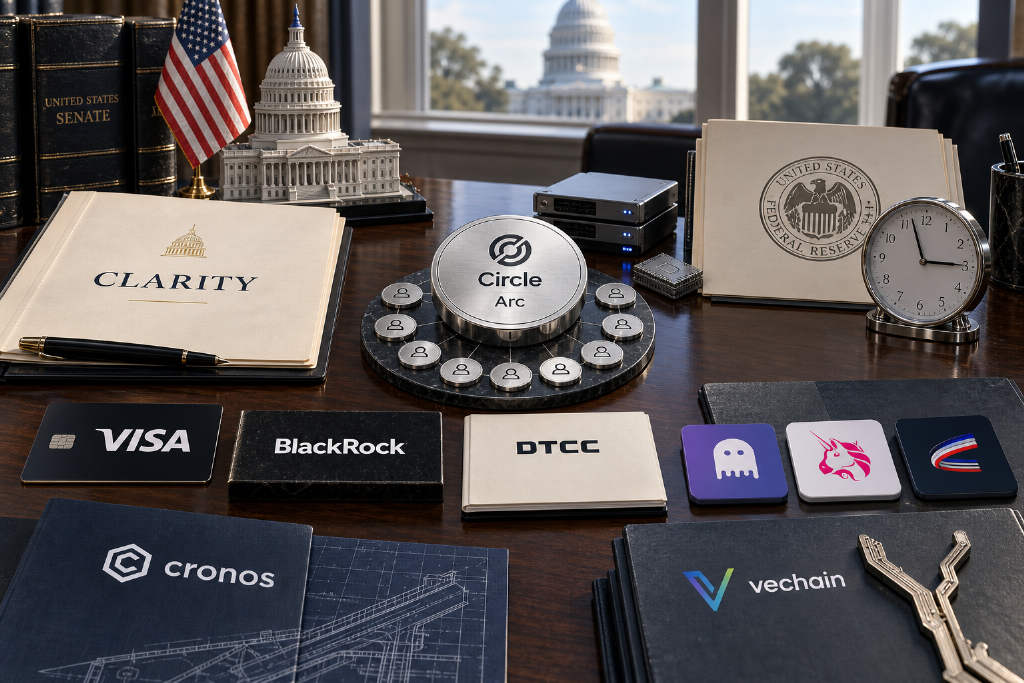
Crypto markets are heading into a crowded week, with a Senate vote on the CLARITY Act, Circle’s Arc public mainnet launch, and the Federal Reserve’s rate decision all landing within roughly 48 hours.
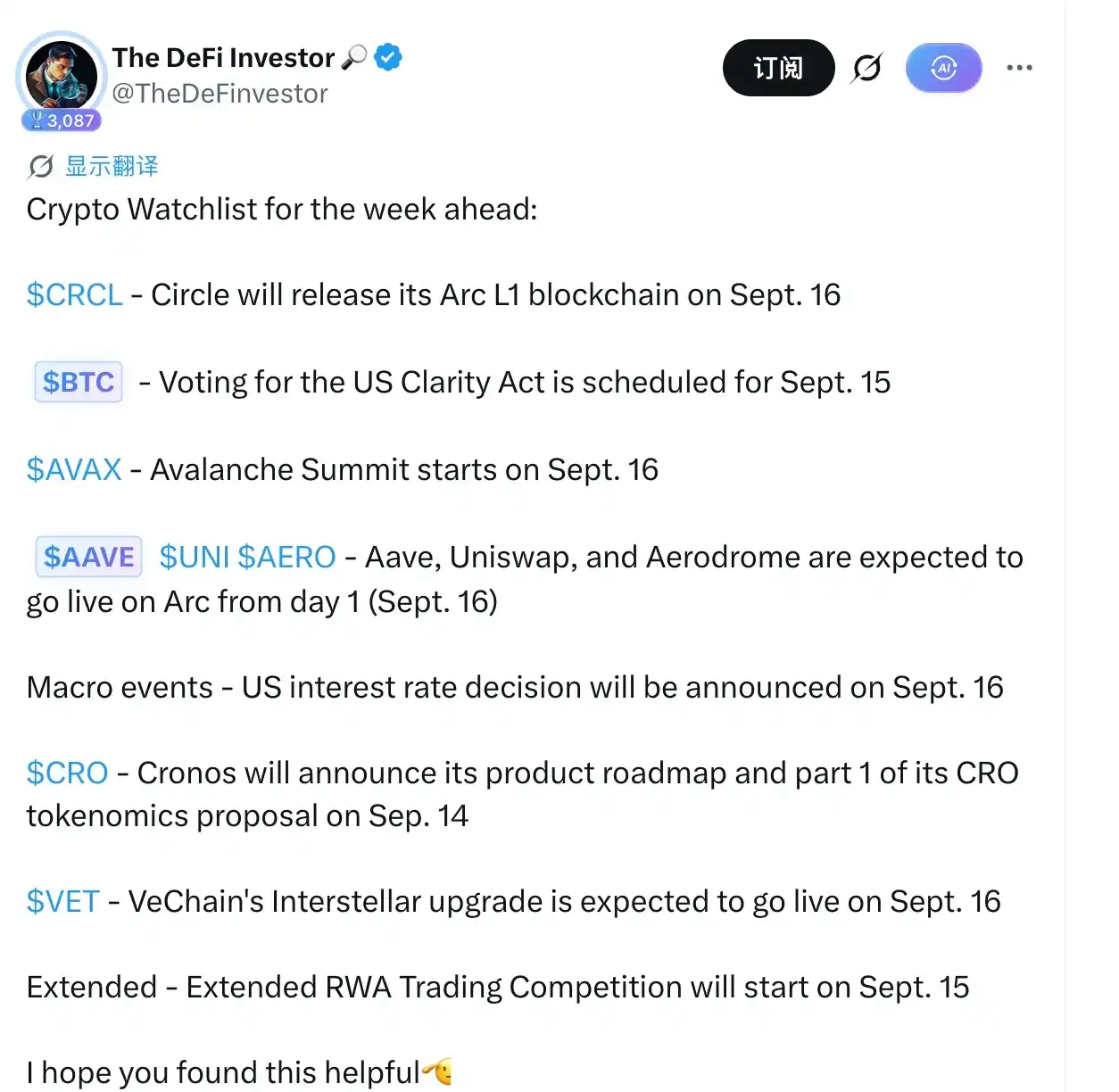
A list compiled by crypto KOL @TheDeFiInvestor also flagged Cronos’ roadmap release, a CRO tokenomics proposal, and VeChain’s Interstellar hard fork as key events on the calendar.
CLARITY Act faces a critical Senate test on Sept. 15
The Sept. 15 vote is not final passage, but it will decide whether the bill can stay alive this week.
According to POLITICO’s Sept. 14 report, Senate Minority Leader Chuck Schumer called a Sunday night Democratic caucus meeting to discuss Tuesday’s voting schedule. The Senate is set to hold a cloture vote on the motion to proceed on H.R. 3633, the CLARITY Act, at 2:15 p.m. Eastern Time on Sept. 15. The threshold is 60 votes. Republicans do not have enough seats to clear that mark on their own, so they need support from some Democrats and independents.
Republicans released a 635-page final text on Sept. 14 and said it incorporated 126 substantive Democratic changes, including limited enforcement authority for state attorneys general. The Associated Press, citing a senior Republican aide, reported that Trump had accepted about 80% of a conflict-of-interest plan put forward by Senators Tillis and Gallego. The remaining dispute is centered on crypto ethics rules for government officials: Democrats want limits on a president profiting through family crypto businesses, while Republicans want to move the bill forward first and continue discussions during debate.
Roughly a dozen Democrats have been negotiating the bill for months, but three categories of issues remain unresolved. Former federal prosecutor Renato Mariotti said, based on his conversations with lawmakers and congressional staff, that the bill is “effectively dead.” Coinbase Chief Policy Officer Faryar Shirzad said publicly that he still sees a path to 60 votes. Ripple Chief Legal Officer Stuart Alderoty called Sept. 15 a key test.
If the bill advances to formal debate, it would set out a jurisdictional framework for how the Securities and Exchange Commission and the Commodity Futures Trading Commission divide oversight of digital assets. It would also establish a classification framework for spot ETF underlyings such as BTC, ETH, and XRP. If the vote fails, regulation would not stop. The SEC and CFTC would continue to move under existing authority, but the congressional window for legislation would be hard to reopen before the 2026 midterm elections.
Circle’s Arc public mainnet opens Sept. 16
Circle said in an official release that Arc’s public mainnet will go live on Sept. 16. The private mainnet has already involved more than 100 institutions and ecosystem builders.
The 11 founding validators are BlackRock, DTCC, Galaxy, Global Payments, ICE, Mastercard, MoneyGram, SBI Group, Standard Chartered, Sumitomo Mitsui, and Visa. Circle CEO Jeremy Allaire told CNBC that the validator set will gradually expand to between 20 and 40, and that ARC token holders will later be able to take part in staking and governance votes.
Arc uses USDC as its native gas token, is EVM-compatible, offers sub-second finality, and includes the StableFX foreign exchange engine. On day one, the DeFi lineup includes Aave, Aerodrome, Uniswap, Morpho, FalconX, and GSR. Payments integrations include Rain, Thunes, and Wirex. Wallet and infrastructure partners include MetaMask, Ledger, Kraken, Upbit, Fireblocks, and Chainlink. The launch is also cited as a shared catalyst this week for AAVE, UNI, and AERO.
Institutional integrations will roll out in stages. BlackRock plans to deploy its tokenized fund BUIDL on Arc so subscriptions and redemptions can happen within a single USDC-based onchain environment. DTCC’s DTC custody asset tokenization collaboration is scheduled for the second half of 2027. In May this year, Circle completed a $222 million ARC token presale at a fully diluted valuation of $3 billion, with participation from a16z, BlackRock, Apollo, ICE, and Standard Chartered.
Circle has also made clear that the mainnet launch and the start of ARC token trading are separate events. The company has not announced the timing of its token generation event.
Fed decision lands the same day
According to CME FedWatch data, as of Sept. 11 the market was pricing an 85.6% probability that the Federal Open Market Committee would raise rates by 25 basis points, lifting the federal funds target range from 3.50%-3.75% to 3.75%-4.00%. Prediction market Kalshi showed 77%, while the probability of a 25-basis-point cut on Polymarket was below 1%.
The shift toward a more hawkish baseline followed the Aug. CPI report released on Sept. 11. Headline CPI was 3.4% year over year, unchanged from July, while core CPI unexpectedly rose 0.3% month over month. Oil moved above $100 a barrel, nonfarm payrolls increased by 162,000 in August, and the unemployment rate held at 4.1%. EY-Parthenon Chief Economist Greg Daco and MUFG Research both changed their calls from no move to a 25-basis-point hike.
The bigger focus is the dot plot. If the median projection for the end of 2026 shows another rate increase in December, risk assets could face a fresh repricing. If the projections indicate the tightening cycle is done, the hike itself could be treated by markets as a sell-the-rumor, buy-the-news type of event. The decision is due at 2 p.m. Eastern Time on Sept. 16, and Federal Reserve Chair Kevin Warsh is scheduled to hold a press conference at 2:30 p.m.
For BTC, that puts the Fed meeting alongside the CLARITY vote as a second major macro event in the same week.
Cronos to release roadmap and first CRO tokenomics proposal
@TheDeFiInvestor’s list said Cronos will release its product roadmap and the first part of a CRO tokenomics proposal on Sept. 14.
Cronos executive Fwiz had already previewed the move on X on Sept. 7, saying the Cronos App would launch within 10 days and that the tokenomics proposal would direct 100% of app revenue to buy back and burn CRO on the open market.
Supply-side questions remain central. Data from cronos.org shows 48.54 billion CRO in circulation, 15.11 billion staked, and 50.17 billion in strategic reserves. Around 1.16 billion CRO is still unlocking from reserves every month. Community members have publicly suggested ending that unlocking schedule after Sept. 17 to reduce future supply pressure. Whether the first proposal addresses that issue is a key question for holders.
Cronos also recently dealt with the Tectonic lending protocol exploit. The attacker manipulated the TONIC price and borrowed about $120.4 million. Validators rolled back 10,961 blocks and recovered about $111.2 million, while about $9.19 million was not recovered. After the official post-mortem was released on Sept. 8, CRO rebounded from around $0.057 to above $0.06.
VeChain hard fork set for Sept. 16
VeChain said the Interstellar hard fork, VIP-255, is scheduled to activate at block height 25,902,540, with the estimated time at 11:15 UTC on Sept. 16. It marks the third phase of the VeChain Renaissance roadmap.
The proposal passed on the VeVote governance platform between Aug. 10 and Aug. 17. It bundles 11 improvement proposals drawn from Ethereum’s Cancun, Prague, and Osaka upgrades into a single fork, including BLS12-381 signature verification, secp256r1 biometric authentication, and transient storage. The stated goal is to align the VeChainThor virtual machine with Ethereum execution-layer standards.
Ordinary token holders do not need to do anything. There is no token migration, no new contract address, and no change to VET or VTHO supply or staking rules. Node operators do need to act and must upgrade to Thor v2.5.0 before activation. Exchanges including Binance will temporarily suspend VET deposits and withdrawals around the hard fork, and users who need to transfer tokens are advised to do so by Sept. 15.
On Sept. 7, Cointelegraph’s validator arm CTDG launched two validator nodes on VeChainThor. The report described it as a new institutional operator added after the Hayabusa upgrade expanded validator seats to 101.
Other catalysts on the calendar
AVAX: Avalanche Summit in New York
Avalanche Summit will take place in New York on Sept. 16 and 17. It is the first time the annual flagship event is being held in New York, with Chelsea Industrial listed as the venue and onchain finance and consumer applications as the focus. Founder Emin Gün Sirer and Kevin O'Leary are among the expected participants.
The report noted that previous summits have often hosted major announcements, including Avalanche9000, FIFA L1, and the VanEck fund. It also pointed to a Sept. 4 announcement from South Korea’s Financial Services Commission and KSD on using Avalanche to build onchain infrastructure for capital markets.
Extended: RWA trading competition starts Sept. 15
Extended is set to launch an RWA-themed trading competition on Sept. 15. Specific rules and the prize pool have not yet been disclosed. Users holding Extended points may want to watch for the relationship between trading activity and points.
A packed 48-hour window
The Senate vote on Sept. 15 and the Fed decision, Arc mainnet launch, and VeChain hard fork on Sept. 16 put several closely watched crypto and macro events into the same 48-hour stretch. In the original roundup, that midweek period was described as the busiest window of the week, with position management and leverage decisions needing to be arranged in advance.