
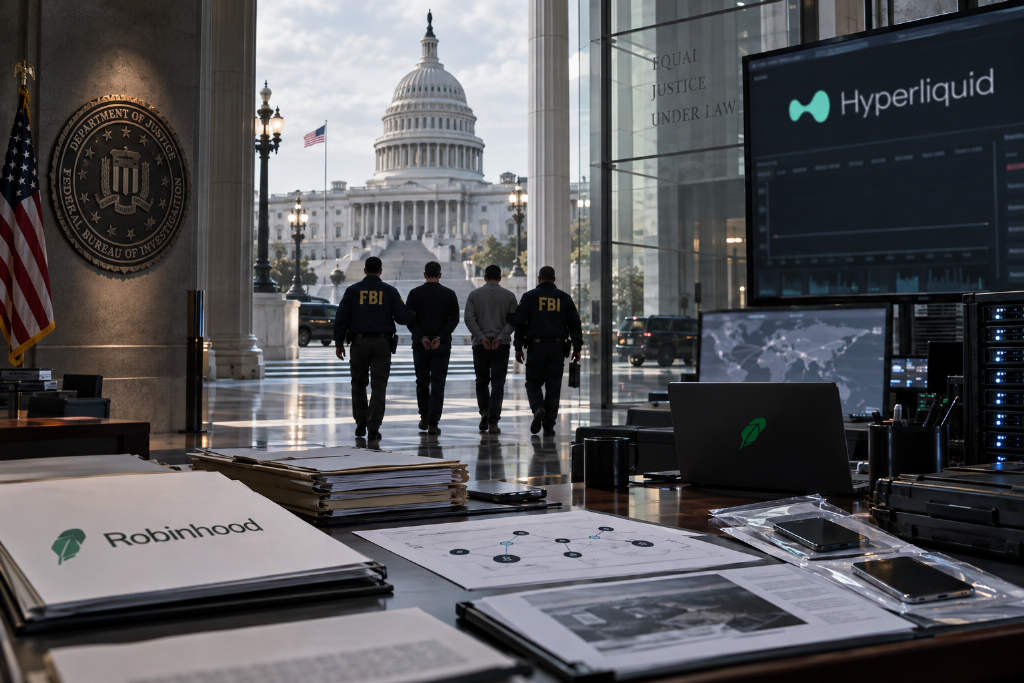
U.S. lawmakers were still arguing over where crypto regulation should begin and end when federal investigators traced a derivatives trade on-chain back to two former Robinhood employees.
On Sept. 15, 2026, two notable crypto developments unfolded in parallel. They were not presented as cause and effect, but together they showed how the U.S. is handling the sector right now. That day, the Senate failed to advance H.R.3633, the Digital Asset Market Clarity Act, after a 49-50 cloture vote, leaving the long-awaited market structure bill short of the next stage. On the same day, the U.S. Attorney’s Office for the Southern District of New York announced that a Manhattan federal court had unsealed two criminal complaints submitted by an FBI agent and that prosecutors had brought federal criminal charges against two former Robinhood engineers.
The defendants are 36-year-old Hefu Chai and 30-year-old Huaisong "Jerry" Xiang. Prosecutors allege that the two men used nonpublic token listing information obtained through their jobs to build perpetual futures positions on decentralized derivatives exchange Hyperliquid before Robinhood publicly announced the relevant listings, then closed those positions around the listing window for profit. According to the DOJ, each made more than $50,000 in illegal gains.
Each defendant was charged with one count of commodities fraud under the Commodity Exchange Act and one count of federal wire fraud. The commodities fraud count carries a statutory maximum of 10 years in prison, while the wire fraud count carries a statutory maximum of 20 years.
This is not the first criminal insider trading case tied to crypto. What makes this one different is that the alleged trading took place on a decentralized derivatives platform from start to finish. The charging documents show prosecutors combining internal communications with on-chain data to build the current case, a reminder that blockchain activity is pseudonymous rather than fully anonymous.
Two competing narratives about how the case surfaced
Public discussion of how the matter first came to light has split into two distinct versions, and the difference matters.
Many third-party reports described the case as one that began when Robinhood’s internal risk controls detected suspicious trading and alerted regulators. Robinhood’s public statement said:
「We have robust insider trading policies and procedures in place, including for new crypto listings. We immediately investigated and reported this matter to law enforcement and regulators, and will continue to cooperate with the investigations.」
That statement supports a narrower point. It shows the company investigated after identifying suspicious circumstances and reported the matter to law enforcement and regulators. It does not say an automated surveillance system flagged unusual on-chain activity, nor does it describe the trigger in that level of detail.
The DOJ’s public criminal complaint, signed by FBI Special Agent Joseph Kim, describes the evidence base differently. It says the investigation relied on documents provided by Robinhood, conversations with law enforcement personnel and a Robinhood employee, publicly available trading data from Hyperliquid, and records provided by crypto companies. The DOJ press release also thanked Robinhood for its cooperation, but did not describe an automated internal alert.
What the public record supports is this: Robinhood opened an internal investigation after discovering that employees may have used confidential listing information for profit, and the company cooperated with federal investigators throughout. There is no public official document confirming that an internal surveillance system automatically detected the trades and triggered the case. For that reason, that claim cannot be treated as established fact.
The DOJ’s complaint also does not identify community-based on-chain monitoring as the source of the lead, and it does not say whether outside researchers played any role in the initial discovery. After the case became public, some media reports said an anonymous on-chain researcher known as Astra Trades had tracked unusual Hyperliquid trading that closely matched Robinhood listing times as early as 2025 and had publicly tagged related wallet addresses. Whether that work contributed to the initial investigation cannot be confirmed from the public filings.
What can be confirmed is that both defendants were employees with access to confidential listing information and were classified by Robinhood as "Coin Aware Individuals." Under that designation, they were barred from trading the relevant tokens and were also prohibited from trading those assets for 24 hours after a listing announcement was published.
The complaints say those confidentiality rules were communicated internally more than once. Xiang acknowledged an email about confidentiality obligations in November 2024, and an internal communication in May 2025 again stated that employees were prohibited from trading in the 24 hours before a listing. Prosecutors say that, against that backdrop, the timing of the trades lined up with the defendants’ access to confidential information. Robinhood then conducted an internal review and referred materials to law enforcement, after which the FBI cross-checked internal communications against on-chain trading data.
How prosecutors say the trades were executed
The two defendants are described as following highly similar patterns. At the center of both cases is the alleged use of nonpublic listing information obtained at work to establish perpetual futures positions before the market knew what Robinhood was about to list.
Robinhood is a major U.S. retail trading platform, and a token listing there can create new demand and upward price pressure. According to the complaints, both men had access to internal listing information through their job duties and used that information to trade corresponding perpetual contracts on Hyperliquid before the public announcements.
The complaints describe Hyperliquid as a decentralized derivatives trading platform. They also say the platform was not approved by the U.S. Commodity Futures Trading Commission to operate a futures market and that it geoblocked U.S. IP addresses. The FBI agent wrote that such geographic restrictions can be bypassed with a VPN, but the complaints do not allege that either defendant actually used a VPN to access Hyperliquid.
The investigation, according to the filings, drew on Robinhood documents, interviews with employees and other law enforcement personnel, public Hyperliquid trading information, and records from crypto companies.
The alleged trading sequence followed a similar pattern in both cases. Prosecutors say the defendants first learned through internal Slack channels about a token’s planned listing and timing. They then moved funds from exchange accounts linked to them into wallets associated with Hyperliquid and used those wallets to open long perpetual positions in the relevant tokens.
The timing of the exits is also important. The complaints say some digital assets on Robinhood could become available for trading as much as about one hour before the formal public announcement. That meant the defendants could allegedly close positions after the asset was already live on Robinhood but before the company had published the official listing announcement.
Xiang’s alleged trades
The complaint uses Xiang’s first charged trade as an example. On March 10, 2025, he learned through an internal Robinhood Slack channel that the company was considering listing POPCAT on March 13. On March 12, an exchange account in his name transferred about 18 ETH to a Hyperliquid wallet associated with him, identified as 0x8081. Later that day, he received another Slack message stating that Robinhood planned to list POPCAT at 9 a.m. on March 13.
On March 13, Xiang used that wallet to open a long POPCAT perpetual position on Hyperliquid. Prosecutors say he closed the position for a profit after POPCAT had opened for trading on Robinhood but before the official announcement was released.
The complaint says that, beyond that trade, the same wallet was used in at least 10 other trades involving perpetual contracts before Robinhood publicly announced listings, including trades tied to MEW, MOODENG, ONDO, and RENDER.
Chai’s alleged trades
Prosecutors describe Chai’s pattern as largely the same. The complaint says he opened long perpetual positions on Hyperliquid at least 10 times before Robinhood publicly announced token listings. Those trades involved MEW, MOODENG, ASTER, XPL, HYPE, ENA, AERO, SYRUP, LDO, and LIT.
On Oct. 16, 2025, Chai allegedly learned through an internal Slack channel that Robinhood planned to list HYPE on Oct. 23. On Oct. 23, he used an associated wallet to open a long HYPE perpetual position on Hyperliquid. Prosecutors say he closed the trade for a profit after HYPE opened for trading on Robinhood but before the formal announcement was published.
The complaints also say the wallets were not fully detached from the defendants’ real-world identities. Investigators linked the wallets to the defendants through fund transfers involving centralized exchange accounts associated with them.
Why on-chain data matters in a fraud case
The case offers a straightforward example of how pseudonymous blockchain activity can become evidence once it is tied to off-chain records. A wallet address does not usually display a real name, but its activity leaves a public and verifiable trail. Once that address is linked to customer identity information from a centralized exchange, deposit and withdrawal records, or other off-chain material, the wallet’s historical activity can help identify the trader and reconstruct the sequence of events.
Centralized exchanges often collect customer identity information depending on the jurisdiction and business line involved, and they keep records tied to accounts, deposits, and withdrawals. When funds move from an identified or identifiable exchange account into an on-chain wallet and that wallet is then used for trading, the transfers and trades leave verifiable records on-chain, including timestamps, asset amounts, counterparties, and fund flows.
Compared with traditional market investigations, where authorities may need to separately obtain communications, bank records, brokerage data, and witness testimony, public blockchain data can provide an independently verifiable timeline. It also creates a basis for cross-checking on-chain and off-chain information.
The public filings in this case do not show investigators relying on blockchain data alone. The complaints say the FBI reviewed internal Robinhood documents, spoke with law enforcement personnel and a Robinhood employee, and examined Hyperliquid trading information along with records from crypto companies. That let investigators compare the times when the defendants had access to nonpublic listing information inside Robinhood with the timing of fund transfers and trading activity tied to the relevant wallets.
In other words, a wallet address is not the same thing as a real-world identity. But once it is connected to company records, exchange accounts, and money flows, the room for anonymity narrows sharply.
The charges and what the sentencing numbers do and do not mean
One notable feature of the case is what prosecutors did not make central. They did not frame the matter around whether the tokens involved should be classified as securities or commodities. Instead, they brought two fraud-based charges.
- First, commodities fraud under the Commodity Exchange Act. Prosecutors say the defendants used nonpublic information to commit fraud while trading perpetual contracts on Hyperliquid.
- Second, federal wire fraud. Prosecutors say the defendants used interstate or international communications facilities in carrying out the alleged scheme.
The DOJ also explicitly described the trades as perpetual contract trading on Hyperliquid and said the platform had not been approved by the CFTC to operate a futures market.
That matters when it comes to the widely circulated claim that the defendants face "up to 30 years" in prison. The number is only the combined theoretical maximum obtained by adding the statutory maximums for the two counts: 10 years for commodities fraud and 20 years for wire fraud. It does not mean either defendant will necessarily face a 30-year sentence. The DOJ specifically said any actual sentence would be determined by a judge.
The earlier Coinbase insider trading case offers a historical reference point, but not a sentencing formula. In 2023, Nikhil Wahi was sentenced to 10 months in prison for trading on nonpublic listing information obtained from his brother, then a Coinbase employee. His brother, Ishan Wahi, was handled separately. This Robinhood case, however, is still at the charging stage. Neither defendant has been convicted, and no public sentencing guidelines calculation has been disclosed, so prior sentences cannot be used to predict the outcome here.
If they are ultimately convicted, both men would face federal criminal convictions and the longer-term legal and professional consequences that follow.
How the case compares with OpenSea and Coinbase
This is the third widely watched federal criminal insider trading case in the crypto sector. The earlier two involved OpenSea and Coinbase. Taken together, the three matters show prosecutors repeatedly testing how existing anti-fraud laws apply to new forms of digital asset conduct. The path has not been linear. It has involved disputes over legal fit, reversals, and boundary-setting.
The OpenSea case
In June 2022, the DOJ charged former OpenSea product manager Nathaniel Chastain. It was the first federal attempt to apply a wire fraud theory to information-based misconduct in digital assets.
Chastain was responsible for selecting NFTs featured on OpenSea’s homepage. Prosecutors said he used advance knowledge of those selections to buy the NFTs before they were featured and then sold them after the homepage placement pushed prices higher. The trades took place from June to September 2021, covered 45 NFTs, and generated about $50,000 in illegal profit.
The lead in that case came from public discussion in the community about suspicious trading. After the DOJ stepped in, investigators used wallet tracing and OpenSea internal records to preserve the evidence. In May 2023, a jury convicted Chastain of wire fraud and money laundering. In August that year, he was sentenced to three months in prison, three months of home confinement, a $50,000 fine, and forfeiture of about 15.98 ETH.
That result did not stand as a final precedent. In July 2025, the U.S. Court of Appeals for the Second Circuit vacated the conviction in full. The court said the jury instructions were flawed and that OpenSea homepage recommendation information lacked sufficiently definite commercial value to qualify as "property" under the wire fraud statute. In January 2026, prosecutors chose not to retry the case and ended it through a deferred prosecution agreement.
The OpenSea outcome showed that wire fraud has limits in the digital asset context. Conduct cannot be criminalized simply because it appears dishonest. The statutory elements still have to be met.
The Coinbase case
The case that did produce a final guilty outcome was the Coinbase matter launched in July 2022. The DOJ charged former Coinbase product manager Ishan Wahi, his brother Nikhil Wahi, and their friend Sameer Ramani. It became the second major criminal insider trading case in crypto.
According to prosecutors, Ishan Wahi learned in advance which tokens Coinbase planned to list and passed that information to the other two men, who then bought the tokens on-chain before the announcements. The scheme involved at least 14 trades and about $1.5 million in illegal profit.
The discovery chain there was unusually public. On April 12, 2022, the well-known crypto X account @Cobie posted that an Ethereum wallet had bought several low-cap tokens unique to Coinbase’s upcoming listing list about 24 hours before the announcement. The post triggered broad discussion in the crypto community. Coinbase publicly replied that it had opened an internal investigation, and weeks later said the employee responsible for the leak had been fired immediately and referred to law enforcement.
In February 2023, Ishan Wahi pleaded guilty to two counts of conspiracy to commit wire fraud and was sentenced in May that year to 24 months in prison. His brother received 10 months. Ramani remains at large. In a parallel SEC civil case, the parties later reached a settlement, and the SEC did not require the defendants to admit that the tokens involved were securities.
That detail reflected the longer-running jurisdictional contest in crypto. It is also worth noting that Ishan Wahi’s sentence followed a guilty plea rather than a full jury trial and appellate review, so it did not create a broadly binding judicial precedent. Even so, the case showed that the DOJ could pursue misuse of confidential listing information through wire fraud theories without relying directly on securities insider trading law.
What the Robinhood case adds
The Robinhood case extends that line of enforcement in several ways.
Unlike the OpenSea matter, where the commercial value of homepage recommendation information became a central weakness, Robinhood listing information directly affects token trading volume and platform user activity. Prosecutors appear to be treating that information as having clearer commercial value. They also paired a Commodity Exchange Act fraud count with wire fraud, giving the case a broader legal foundation than earlier matters built only around wire fraud.
The source of the lead also looks different. There was no public trigger comparable to the Coinbase case, where community sleuthing surfaced the suspicious wallet activity before the company’s own public response. Here, the public record shows an internal company review followed by cooperation with law enforcement, while the initial trigger remains undisclosed.
The trading instrument changed as well. Earlier cases involved NFTs and spot tokens. This one centers on perpetual derivatives. The venue changed too, moving from a centralized NFT marketplace and spot token trading into a decentralized derivatives exchange that geoblocked U.S. IP addresses. The conduct pattern shifted from a tipper-tippee model, where one insider leaked information to others, to a case in which the alleged insiders traded directly themselves, removing one layer of proof about information transmission.
Across all three cases, the core logic is consistent. Whether the asset is an NFT, a spot token, or a perpetual contract, and whether the venue is centralized or decentralized, the use of confidential business information obtained through one’s job for personal gain can fall within fraud-based enforcement. Whether a charge ultimately holds up in court still depends on the statutory elements and judicial review.
What the case says about U.S. crypto enforcement
The Senate’s failure to move the CLARITY Act forward does not mean crypto enforcement has slowed. But it would also be too simple to say that stalled legislation automatically leads to more aggressive enforcement. The two tracks operate differently.
Congress moves slowly because lawmakers and industry stakeholders are still contesting the broader rulebook, especially where regulatory boundaries should be drawn and which agencies should control what. Enforcement agencies do not need to wait for a new crypto-specific statute. If conduct fits within existing anti-fraud laws, criminal charges can be brought now.
Even after the OpenSea conviction was vacated for failure to satisfy the legal requirements, the DOJ did not stop testing anti-fraud theories in crypto. The final outcome in the Coinbase case and the current Robinhood prosecution both show that. Whatever the technology stack looks like, whether DeFi, DEX trading, or perpetual contracts, existing law may still apply where the alleged conduct is the use of nonpublic information to commit fraud and undermine market fairness. Whether a court agrees is a separate question.
The case also cuts against two common assumptions in the industry: that decentralized venues sit outside enforcement reach, and that on-chain addresses are too anonymous to support accountability. Blockchain pseudonymity does not reveal a user’s identity on its face. Public, tamper-resistant transaction records, however, can be combined with KYC records from centralized exchanges, internal company communications, and timestamp analysis to form a coherent evidentiary chain.
If the information comes from a U.S.-based company, the actors are in the United States, and the money moves through compliant U.S. financial infrastructure, U.S. authorities may still assert jurisdiction even when the trading venue is incorporated abroad or lacks a U.S. license. That does not mean there are no gray areas. New technical structures will keep testing the limits of old statutes, and the OpenSea result remains a clear reminder that a charge is not the same thing as a conviction.
Still, the timeline across the three cases points to a more routine pattern of crypto enforcement in the United States. The scope has expanded from NFTs to spot tokens to perpetual contracts, and from centralized venues to decentralized ones. Prosecutors keep trying to fit existing law to new trading environments, while courts continue to define the outer limits.
After this prosecution, internal compliance standards across the U.S. crypto industry may tighten. Many platforms have focused mainly on monitoring employee trading on their own venues. That may increasingly broaden into monitoring linked on-chain addresses across multiple platforms, tracking DEX activity, and matching suspicious trades against listing announcements with greater precision. Participants who circulate so-called insider tips in private groups may also face greater legal risk as the cost of linking information flows to trading behavior keeps falling.
Technology can change where trading happens, what is traded, and how orders are placed. It does not erase the basic rules that govern market conduct. The prohibition on profiting from nonpublic information exists to protect market fairness, and that principle does not disappear because trading moves from a traditional exchange to an on-chain venue. Blockchain transparency can give investigators a more durable record, not a safe haven.
