
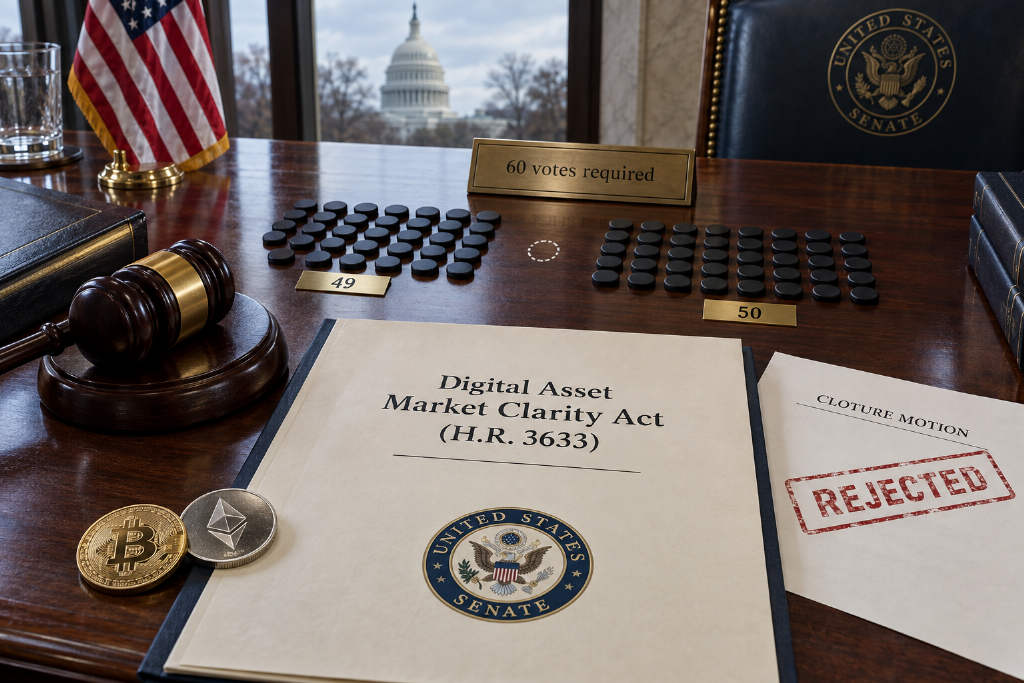
The U.S. Senate failed to advance the Digital Asset Market Clarity Act, H.R. 3633, in a cloture vote on the afternoon of Sept. 15. The chamber’s roll call record shows the motion failed 49-50 in vote No. 234, 11 votes short of the 60 required to proceed.
In this case, cloture referred to the Senate procedure used to end debate and force a vote. The motion here was about whether the Senate should begin considering the bill, not whether the bill itself should receive final passage.
The yes vote also came in below the Republican seat count in the Senate. Republicans currently hold 53 seats, while the motion drew only 49 votes in favor. With 99 total votes cast, one senator did not vote. As of publication, the Senate website had not yet posted the individual voting positions of each lawmaker, leaving the cross-party breakdown unclear.
CoinDesk said the bill was effectively done once opposition cleared 40 votes
CoinDesk tracked the count in real time. Reporter Nikhilesh De wrote during the tally that once opposition reached 40 votes, the next no vote would effectively end the market structure bill. He later said, based on an unofficial count from the Senate floor livestream, that more than 40 senators had voted against the motion, meaning the bill would not advance.
CoinDesk said the failed vote effectively brought the Senate’s market structure legislation work for 2026 to an end.
Ethics language, not the core bill text, became the final obstacle
The impasse centered on ethics provisions for most of the debate around the vote. Republican lead sponsors released what they described as a final revised text late Sunday, and Donald Trump agreed to the ethics restrictions in that version, including a provision allowing state attorneys general to enforce ethics rules against federal officials.
But, as Chain News had reported earlier, Democrats said that language still blocked state attorneys general from directly suing the U.S. president. They also argued that the Office of Government Ethics could still issue notices allowing senior officials to keep crypto business ties. Democrats submitted a counterproposal late Monday night.
Sen. Cynthia Lummis said at the time that the text had already incorporated more than 120 Democratic requests. A White House crypto adviser said the only changes left were "punctuation marks."
The ethics dispute did not suddenly appear this week. According to the report, Sen. Elizabeth Warren and other Democratic senators pushed an amendment in July that would bar the president, vice president, and their family members from profiting from the crypto industry. That provision remained central to negotiations afterward. CNBC reported that when the bill cleared the Senate Banking Committee in May, only two Democrats voted in favor.
Warnings over the 60-vote threshold had surfaced before the vote
In a prior version of the text released on Sept. 11, Republicans had already laid out the 60-vote threshold and the expected timeline. One day before the vote, U.S. Securities and Exchange Commission Chairman Paul Atkins publicly urged Congress to pass the bill, while also saying the SEC’s crypto agenda would not stop regardless of whether the legislation succeeded. After the result, that second point now looks like the more immediate path forward.
Bitcoin and Ether fell during the count, but the vote was not the only driver
Crypto markets reacted as the tally unfolded. CoinDesk recorded Bitcoin slipping toward $76,000, while shares tied to the sector, including Circle, Bullish, and Coinbase, extended losses.
According to CoinGecko prices cited in the report, Bitcoin was trading at about $75,865 early on Sept. 16 Taipei time, down about 4.1% over 24 hours. Ether was at about $2,403, down about 5.5%.
CoinDesk also pointed to two other variables moving at the same time: another rise in international oil prices and less than 24 hours before the Federal Reserve was set to begin a new rate-hike cycle. On that basis, attributing the entire market drop to the Senate vote would be inaccurate.
Industry reaction split over what the failure means
Matt Cole, chief executive of Bitcoin treasury company Strive, said, "The CLARITY Act not passing is bad for America, and bad for cryptocurrency. As an American, I’m frustrated, but not surprised it didn’t pass."
He added, "That said, my honest view is that this is good for Bitcoin."
Strategy Executive Chairman Michael Saylor responded more briefly: "The only clarity you need is Bitcoin." The company also listed Bitcoin’s current standing in the U.S., saying the Commodity Futures Trading Commission has long treated Bitcoin as a commodity, the Internal Revenue Service treats it as property, the SEC has approved spot Bitcoin products, and the Financial Accounting Standards Board classifies Bitcoin as an asset consistent with GAAP.
The motion could be filed again, but the path is narrow
The failed vote was on cloture on the motion to proceed. That means the Senate did not reject the bill in a final up-or-down vote. Instead, the chamber failed to clear the procedural step needed to begin formal consideration, debate, and amendments.
Under Senate rules, a cloture motion can be filed again. Still, CoinDesk’s reading was that the defeat effectively ended Senate market structure legislation for 2026.
Without a dedicated statute in place, U.S. crypto oversight is set to continue relying on agency rulemaking, enforcement actions, and court decisions. That is the route Atkins said the SEC would keep pursuing even if the bill did not pass.