
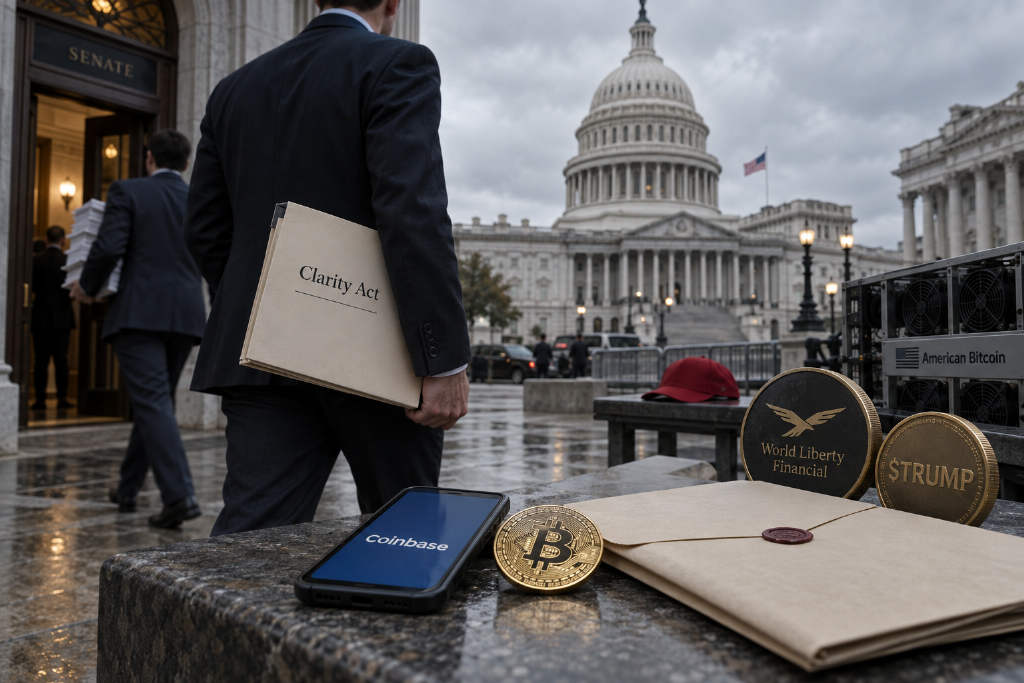
The Clarity Act, the U.S. bill meant to set crypto market structure rules, went down in a Senate procedural vote and took months of work with it. And the report says this was not just Democrats stonewalling. Ethics fights, bad timing, industry mistakes, and a House-Senate strategy mismatch all fed into the blowup.
Democrats drew a line around Trump’s crypto interests
The report says the core fight was over ethics language. Democrats had been sounding alarms since 2025 about the Trump family’s crypto ties, including World Liberty Financial, the $TRUMP meme coin, and the American Bitcoin mining business.
The piece says Trump’s June financial disclosure listed $1.4 billion in income from crypto-related investments during his first term, out of $2.2 billion in total annual income. That number turned into a big bargaining chip for Democrats in the talks.
Senators Ruben Gallego and Angela Alsobrooks said they would not back the bill without enough ethics provisions. Senator Kirsten Gillibrand, who had long been viewed as crypto-friendly, also said publicly at Consensus 2026 that the bill was not going anywhere without ethics language. The White House and Senate Republicans floated several ethics amendments, Democrats replied with counterproposals, and Thom Tillis and Gallego even put together a bipartisan compromise draft. But no deal. The three sides still failed to land on an agreement before the September vote.
Ripple Chief Legal Officer Stu Alderoty put it this way: "The policy itself is good, but the industry needs to understand politics better." He said the Clarity Act had morphed from a market structure bill into an ethics bill.
Coinbase’s January pullback was blamed for missing the window
The report says some blame also landed inside the industry. It points to a Wall Street Journal report from last week saying some insiders faulted Coinbase and CEO Brian Armstrong after he publicly pulled support for that version of the Clarity Act ahead of the Senate Banking Committee vote in January.
The fight was over how the bill handled stablecoin yield, which the article says did not match exchange interests. Several industry figures and Senator Cynthia Lummis stood up for Coinbase. But lobbyists interviewed by CoinDesk saw it differently. Their view: Armstrong’s post, and the months of trench warfare over stablecoin yield that followed, helped freeze a bill that might have moved faster otherwise.
Alderoty said January had been a real opening. No midterm election pressure yet. More room to bargain.
The Senate did not take up the House-passed version
The article says another problem was the process itself. The House had already passed its own Clarity Act in July 2025 by a 294-134 vote, with 78 Democrats in support. The Senate never took up that bill. Instead, senators wrote their own from scratch, first calling it the Responsible Financial Innovation Act and only later switching to the Clarity Act name.
Wintermute Head of Policy Ron Hammond said the bill was behind from day one once the Senate decided not to directly adopt the House version. In his view, many of the problems dragging on the bill this year, including bank lobbying over stablecoin yield and tougher political pressure, had not fully formed the year before.
And even if the Senate had passed its own version, it still would have had to go back to the House for another review round. Then the House adjourned right after the Senate returned to session, which pushed the earliest next opening into the lame-duck session after the election.
Midterm politics left neither party eager to hand over a win
With 2026 being a midterm year, the report says the political math turned against the bill. Polling suggested Republicans could lose their House majority, and several Senate contests were tight. The crypto industry had seen this Congress as the most crypto-friendly ever. JPMorgan Chase CEO Jamie Dimon said as much on X. But as the election got closer, that edge started to look like baggage.
Democrats did not want to look like they were helping Trump notch a political win. The report also says crypto voters are often seen as leaning Democratic. A CoinDesk-commissioned survey found only 1% of registered voters named crypto as their top issue. Cost of living, jobs, and health insurance ranked much higher. Among Democratic voters, negative views of crypto outpaced positive ones, and 62% said they did not trust the Trump administration to handle the crypto sector.
Ava Labs President Charley Cooper said, "With 6 weeks left before the vote, neither side wanted to take the risk of giving the other a photo of a political victory."
Negotiations were criticized as messy and poorly handled
The talks themselves got hammered. The article says bipartisan bills are usually written with staff from both parties working together, side by side. Here, Republicans drafted a version, Democrats commented, Republicans released an updated version, and then called the result bipartisan.
At some points, the report says, Republicans inserted concession language on their own, hoping Democrats would come along, and then told industry players that consensus had been reached before Democrats had formally signed off. One source said Republican aides slipped up by not fully bringing Democratic staff into the process. Simple point. If a concession is not formally accepted, the other side still has leverage.
White House crypto adviser Patrick Witt also took heat from multiple people quoted in the report, who said he lacked the experience for a bill this complicated. His X posts about an alleged breakthrough were said to have warped industry expectations.
On the eve of the September 15 vote, Tillis tried one last round of talks to get the Tillis-Gallego ethics amendment voted on before the full Senate vote. Eleanor Terrett of Crypto in America first reported that aides to Senate Banking Committee Chair Tim Scott later shut that effort down. Gallego and Schumer later said bipartisan consensus had been close.
Fairshake’s Republican bet is now under scrutiny
After the bill failed, attention swung to Fairshake and other crypto super PACs. Fairshake has already said it will spend $30 million attacking former Senator Sherrod Brown, who had opposed crypto legislation.
The article asks whether that approach could become a problem if Democrats retake the House in the midterms and the industry is seen as having pushed all its chips onto Republicans. One source said Fairshake was not built for a wave election. The group had already come up short twice, including a $10 million push against Illinois candidate Juliana Stratton that still ended with her winning the primary.
The broader message in the report is blunt: the crypto industry cannot afford a clean break with Democrats, and the Clarity Act’s failure has left that relationship in a shakier state.
The political weight of crypto voters remains in question
The article also pushes back on the idea that crypto voters are a deciding force. The Ripple-backed National Cryptocurrency Association estimates that about 67 million Americans own crypto assets. Even so, the report says the industry has had a hard time convincing senators to meet directly with holders and talk through real-world use cases.
A former legislative aide said it plainly: "The industry can say tens of millions of people own crypto, but if lawmakers go back home and do not hear anyone talking about it, they do not care."
The regulatory gap may last longer
What happens next with the Clarity Act is still murky. Some people still think talks could restart before the end of the year. But whatever happens in the election, a new Congress takes office in January, which means the whole thing could start over from square one. One industry source said Democrats may eventually introduce their own market structure bill, at least giving the party a starting draft.
Without legislation, the SEC and the Commodity Futures Trading Commission have already begun using joint guidance to cover part of the gap. But SEC Chair Paul Atkins has said again and again that a market structure law is still needed and that agencies cannot stand in for Congress.
The report presents the failed bill as a reminder of how Washington works. Political calculation can beat policy logic. The crypto industry spent hundreds of millions of dollars on lobbying and helped shape what it saw as the most crypto-friendly Congress on record, only to watch the bill die near the finish line because of ethics fights tied to Trump’s personal interests and the pressure of a midterm election year.