
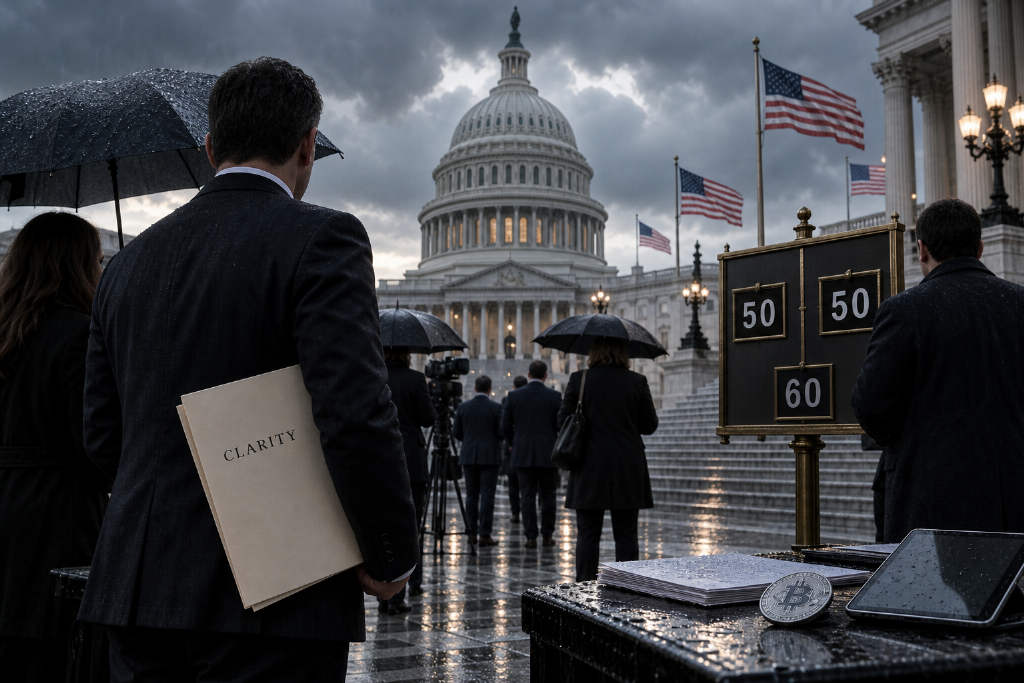
A procedural vote in the U.S. Senate has left the Digital Asset Market Clarity Act, or the CLARITY Act, short of formal consideration for now. In the early hours of Sept. 16, senators voted on whether to end debate over a motion to proceed to the bill. The threshold was 60 votes. The final tally was 50 in favor and 50 against.
That result means the CLARITY Act cannot move into formal Senate consideration in the near term. The vote showed that the bill still has principled support, but its current version has not secured a broad enough bipartisan coalition.
A 10-vote gap remains
The outcome means that in the next vote, supporters would need at least 10 senators who voted no to switch sides, or they would need to gain an equivalent number of new backers after further negotiations. In bipartisan Senate lawmaking, a 10-vote gap points to substantial resistance.
Even if the bill eventually reaches 60 votes, it would still need to go through amendments, a possible additional cloture vote, and final passage procedures.
Lummis said revisions added concessions
In the final round of lobbying before the vote, Senator Cynthia Lummis, one of the leading advocates of crypto legislation in the U.S., said the revised bill had added more ethics restrictions, participation by state attorneys general in enforcement, authority to respond to stablecoin deposit outflow risks, and protections for developers.
She said those compromises were sufficient to create conditions for bipartisan movement on the bill. Lummis also described the procedural vote as a key window, saying that if the legislation could not clear the 60-vote threshold even to enter formal consideration, room for later negotiations would narrow sharply. She also said continued delay would leave the United States behind other countries in the competition over digital asset regulation and financial innovation.
Warren raised conflict-of-interest concerns
Senator Elizabeth Warren also spoke before the vote. She warned that the current text does not adequately constrain conflicts of interest that could arise if a president or senior officials participate in crypto businesses.
Warren said she supports clearer rules for the crypto industry, but argued that rulemaking should not give politicians or their families a special lane. She added that without stricter ethics and consumer protection provisions, the legislation would leave room for political figures to profit from the digital asset market.
She pointed in particular to the Trump family’s expanding crypto business activities, and said Congress needs to address conflicts tied to self-dealing by public officials, token issuance, and stablecoin businesses while advancing a market structure bill.