
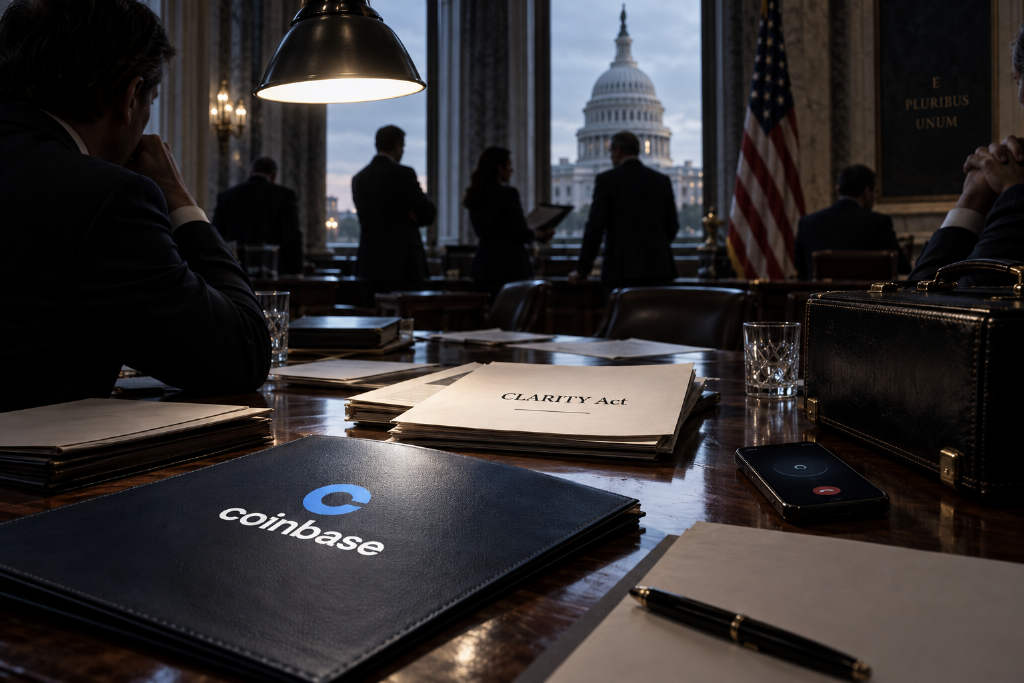
The CLARITY bill failed in the U.S. Senate this week, ending what many in crypto had seen as a major opening to put a lasting market framework for digital assets into law.

Its collapse has set off finger-pointing across the industry, Capitol Hill and the banking sector. At the center of the fight, according to The Wall Street Journal, was Coinbase Chief Executive Brian Armstrong, whose opposition to parts of the bill repeatedly complicated negotiations.
In January, Maryland Democratic Senator Angela Alsobrooks, a key figure in the CLARITY talks, received a roughly three-minute voicemail from Armstrong while she was on vacation, the report said. People familiar with the matter said some participants in the legislative effort viewed his tone as inappropriate as talks became strained. One of those people said Armstrong told the senator, “Once you give in, the banks will keep taking more.”
Armstrong pulled support before a key vote
Less than two weeks later, as the bill was nearing a vote, Armstrong made a move that rattled the sector. Ahead of a key Senate vote on Jan. 15, he said on X that “no bill is better than a bad bill” and withdrew support for an early version of the legislation.
The CLARITY bill had been negotiated for months. It was designed to establish a broader regulatory framework for digital assets, support wider adoption and move crypto deeper into mainstream finance. Its failure came just as the industry had begun to feel stronger politically and was operating with support from President Donald Trump.
There is no single explanation for why it failed. Some crypto executives and lawmakers blame Democratic opposition. The report also said Trump’s June disclosure of large crypto-related earnings renewed scrutiny over the ethics of a sitting president maintaining business interests tied to the sector. As 2026 progressed, lawmakers also had other priorities competing for attention, including Iran, inflation, and public backlash tied to data centers and rogue AI agents. Others in the industry argue the real mistake came earlier, when crypto failed to lock in a deal during a more favorable window at the start of the year.
Armstrong had unusual leverage in that process. People involved in the negotiations said that, apart from Trump, almost no one had comparable influence over the bill’s direction. From the 2024 election through the September vote, he made 13 trips to Washington, and his lobbying team held weekly strategy meetings with industry participants for months.
People familiar with the talks said the 43-year-old billionaire effectively had veto power over provisions he disliked and used it more than once, adding friction to an already difficult legislative process. Some inside crypto backed that hard line. Ripple CEO Brad Garlinghouse said, “We had momentum in January. But part of the industry basically shot itself in the foot.”
Coinbase said Armstrong’s decision to withdraw support in January reflected what it believed was best for the broader crypto industry after the company identified multiple problems in the bill. Chief Policy Officer Faryar Shirzad said in a statement, “We made compromises many times to preserve the industry coalition and move legislation forward.”
From GENIUS to CLARITY
Armstrong co-founded Coinbase in 2012 and became a major Republican fundraiser and donor in 2024, helping turn crypto voters into a force politicians could not ignore. After Trump took office, he quickly assumed a leading role in the push for crypto legislation.
His first test was the GENIUS bill, a stablecoin measure. The Journal described him lobbying for that bill on Capitol Hill in a navy suit, a campaign that ended with broad Democratic backing. Trump signed that legislation into law last summer, giving the industry a major win and strengthening Armstrong’s position as a power broker between crypto and Washington.
Negotiations then shifted to CLARITY, a far broader proposal that touched many corners of the crypto business. After regulatory pressure and lawsuits during the Biden administration, the industry wanted a permanent framework written into law to protect new products and reduce the risk of another hard turn by regulators.
Banks saw the bill very differently. They treated it as a chance to shut down activities they viewed as equivalent to paying interest on deposits and therefore a competitive threat. Stablecoin issuers were already barred from paying interest directly on tokens, but bank groups also wanted to stop partnerships they believed sidestepped that restriction.
Coinbase became the most visible example. The company has a revenue-sharing agreement with Circle, the issuer of USDC, and the amount is tied to USDC balances held on the exchange. Coinbase had also previously promoted USDC rewards of as much as 3.75% annually. Banking lobby groups argued that arrangements like this could trigger large deposit outflows, reduce banks’ ability to lend and hurt the broader economy.
As CLARITY talks intensified, Armstrong strongly opposed provisions that would curb Coinbase’s rewards business. People involved in the negotiations said his position hardened when talks stalled, frustrating even Senate allies who had supported the bill. According to people familiar with the matter, he at times bypassed congressional staff and spoke directly, and sharply, with senators, including some who had wanted to help get the measure passed.
Shirzad disputed the characterization, saying Armstrong had good relationships with senators in both parties and remained respectful in those discussions. “These were high-stakes negotiations. Disagreements were unavoidable, but disagreement is not disrespect,” he said. A spokesperson for Alsobrooks said the senator would not comment on private conversations but had “positive and productive” exchanges with Armstrong and other digital-asset and banking executives. The spokesperson added that her goal had always been to regulate a technology worth tens of billions of dollars.
A 15-page compromise still fell apart
The dispute over stablecoin rewards burst into the open in January. People in the talks said early drafts of the bill left Armstrong and others dissatisfied with where the legislation was headed.
Shortly after a Senate committee vote was put on hold, Armstrong went on television and accused banks of using customer deposits without permission, aiming his criticism at the industry’s long-standing lending model. The comments angered Wall Street executives. The Journal reported that JPMorgan Chase CEO Jamie Dimon confronted Armstrong at the World Economic Forum in Davos in late January and accused him of lying.
The conflict did not fade. Negotiations around stablecoin rewards ran for five months, and some crypto participants came away feeling the industry was steadily giving ground on a core issue.
In May, Alsobrooks and Republican Senator Thom Tillis announced a compromise. The proposal would not directly ban stablecoin rewards, but it would force Coinbase to change its existing program. Armstrong agreed to that framework, and Coinbase described it as a major concession. Banks still said it did not go far enough.
Negotiators then turned to many other unresolved issues. To pass the bill, Republicans needed at least some Democratic votes. In late June, Republicans tried to restart bipartisan talks and delivered a 15-page document with multiple compromises to Democratic members of the Senate Agriculture Committee. People familiar with the matter said Democrats signaled the next day that they could accept most of those ideas.
Armstrong objected. After learning that the Coinbase CEO did not support some of the provisions, Republicans shelved several proposals, leaving Democrats confused, according to the report.
Trump’s crypto disclosures changed the politics
The political climate then worsened. Trump disclosed that his family’s meme coin and crypto businesses generated $1.4 billion in 2025. The report said no U.S. president had previously recorded crypto-related income on that scale.
Democrats seized on that disclosure before the midterm elections and used it to sharpen ethics attacks. They focused on the CLARITY bill’s ethics provisions and proposed banning public officials from holding crypto assets. That approach would have applied to Trump and his family, and Democrats pushed for the president and his children to divest sizable crypto holdings.
By late summer, the CLARITY text had grown to more than 600 pages. People in the negotiations said lawmakers in both parties were worn down by the length of the talks and the number of parties involved. Bank groups kept trying to weaken the bill, and community bankers traveled to Washington to tell lawmakers the proposal posed something close to an existential threat to them.
At the same time, staff in both chambers and both parties were irritated with crypto lobbyists, especially with Armstrong and his team as they kept pressing for concessions that would benefit Coinbase and the broader industry.
Tensions were high enough that earlier this year, a staff member for Republican Senator Cynthia Lummis, one of the bill’s chief architects and one of crypto’s most important allies in Congress, refused to meet with a member of Armstrong’s lobbying team, the report said. A spokesperson for Lummis declined to comment on private conversations but said the senator had a good relationship with Coinbase and appreciated its efforts to help move CLARITY forward.
In August, Trump invited Armstrong and other crypto and finance executives to the White House for a meeting that was livestreamed in full. The president joked with attendees and later showed them the Oval Office. The Senate then broke for its August recess, pushing the vote back again.
Last weekend, Republican senators released a new version of the bill. Trump’s side made another concession by adding language that would require the president to place crypto assets into a blind trust. Democrats still were not satisfied. A White House official said the administration had agreed to the broadest ethics provisions ever considered.
The bill failed, and Coinbase stock swung sharply
On Tuesday, the CLARITY bill failed to secure the 60 votes needed to advance, falling at the final procedural hurdle. Coinbase shares closed down more than 10% that day.
Two days later, the industry got a separate boost. The U.S. Securities and Exchange Commission cleared tokenized stocks to trade in the United States, and Coinbase shares jumped 12% on Friday.
Early Saturday, Armstrong posted on X that although the bill failed, the final draft was better than the early versions. “I’m proud of the effort, and I would do it again because the negotiations produced a better bill. This is just one step in a long process,” he wrote.
