
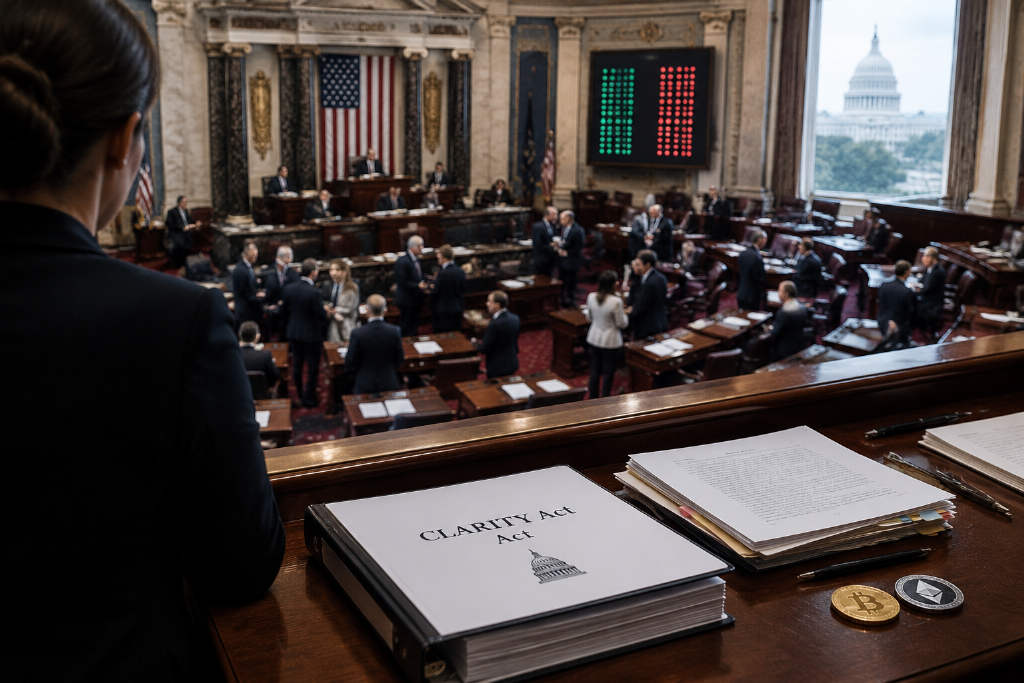
A key procedural vote on the U.S. Senate’s CLARITY bill failed early on Sept. 16 Beijing time, after senators could not clear the 60-vote threshold needed to move the legislation forward. The motion to end debate on the motion to proceed was rejected 49-50, with one senator not voting.
A day before the vote, Republican senators Cynthia Lummis, John Boozman, and Tim Scott released a 635-page final draft. Republicans said the new text incorporated 126 substantive changes requested by Democrats. Earlier negotiation results also showed that Donald Trump had accepted “about 80%” of the ethics proposal put forward by Republican senator Thom Tillis and Democratic senator Ruben Gallego.
Those concessions were meant to solve the Senate math. Republicans hold 53 seats, so the CLARITY bill needed Democratic support to reach 60 votes and close debate.
When the roll call came, the split that had been masked by more than a year of negotiations was exposed. All Democrats and independents who voted opposed the motion. Republicans were not fully unified either. Tillis, who initially voted yes and had backed moving the bill forward, later switched to no in order to preserve procedural rights for reconsideration. Even excluding that tactical switch, Republicans were still about 10 votes short of the threshold.
The central question remained: if Trump had already accepted roughly 80% of what Republicans described as Democratic ethics demands, why was the remaining 20% enough to keep every voting Democratic senator opposed?
What the final draft tightened
Compared with earlier versions, the final Republican draft expanded the scope of restrictions on crypto activity by public officials.
The text would bar the president, vice president, members of Congress, senior federal officials, and federal judges from personally creating, minting, or issuing digital assets. It also separately defines “sponsor.” A public official could fall under the restriction if that person supports the creation, issuance, or explicit promotion of a specific digital asset through licensing, revenue-sharing, transaction fees, or similar agreements, or authorizes the use of a name, likeness, or office for promotion.
The new version also, for the first time, requires officials to address certain equity interests tied to crypto firms. Under the draft, a covered person holding a qualifying “significant financial interest” must sell that interest or transfer it into a qualified blind trust.
That term refers to equity worth at least $15,000 in a company or subsidiary, where issuing or sponsoring digital assets was the company’s largest single source of revenue in at least one of the past three calendar years. The bill does not require that revenue to exceed 50% of total revenue. It only needs to be larger than any other single category.
Penalties were also strengthened. If a public official knowingly and willfully violates the ban on issuing or sponsoring digital assets, that person would have to disgorge all profits and pay a civil penalty equal to the greater of 20% of the consideration received or $500,000. A covered person who continues to hold a significant financial interest that should have been disposed of would face a penalty equal to the greater of 20% of the value of that interest or $500,000. Trading platforms and other digital asset intermediaries would be barred from continuing to offer trading services for digital assets issued in violation of the law, and penalties could reach $250,000 per violation per day.
Compared with the version released in July, the draft also addressed two issues Democrats had raised earlier. An earlier sunset clause, which would have caused the ethics enforcement framework to expire after Trump left office, was removed. The new draft also for the first time added a channel for state attorneys general to participate in enforcement.
Republicans used those changes to argue that the final text had absorbed a large share of Democratic ethics demands. Democrats, though, had shifted the argument. Their concern was no longer simply whether the bill contained ethics language, but whether those restrictions could actually be enforced in practice. Senator Elizabeth Warren and other Democrats argued that even if the bans became law, Trump would not face real consequences for ignoring them.
Why enforcement remained the core dispute
An independent enforcement role for state attorneys general had long been a red line in CLARITY negotiations. Tillis, Gallego, and others had pushed to expand their role. Democratic senator Angela Alsobrooks said plainly that if the Department of Justice refused to act, state attorneys general should be able to step in.
One reason the issue mattered so much to Democrats was their doubt that Trump’s own appointee as attorney general could independently enforce conflict-of-interest rules against Trump himself.
Attorney General Todd Blanche had previously served for years as Trump’s personal lawyer. In a congressional hearing in July, he misspoke and said, “I am his lawyer,” before correcting himself and saying he “used to be his lawyer.”
In May, the Justice Department under Blanche also reached a settlement with Trump’s side in Trump’s lawsuit against the IRS. The deal planned to use $1.776 billion in public funds to establish what was described as an “anti-weaponization fund.” That arrangement drew criticism, including from some Republicans, before a federal court blocked it through a preliminary injunction. The Justice Department later formally rescinded the order creating the fund.
For Democrats, that history made the enforcement structure hard to trust. The Republican draft did open a path for state attorneys general to get involved, but it did not change the core design. For the president and other covered public officials, the U.S. attorney general would still be the only official able to bring direct civil enforcement actions under the bill.
State attorneys general would have much narrower authority. In a case involving alleged misconduct by Trump, for example, they could not sue Trump directly. They also could not independently ask a court to impose fines, recover profits, or force divestment. Their only route would be to sue the attorney general, challenge federal non-enforcement, and seek injunctive relief in federal court.
That is why Warren kept up her criticism before the procedural vote. She called the Republican proposal a “weak fig leaf” and said on the Senate floor that state attorneys general could not take direct enforcement action against the president. “All they can do is sue Trump’s former personal lawyer, who is now the attorney general, and try to get him to act,” she said.
Even that route faced a second gatekeeper: the “supervising ethics office.”
Under the final draft, if the relevant ethics body had already issued a legal opinion saying a potential act was not barred by the ethics provisions, a state attorney general could not bring suit through this mechanism. In cases involving a “significant financial interest,” the same bar would apply if the supervising ethics office had issued notice confirming that the interest had been sold or transferred into a qualified blind trust.
Under current U.S. law, the supervising ethics office for the president and other executive branch officials is the Office of Government Ethics, or OGE. Senators, House members, and federal judicial personnel each have separate ethics bodies: the Senate Ethics Committee, the House Ethics Committee, and the Judicial Conference of the United States.
That left Democrats with what they saw as two stacked limits. The new version no longer shut states out entirely, but direct enforcement against public officials remained concentrated in the Justice Department, while ethics bodies within the federal system still retained the ability to block state lawsuits. Warren described the structure before the vote as a switch that could “turn off enforcement.”
State attorneys general also objected on a second front
Their concerns were not limited to presidential conflicts of interest. On Sept. 14, New York Attorney General Letitia James led a bipartisan group of 17 state attorneys general in a letter to Congress urging senators to oppose the CLARITY bill.
The focus of that letter was different. It argued that the federal regulatory rewrite could weaken existing state securities oversight and anti-fraud enforcement powers.
James and the other signatories said the bill could allow the U.S. Securities and Exchange Commission to “preempt state registration authorities,” while using language that was not clear enough, increasing future legal disputes when states try to fight fraud and hold violators accountable. They warned that a broader assertion of SEC federal preemption could affect not only digital assets but also the long-standing boundary between federal and state securities regulation.
In practice, state officials raised two separate objections to CLARITY. One was a demand for more authority: truly independent and direct enforcement power. The other was defensive: preserving the investor-protection and securities-enforcement powers they already have.
No retroactive reach, and no full break with existing crypto wealth
Beyond enforcement, Democrats also objected to how the final draft handled preexisting crypto wealth.
Timing matters here. The bill says the digital asset ethics subtitle would generally take effect no later than 360 days after enactment. If final rules are completed earlier, it could take effect 60 days after those rules are formally published.
More importantly, the draft says the ban on public officials issuing or sponsoring digital assets applies only to assets issued or sponsored on or after the effective date of the ethics subtitle. That means the framework would not reach back to Trump’s earlier issuance of $TRUMP or use its disgorgement provisions to claw back revenue obtained before the law took effect.
That does not mean all of Trump’s existing crypto interests would be automatically untouched. If an interest qualifies as a “significant financial interest,” it would have to be disposed of before the ethics subtitle takes effect. But disposal does not have to mean a sale. The bill also allows a transfer into a qualified blind trust.
A blind trust cuts off management authority and access to information. Once assets are handed to an independent trustee, the covered public official cannot direct day-to-day investment decisions or freely learn how the trustee is trading. The Republican CLARITY draft goes further and says that once an interest has been lawfully transferred into a blind trust, future actions by the trustee or by companies held through the trust, including continued issuance or sponsorship of digital assets, generally would not be attributed to that public official.
But loss of control is not the same as loss of economic benefit. Under the current Ethics in Government Act, a qualified blind trust does not require the original owner to give up the ultimate beneficial interest. The public official, a spouse, or qualifying children may still remain beneficiaries of the trust principal and income. In other words, an official may not know how the assets are being managed and still benefit from the income and appreciation they generate.
That marks a basic divide between the parties. The Republican approach focuses on cutting off direct control over private assets. Supporters argue that if a president cannot personally manage a business, direct investments, or know specific trading information, the risk of using public power to actively manage private wealth is reduced. Some Democrats want a deeper financial separation. In their view, even if day-to-day investment decisions are handed to a third party, a president setting policy for the crypto sector still has a potential economic tie to that sector.
Gaps remained around complex firms and adult children
Not every crypto-related equity holding would trigger the “significant financial interest” rule. Under the bill’s definition, even a company heavily exposed to crypto may fall outside the requirement. If a business has multiple revenue streams, such as token sales, stablecoin reserve income, transaction fees, lending, custody, and investment income, it would not qualify if issuing or sponsoring digital assets is not its largest single source of revenue.
That matters for companies with complicated structures and ownership arrangements, including World Liberty Financial. The bill’s text does not make it possible to determine from crypto exposure alone whether an interest would be restricted. The answer would depend on the revenue mix of the relevant legal entity, the exact interest Trump holds, and how regulators classify different revenue streams.
Existing long-term licensing and revenue-sharing agreements also remain hard to categorize. The bill clearly does not apply retroactively to digital assets already issued or sponsored before the effective date. But if a branding, revenue-sharing, or promotional agreement signed earlier continues to be performed after the law takes effect, the final text does not fully resolve whether that counts as a completed “existing sponsorship” or an ongoing act of “sponsorship.” That question would still require interpretation by the relevant ethics office.
The family-coverage rules leave another visible gap. The final text clearly applies to public officials themselves and their spouses, but not to adult children. Trump’s sons therefore would not be directly subject to the bans on issuing tokens, sponsoring digital assets, or holding a “significant financial interest.”
So long as their conduct does not further trigger Trump’s own covered interests, the CLARITY ethics rules would not apply to them. Democrats made one last push before the vote to expand the family definition and include Trump’s adult children. Republicans did not accept that demand.
The “last 20%” became the decisive gap
The crypto industry wants Congress to end long-running regulatory uncertainty and set a more stable framework for digital asset markets. That is one reason the CLARITY bill had drawn bipartisan effort in the first place.
At this stage, though, the legislation is running into a special political reality. The U.S. president has sizable crypto business interests while also controlling appointments at the Justice Department, naming leaders of executive regulators, and wielding substantial policy execution power. In that setting, the ethics provisions are no longer a side appendix. They sit near the center of whether the bill can command enough political support.
Democrats have kept asking the same underlying question: does the system really sever the economic link between a president’s private crypto wealth and the public power used to regulate the sector? If executive-branch ethics offices still interpret key parts of the rules, if direct enforcement against the president remains concentrated in the Justice Department, if earlier token income remains beyond reach, if qualifying interests may stay inside blind trusts with beneficial ownership preserved, and if adult children remain outside the bill’s direct scope, then some Democrats will still see the separation as incomplete even with bans, divestment requirements, and civil penalties written into law.
Republicans had said Trump accepted about 80% of the Tillis-Gallego ethics framework. The Sept. 15 procedural vote still failed to clear 60 votes. That result showed the remaining dispute was not a marginal 20%. It may be the part that decides CLARITY’s fate.