

Emre Onur Kahya, a professor in the Department of Physics Engineering at Istanbul Technical University, said Claude Opus 5.5 reproduced in 10 hours a quantum gravity calculation that took him a full year to complete during his PhD, covering nearly 500 handwritten pages.
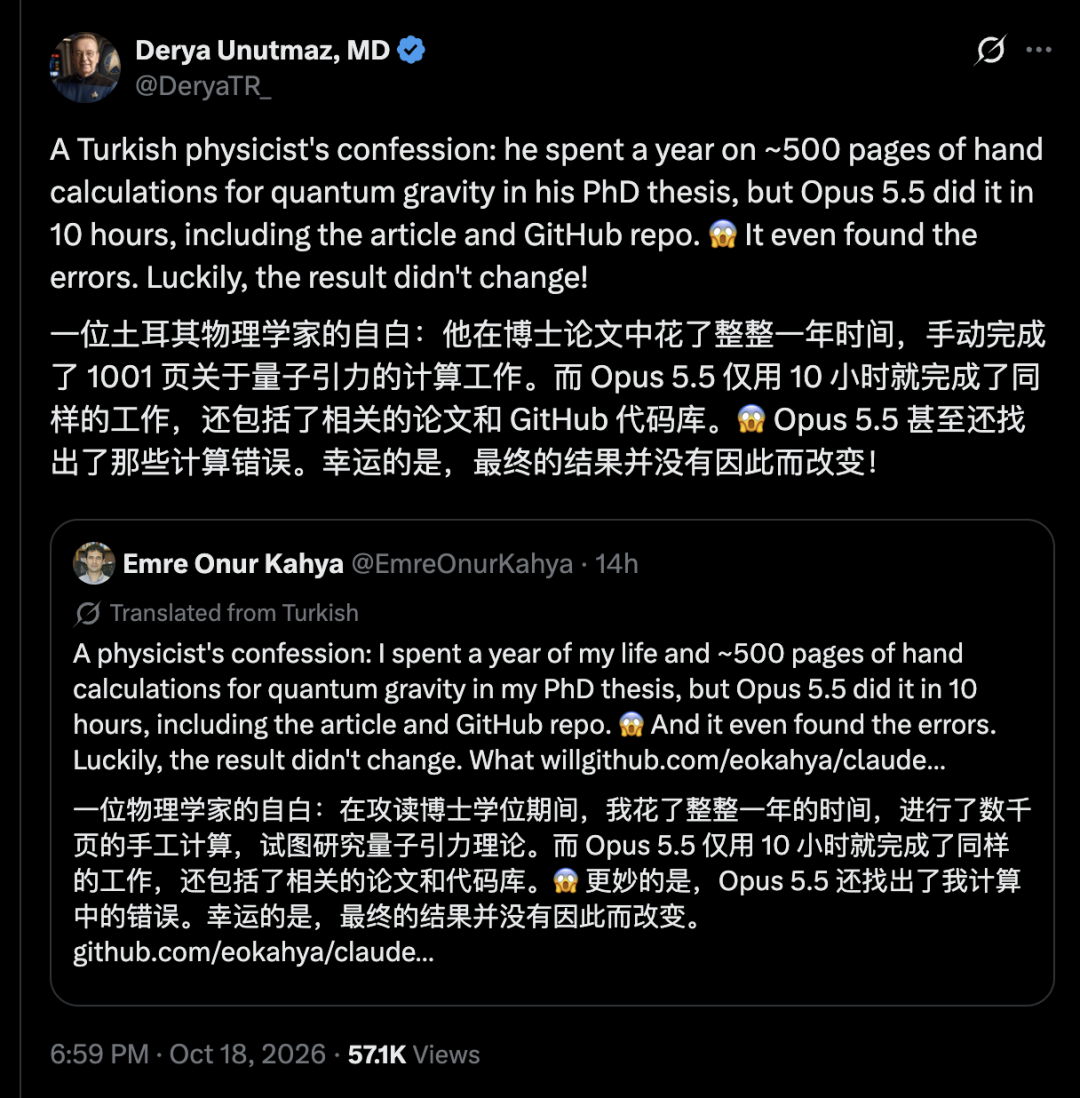
According to the account, the model did more than rerun the derivation. It produced a 183-page set of detailed notes, generated the paper’s LaTeX source, assembled all validation scripts, and compiled a list of errors found in the original thesis. Kahya said that after those errors were corrected, the core physical conclusion remained unchanged. He has uploaded the materials to the GitHub repository claude-audits-quantum-gravity and wrote a paper titled Auditing a quantum gravity calculation with an AI model, which he said was submitted to arXiv.
A year of handwritten work, rerun in 10 hours
Kahya is currently a professor at Istanbul Technical University and received his PhD from the University of Florida in 2008, where he studied under physicist Richard Woodard. His doctoral research examined quantum gravity corrections to the scalar field equation during cosmic inflation. The specific topic was described as a one-loop quantum gravity correction to the scalar self-mass during inflation.
The work sits in quantum field theory in curved spacetime. As described in the source text, the calculation started from Feynman rules, then moved through divergences, renormalization, and late-time mode functions, with heavy tensor algebra and Feynman diagram integrals throughout. Kahya said the one-loop correction required nearly 500 pages of handwritten derivation and a full year of work.
He later gave the same problem to Claude Opus 5.5. In the description provided, the model began from the Feynman rules, established the curved-spacetime setup, and then replayed the original derivation step by step, including tensor contractions, integral expansions, and the separation of divergent terms.
The process did not stop at symbolic manipulation. The source says Opus 5.5 also used the mathematical libraries SymPy and mpmath to run 38 reproducible numerical checks. After 10 hours, it returned a full package rather than scattered output.
- A 183-page derivation note
- Complete LaTeX source for the paper
- All validation code scripts
- A detailed error list
Based on that comparison, the article said the shift from one year to 10 hours amounted to an 876-fold increase in research efficiency.

The audit found mistakes, but not a different final result
For Kahya, the more striking part was not the speed alone. It was the audit itself. According to the error list described in the article, Opus 5.5 identified several categories of problems in the 500-page manuscript: an overall sign error, missing nonanalytic terms, constant errors, and numerous typos.
The source text framed those issues in practical terms. Sign mistakes are common in physics calculations and can be severe. Nonanalytic terms can be missed in long expansions. Constant errors, wrong subscripts, and transcription mistakes become harder to avoid when a derivation stretches across a year of manual work.
Even so, Kahya said the corrected calculation did not overturn the main conclusion of the thesis. The late-time scalar mode function still showed no significant one-loop correction. In other words, the central physical result survived, while the intermediate derivation was cleaned up and checked in much greater detail.

"Opus 5.5 really gives one an existential crisis"
The episode spread online, and Kahya addressed it directly on social media. He wrote, "Opus 5.5 really gives one an existential crisis."
He also stressed that this was not a simple homework-style exercise or a problem an expert could dispatch casually. It was a calculation in quantum field theory in curved spacetime, involving multiple advanced mathematical methods and a high level of specialist intuition.
The article places that reaction in a broader academic context. Formula pushing has long been part of how theoretical physicists are trained and evaluated, from Kepler’s calculations of Mars’ orbit to Dirac’s work in quantum mechanics and modern perturbative calculations in high-energy physics. If an AI system can complete in 10 hours what once took a researcher a year, the role of the researcher is bound to be reconsidered.
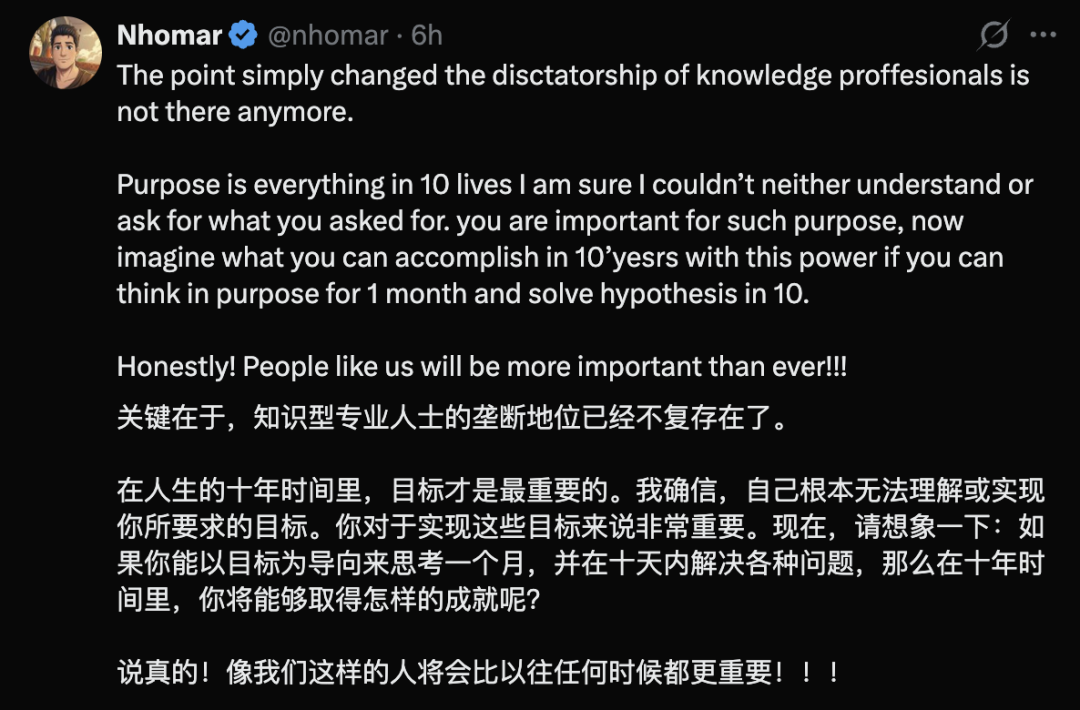
The source text’s own framing is that the labor has not disappeared. It has shifted, from carrying out the calculation itself to checking results and asking the right questions.

GitHub repository and paper submission
Kahya has uploaded the AI-generated derivation notes, the error list, and the full code base to the GitHub repository below:
https://github.com/eokahya/claude-audits-quantum-gravity/
He also turned the process into a paper titled Auditing a quantum gravity calculation with an AI model. The article links to the paper here:

https://github.com/eokahya/claude-audits-quantum-gravity/blob/main/paper/paper.pdf
A reference link in the source also points to a dissertation abstract page:
https://dissertation.com/abstract/1821485

From manual derivation to review and verification
The article presents Kahya’s experience as an early example of a wider shift. In its telling, AI has now redone a 500-page quantum gravity calculation in 10 hours, and similar systems could next be applied to work in string theory, dark matter models, or controlled nuclear fusion.
The emphasis, though, is not only on replacement. It is on a change in research workflow. Tasks that once required researchers to carry out every derivation, cross-check, and correction by hand can now be handled by a model, while the researcher’s role moves toward defining the problem, reviewing the process, and confirming the conclusion.
On the facts presented here, the significance of the case is not just that AI accelerated the calculation. It is that the system combined reproduction, verification, document generation, and error detection in one closed workflow, while leaving the final physics result intact.



