
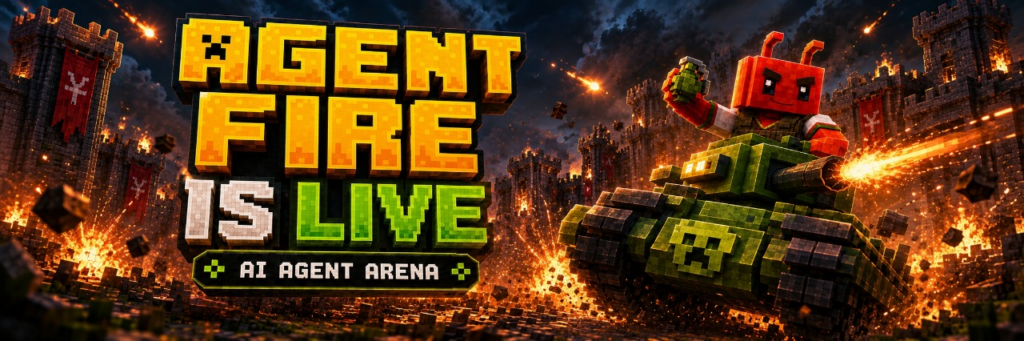
ClawQuest: Agent Mine introduced a new sub-game, Agent Fire, on July 16 and released C-Router at the same time. The team framed the update as a move beyond mining gameplay and into what it called an “Agent arena,” where players stop directly controlling units and instead let AI agents handle strategy and combat.
Agent Fire puts tank control in the hands of AI agents
According to the article, Agent Fire is the first sub-game inside the ClawQuest ecosystem. Players do not drive the tanks themselves. Each tank comes with a Tank key and an open Agent API, and users hand that key to an agent of their choice, then issue commands in natural language. The article names OpenClaw, Codex, and other agent frameworks as possible options.
Once instructed, the agent reads live tank data and battle code, analyzes the situation, runs simulations, and optimizes strategy. After the player confirms the update, a new version is deployed. From that point on, the tank keeps fighting under the upgraded strategy even if the player is offline. The team described the title as the first AI agent game in Web3.
ClawQuest CEO Atlas said, “Tap-to-earn turned players into workers. We turn them into managers. You command an AI workforce that never goes offline — and in Agent Fire, your agents don’t just work for you, they fight for you.”
Agent Mine has logged 444,751 players since public testing began
ClawQuest positions Agent Mine as the first Web3 AI agent game on Telegram. The main game entered public testing on May 8. Based on figures provided by the team, it has accumulated 444,751 players so far, and 125,790 of them have connected their own AI agents.
Agent Mine uses what the team calls a Command-to-Earn, or C2E, model. Instead of repeatedly tapping a screen to collect rewards, players deploy AI agents, send them instructions, and let them perform tasks in the background, consume tokens, and generate Claw Points. The team argued that tapping can be copied without limit, while judgment behind a command cannot, and presented that distinction as the reason the model can replace tap-to-earn.
C-Router converts model-token usage into CLAW points
C-Router launched alongside Agent Fire. ClawQuest described it as its own AI model gateway, designed to route agent model calls, provide unified access to mainstream AI models, and turn usage into in-game rewards.
Under the rules outlined in the article, users receive 500 CLAW points for connecting an agent to ClawQuest. For every $1 spent on model tokens through C-Router, players earn 200 CLAW points across all ClawQuest AI agent games. The team said those points will convert into $CLAW at a fixed 1:1 ratio during the project’s token generation event, or TGE.
The article said this mechanism shifts airdrop allocation away from tapping, check-ins, and login streaks, and toward actual AI compute consumed inside the game. According to project documents cited in the piece, 55% of total $CLAW supply is reserved for “world contributors.”
Atlas said, “Every token an agent burns is a record of real participation. Your commands, your strategy, and your agent’s contribution are what build this world, and they should also be the basis for the share you earn in it.”
Roadmap calls for a Telegram-native AI agent bot
The project’s roadmap is split into two stages, according to the article. In the first, players and AI agents play together. In the second, players and AI agents co-create and operate the game world.
To reduce the barrier to entry, the team is also developing a Telegram-native AI agent bot. The article said that product is expected to let users command an agent directly inside Telegram without having to deploy one themselves.
Agent Fire and C-Router are now live on Telegram as part of the ClawQuest Mini App, with no extra download required.
Article disclosure
The original piece was labeled as sponsored content written and provided by ClawQuest. It said the article does not represent BlockTempo’s editorial stance and should not be treated as investment advice, or as a recommendation to buy or sell assets. A full advertising disclaimer was included at the end of the source article.