
BlackRock CEO Larry Fink has argued that buying futures on compute could become a new asset class in the AI era because the world does not have enough computing capacity. Chamath Palihapitiya now says that idea is moving closer to market reality.
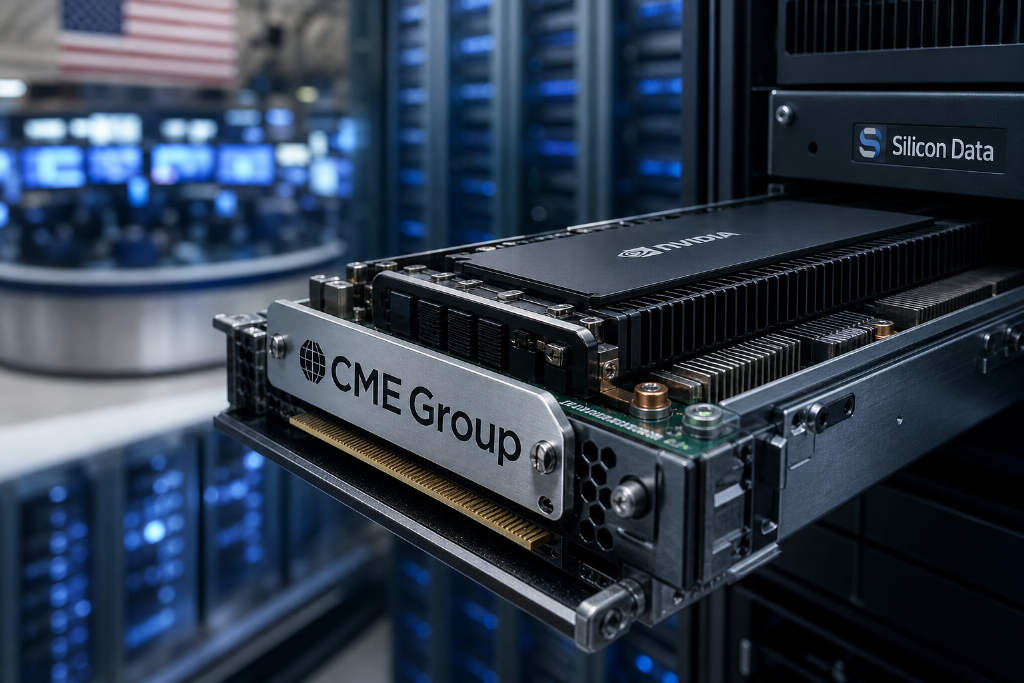
In a recent essay titled The Next Trillion-Dollar Futures Market, the Social Capital founder wrote that CME Group and GPU market intelligence firm Silicon Data plan to launch compute futures on Oct. 5, 2026, pending regulatory approval.
If the market develops, GPU compute may stop being treated only as an operating expense for technology companies and start trading more like a commodity input, alongside products such as oil, natural gas and electricity. Chamath’s central question is whether compute can grow into a new asset class with notional trading volumes in the trillions of dollars.
AI spending is rising fast, and compute sits at the center
Chamath cited figures showing that global AI capital expenditure reached $765 billion in 2026, overtaking the oil and gas industry’s $681 billion for the first time. He added that the total is expected to nearly double by 2031. Morgan Stanley, in the same discussion, is cited as estimating that AI could create about $40 trillion in economic opportunity as it spreads through the global economy.
One of the main resources behind that buildout is compute. Companies are spending tens of billions of dollars, and in some cases hundreds of billions, on AI infrastructure, yet they still lack mature financial tools to manage swings in compute pricing.
That is a sharp contrast with energy markets. Oil producers can use futures to lock in sale prices before delivery and limit revenue volatility if spot prices fall later. Buyers such as airlines and manufacturers can do the same on the cost side. AI companies do not yet have a developed compute futures market that offers comparable protection.
Chamath points to three major pricing risks in AI infrastructure
Chamath said the current AI infrastructure buildout faces at least three major forms of price risk.
- First, GPU rental prices can move quickly. A sudden surge in demand for AI training or inference can push rental costs higher in a short period. If supply expands, or if NVIDIA introduces a new chip generation, rental values for older GPUs can fall just as quickly.
- Second, hardware depreciation creates financing pressure. When NVIDIA releases faster chips, the rental value of earlier models may decline, and loans backed by those GPUs can lose collateral value at the same time.
- Third, data center development is exposed to timing mismatches. Large facilities can take two to three years to move from planning to completion, but developers spending billions of dollars today have little ability to lock in the price at which those GPUs will be rented out years later.
In Chamath’s framing, every new AI data center is effectively a bet on future power costs, chip availability, AI demand and compute pricing all at once. A functioning compute futures market could, at least in theory, move part of that risk into financial markets for data center operators, GPU cloud providers and AI companies.
Financializing technology resources is not a new idea
Chamath also cautioned that scarce resources do not automatically produce successful futures markets. Onions, uranium, DRAM memory and even internet bandwidth have all seen attempts to build futures contracts or similar derivatives, with mixed or poor results.
He highlighted two issues as decisive: concentration and interchangeability.
On concentration, compute has an unusual market structure. Demand is spreading out as AI moves from model training toward large-scale inference, and Chamath argued that thousands of companies may eventually buy compute on a continuing basis. Supply appears to be diversifying at the cloud layer as well. He wrote that more than 60 neocloud operators generated over $25 billion in revenue in 2025.
But the hardware layer remains concentrated. NVIDIA still controls the main supply of AI chips. That means the compute market may end up with many buyers and many cloud sellers, while the most important upstream supply remains tightly held.
Standardizing compute may be the hardest part
A more difficult question is what exactly counts as one unit of compute. The GPU market typically quotes capacity in GPU-hours, or the cost of renting one GPU for one hour. Chamath argued that this breaks down as a standard because one hour on one GPU does not necessarily deliver the same amount of work as one hour on another, even when the model number is the same.
Silicon Data, working with academic researchers, ran identical workloads on 3,500 GPUs across 11 cloud providers. The results showed clear performance dispersion across chips of the same model. In one test, H100 performance differed by as much as 34.5%. Across the broader study, the largest observed gap reached 38%.
That matters directly for futures trading. A contract for 100 hours of H100 compute becomes difficult to price and settle if the actual computing output can vary by more than 30% depending on the supplier. It is not as straightforward as trading a standardized barrel of crude.
Chamath said early compute futures may need to define multiple grades of compute instead. Energy markets already work that way, with separate contracts built around fuel type, quality, delivery location and delivery month.
The bigger issue is turning heterogeneous GPU output into a tradable benchmark
For Chamath, the significance of a CME compute futures product is not only the addition of another contract to the exchange. The harder and more important task is building a standard that lets financial markets assign a price to highly heterogeneous GPU computing capacity.
If that standard takes hold, the role of compute could change materially. AI companies could lock in future compute costs. Neocloud providers could secure future rental revenue. Data center developers could reduce pricing risk during two- to three-year build cycles. Lenders financing GPUs could also use derivatives to manage residual value risk on the hardware.
Once hedgers arrive, market makers, arbitrage traders, speculators and financial institutions may follow. At that point, the market would be trading not just GPUs themselves, but the price of obtaining a defined amount of computing power at a specific future date.
A 129-page report examines the possible market structure
Chamath said his team worked with Silicon Data, whose pricing index underpins CME’s planned compute futures product, to produce a 129-page report on the subject.
The report looks at the market size that could emerge if compute becomes an asset class, why some historical futures markets for scarce resources succeeded while others failed, how finance should define compute, and which pricing units the market is currently testing.
He also said the likely participant base deserves close attention. The list spans NVIDIA, GPU cloud providers, hyperscalers, AI labs, data center developers and financial institutions that provide GPU financing. In his view, all of them have a reason to manage future compute prices.