

Coin Metrics says the market may be overstating the importance of Federal Reserve rate decisions as Bitcoin’s main macro catalyst. In its latest research, the firm found that if the focus is limited to the first 30 minutes after a release, US labor data has been the event most likely to push BTC into a sharp directional move.
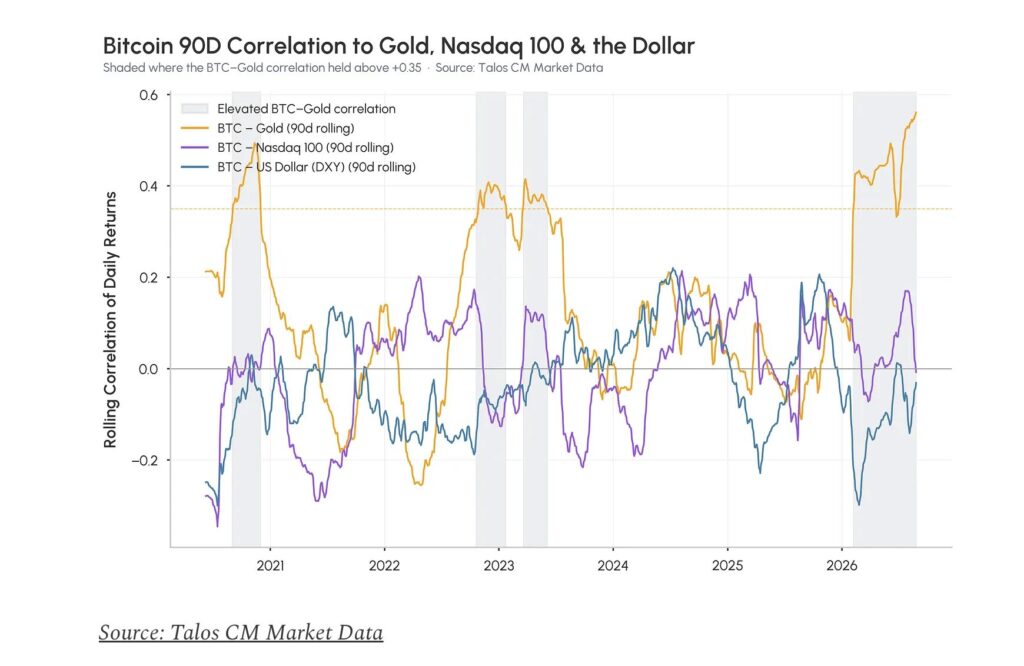
In a Sept. 8 report titled Bitcoin’s Shifting Macro Identity, Coin Metrics compared Bitcoin’s price behavior around nonfarm payrolls, core Consumer Price Index readings, and Federal Open Market Committee decisions from January 2025 through September 2026. The study found that the median absolute BTC price move in the first 30 minutes after a payrolls release was about 2x a normal non-event period. Core CPI was next at about 1.8x. FOMC rate decisions, by comparison, remained broadly near normal baseline volatility across the two observation windows discussed in the report.
Payrolls spark the first move, core CPI shapes how long it lasts
Coin Metrics said that does not make CPI less important. Its conclusion is more specific: payrolls deliver the strongest immediate shock, while core CPI has the more persistent impact.
The reasoning in the report is straightforward. Employment data can quickly alter market views on whether the economy is overheating and whether the Fed still has room to raise rates. Inflation data affects real rates and the policy path more directly, so the repricing that follows can last longer.
Put another way, if the question is which release is most likely to force Bitcoin into a direction within half an hour, payrolls currently top the list. If the question is which release is more likely to reshape rate expectations for the coming weeks, core CPI is at least as important.
The report also offered an explanation for the relatively muted response to FOMC decisions. Rate outcomes are often priced in gradually through earlier payrolls data, CPI prints, comments from Fed officials, and rate futures. By the time the Fed announces its decision, much of the real shock may already have passed through markets.
Case study: BTC fell 2.32% in 30 minutes after the Sept. 4 jobs report
Coin Metrics highlighted the US August employment report released on Sept. 4 as a clear example. Nonfarm payrolls increased by 162,000, well above the roughly 56,000 expected by the market. Reuters reported that after the release, traders briefly pushed the probability of a September rate hike to around 60%.
According to Coin Metrics, BTC fell 2.32% in the 30 minutes after the data was released, about 6x the typical 30-minute reaction to a payrolls report.
Derivatives markets deleveraged at the same time. BTC open interest fell about 3% within half an hour. Long liquidations reached about $119 million, while short liquidations were only about $24 million, a ratio close to 5:1. The report said macro data often acts as the spark, but the scale of the sell-off depends on how much leverage the market has built up at the time.
Bitcoin is trading more like gold and less like a tech proxy
Coin Metrics said the more important change may be Bitcoin’s shifting relationship with traditional assets. Its latest data shows BTC’s 90-day return correlation with gold has climbed to +0.56, the highest since 2020. At the same time, Bitcoin’s correlation with the Nasdaq 100 and the US dollar has dropped close to zero.
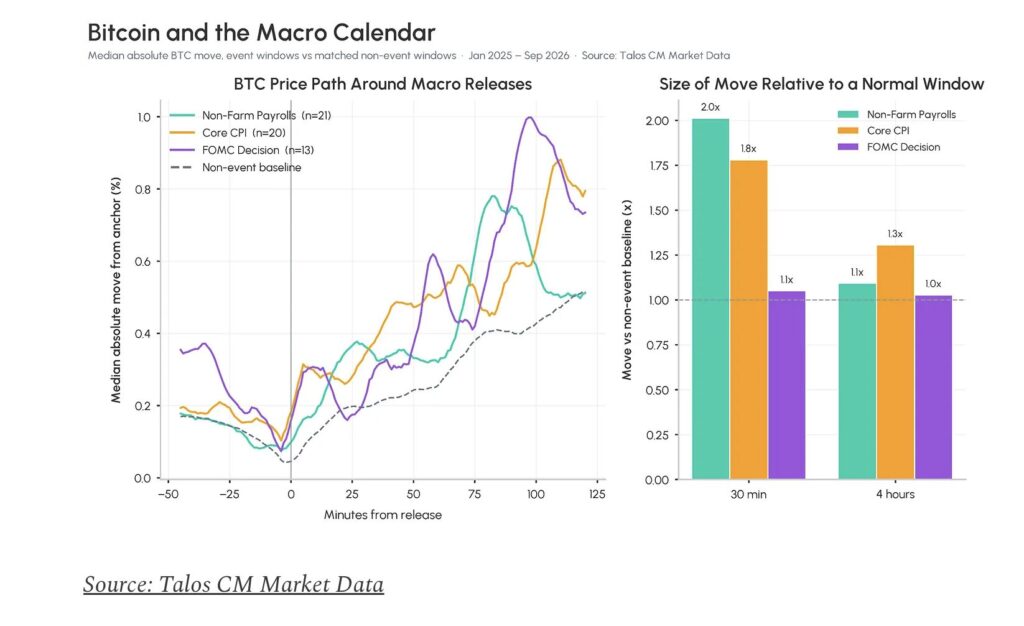
That stands in contrast with the older market view of Bitcoin as a high-beta tech trade. Coin Metrics said Bitcoin and gold have recently been driven by similar macro forces, including concerns over purchasing power, government debt, fiscal deficits, and the direction of real rates. When markets worry about fiat debasement and sovereign debt, both scarce assets can attract trades in the same direction.
The report noted that this is not the first time such a pattern has appeared. During the large-scale monetary and fiscal stimulus that followed the 2020 pandemic shock, and again during the 2023 US regional banking crisis, BTC and gold moved closer together as liquidity concerns and financial-system risk came back into focus.
Coin Metrics added that a +0.56 correlation does not mean Bitcoin has permanently become “digital gold.” Correlation is a rolling indicator and can change quickly with market conditions. The firm said earlier research has also shown that Bitcoin can switch between a “tech stock/risk asset” role and a “scarce monetary asset” role across different cycles.
Its conclusion was narrower: rather than saying BTC has fully decoupled from the Nasdaq, it is more accurate to say Bitcoin is currently in a macro trading regime that leans more toward gold than toward equities in the technology sector.
Next test arrives with Sept. 11 CPI before the Sept. 15-16 FOMC meeting
That setup will face another near-term test. The US Bureau of Labor Statistics is scheduled to release August CPI on Sept. 11 at 8:30 a.m. Eastern Time. The Federal Reserve will then hold its FOMC meeting on Sept. 15 and 16.
Coin Metrics’ historical work suggests markets should not focus only on the Sept. 16 rate outcome. If core CPI comes in above expectations, traders may move first to price in higher odds of rate hikes and higher real rates, putting pressure on both BTC and gold. If core inflation cools, the hawkish repricing triggered by the jobs report could be partly reversed.
The transmission chain outlined in the report runs like this: payrolls shift rate expectations, CPI confirms or challenges that view, Treasury yields and the dollar reprice, and the FOMC then confirms the policy path.
On that reading, Bitcoin is no longer simply waiting for the Fed to announce the answer. The biggest turn in the market may already be underway before the formal answer arrives.
With BTC-gold correlation now at 0.56 and Bitcoin’s link to the Nasdaq close to zero, the September CPI release and the FOMC meeting will offer an important test of whether Bitcoin is only temporarily trading away from the tech-stock narrative, or moving back toward a digital-gold framework.