

Coinbase Chief Executive Brian Armstrong said Thursday that Bitcoin reaching $400,000 by 2030 still stands as a "reasonable target," even with BTC trading around $77,000. He made the remarks in an interview with CNBC's Squawk Box Asia.
Armstrong says the latest Bitcoin cycle may have already bottomed
Armstrong pointed to Bitcoin's widely discussed four-year cycle, saying the asset usually follows a familiar sequence: a run-up, a euphoric phase, and then about a year of decline.
"We've actually just come across the one-year mark for this down period," he said. He added, "I personally believe that the bottom is in on Bitcoin in this most recent cycle," after its rise from around $60,000.
He also said Bitcoin tends to rally ahead of halving events, with the next halving due in around 18 months. "I think the next year or two is going to be good for Bitcoin," Armstrong said.
A move to $400,000 would amount to a roughly fivefold gain in a little more than three years. During the downturn, Coinbase cut 14% of its staff and missed second-quarter earnings as trading activity slowed.
He is more confident about the regulatory picture in Washington
Armstrong said the U.S. Senate is scheduled to vote on the Clarity Act on September 15. Based on the people he has spoken with in Washington, he said the bill is "ready to get a yes vote."
Law enforcement groups, many banks, and crypto companies support the measure, he said, and the objections Coinbase had raised earlier have been resolved.
The main unresolved issue involves ethics rules covering the president's family crypto ventures. Armstrong said the White House has offered a provision he described as "unprecedented" for a sitting president, while Democrats are pushing for divestiture. He said those talks are active and close to a solution, calling them "a little above our pay grade."
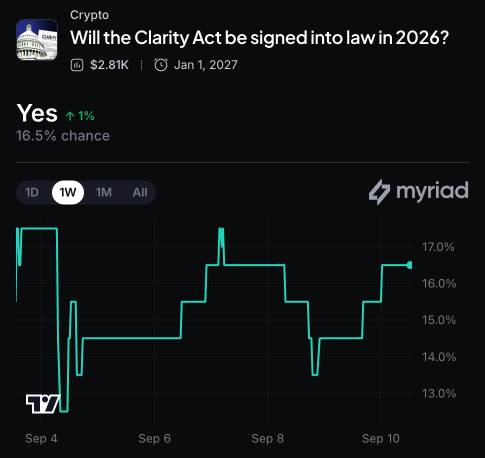
Users on prediction market Myriad, owned by Decrypt parent company Dastan, are less optimistic. They assign only a 17% chance that the Clarity Act will be signed into law in 2026.
Armstrong said failure of the bill would not matter much because the U.S. Securities and Exchange Commission and the Commodity Futures Trading Commission have both said they are ready to publish rulemaking and innovation exemptions under existing authority. Either way, he expects regulatory clarity within a month.
Coinbase is still building tokenized stock and perpetual futures products
As a precedent, Armstrong cited last year's Genius Act, saying more than 150 large companies integrated stablecoins within three months after it passed. He said passage of the Clarity Act would also bring tokenized equities and perpetual futures to U.S. customers.
Coinbase has been working toward both products regardless of the bill's fate. In June, the company laid out plans for tokenized stock trading with automatic dividends. Armstrong contrasted that with rivals offering "some form of derivative or IOU." Coinbase is also preparing options tied to crypto and equities.
In May, Coinbase became the first U.S. exchange approved to offer crypto perpetuals. Company executives have described the goal as building the "everything exchange."