
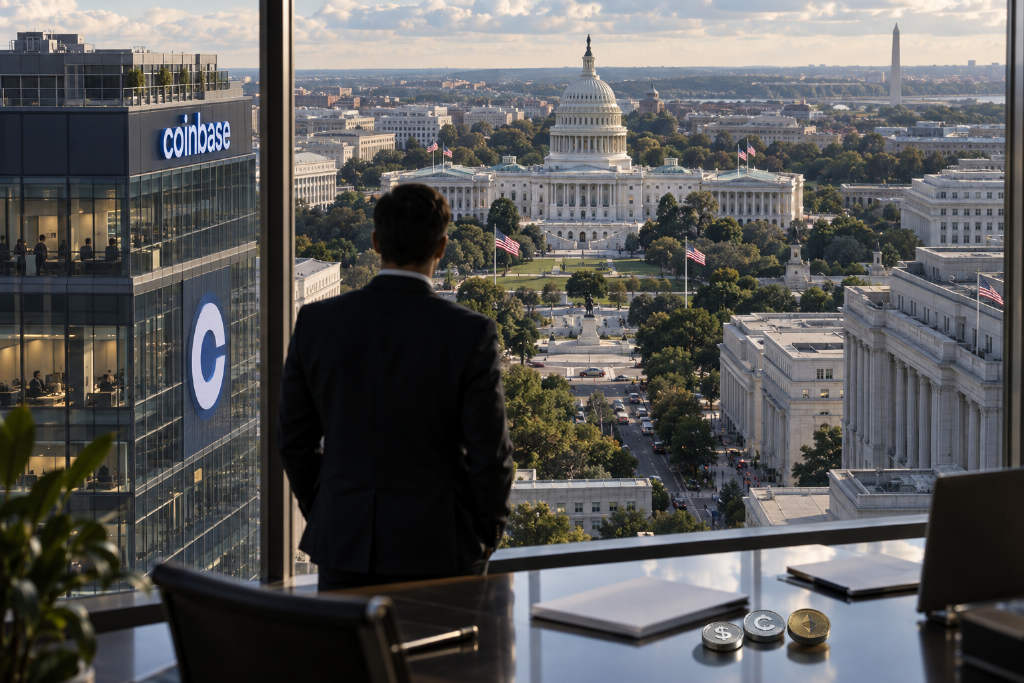
Taiwanese YouTuber Bonnie Blockchain recently sat down with Coinbase co-founder and CEO Brian Armstrong at Coinbase’s office, with the interview arriving just ahead of a key procedural vote in the U.S. Senate on the CLARITY Act.
The discussion covered Coinbase’s startup story, stablecoin rewards, banking-sector resistance, and whether the CLARITY Act can advance in Washington.
Under the current schedule, the Senate is expected to hold a cloture vote on the afternoon of Sept. 15 Eastern Time, or about 2:15 a.m. on Sept. 16 in Taiwan. The vote is a procedural step to end debate and move the bill forward, not a final vote on passage. Clearing that hurdle would typically require support from 60 senators.
Armstrong says banks are still trying to stop the bill
During the interview, Bonnie asked whether banks began pushing back more aggressively after the GENIUS Act passed because they realized they had conceded too much once regulatory clarity became real.
Armstrong said the GENIUS Act created significant clarity for stablecoins. One provision he highlighted as beneficial to U.S. users was the ability for users to receive rewards from stablecoins.
He said some large banks and banking lobby groups later came to regret parts of the bill, and he suggested that competition is likely at the heart of that response. If stablecoins can offer rewards, they could threaten banks’ existing payments and deposit businesses, he said, but that is not a legitimate reason to block legislation.
Armstrong said, 「People should support a fair competitive environment where everyone gets to compete.」
He said the fight has now shifted to the CLARITY Act, which is aimed at crypto market structure. According to Armstrong, banks are trying to secure a more favorable position in the new bill, while Coinbase continues to lobby in defense of users’ right to access stablecoin rewards.
Based on the draft he had seen at the time, stablecoins would not be allowed to pay rewards on completely idle balances. Still, platforms could offer rewards if users engaged in transactions or payments within a relatively short period.
He described that framework as a compromise produced through negotiation. Armstrong said some banks still oppose the arrangement and are trying to sink the bill, but he added that financial institutions including BNY Mellon, Goldman Sachs, and Fidelity have expressed support, which is why he believes the legislation still has momentum.
The Senate vote is procedural, not final passage
Armstrong stressed that the upcoming Senate action is only a procedural vote and does not mean the CLARITY Act would immediately take effect.
The bill still faces resistance from the banking industry over stablecoin rewards, while Democrats are seeking tougher limits related to crypto conflicts of interest involving the Trump family. The latest Republican version adds restrictions on crypto income for public officials and allows state attorneys general to enforce some provisions, but it is still unclear whether enough bipartisan votes are available.
When Bonnie asked him to predict the outcome, Armstrong said market consensus viewed the chances of clearing the procedural hurdle as relatively low, but he was willing to take the other side. 「I think it is more likely to pass,」 he said.
Even so, he added that politics offers no guarantees. Events in Washington that have nothing to do with crypto or the bill itself can still disrupt the agenda at any time.
Armstrong also said that even if Congress ultimately fails to pass the bill, U.S. regulators have already indicated they may still provide a degree of clarity through rulemaking.
Stablecoins, reserves, and the banking model
Bonnie also asked whether a financial system built around full-reserve stablecoins rather than fractional-reserve banks might be safer, and where credit creation would come from in that case.
Armstrong said he agreed that fully reserved stablecoins could be a safer system. He noted that stablecoins compliant with the GENIUS Act must be backed 100% by assets such as short-term U.S. Treasuries. By contrast, he said, traditional banks are heavily regulated precisely because they do not hold all depositor funds in reserve.
At the same time, he said he does not believe stablecoins will eliminate bank deposits altogether. In his view, stablecoins may be used mainly for internet payments, while banks will continue providing deposits and credit.
What he opposes is the practice of banks lending out customer deposits without clear customer consent. He said credit markets still serve an important purpose and people need access to borrowing to build businesses and support economic activity. But depositors should be able to choose whether to put funds into lending products, DeFi, or traditional financial instruments to earn yield, rather than having lending treated as the default.
‘Semi-government institutions’ and the cost of compliance
Armstrong said the fractional-reserve system produces another consequence: banks face such high regulatory thresholds in trying to control runs and collapse risk that they gradually become something like 「semi-government institutions.」
When only a small number of large institutions can afford those compliance costs, the market becomes vulnerable to oligopoly, he said. In that setup, banks end up prioritizing regulators ahead of customers.
Armstrong said, 「Your first priority is the regulator, and the customer comes second. That is why most customers are unhappy with the current financial system.」
He tied that point back to Coinbase’s defense of stablecoin rewards, saying the dispute is not only about crypto regulation but also about whether newer financial players can compete with banks on something closer to equal footing.
How Coinbase learned to operate in Washington
Armstrong said that when he first went to Washington, he assumed that if lawmakers were given enough information about how crypto technology worked, reasonable legislation would naturally follow.
He later realized that Washington is dealing with a wide range of issues at once, including war, trade, AI, and data centers. Without sustained resources, a large voter base, and the ability to turn an issue into election pressure, he said, almost nothing simply happens on its own.
That led Coinbase and other crypto companies to build a real political operation. Armstrong said that effort included funding Stand With Crypto, organizing millions of voters who support crypto policy, backing crypto-friendly candidates, and spending through Super PACs, political donations, and policy research.
He said, 「For better or worse, money is a factor in U.S. elections.」 In his view, the crypto industry’s growing political machinery is what gave bills such as the GENIUS Act and the CLARITY Act a chance to move into Washington’s priorities.
Coinbase started as Bitbank, and the domain cost $1,700
The interview also revisited Coinbase’s founding story. Armstrong said the company was originally called Bitbank, but after entering Y Combinator, lawyers told him a company without a banking license could not use the word “bank” in its name.
He wanted a replacement that was short, easy to hear, easy to spell, and connected to what the company did. He eventually found that the Coinbase.com domain could be purchased for $1,700.
Armstrong said he did not even like the name very much at first and intended to use it only temporarily before replacing it later. Fourteen years on, the name remains and has become one of the most recognizable brands in crypto.
His takeaway was that a company name does not need to be perfect at the start. What matters more is how a product and its marketing give that name meaning over time.
Argentina, inflation, and reading the Bitcoin white paper
Armstrong said he lived in Argentina for about a year and saw high inflation firsthand, along with the difficulty people faced when trying to move money across borders.
He was also reading writers such as Ayn Rand and Milton Friedman, which exposed him to free-market and libertarian economic ideas. Those experiences became part of the framework that helped him quickly grasp Bitcoin’s potential when he read the Bitcoin white paper in December 2010.
He added that he had no certainty Coinbase would succeed. When he introduced Bitcoin to some of the smartest people he knew, the reaction he got was: 「Why would anyone use a currency not issued by a government?」
Armstrong said successful startups need to find a position that is “contrarian but right.” If something is obviously right, others are usually already working on it. But being different for its own sake is not useful either. The real opportunity comes from seeing something earlier than the broader market sees it, then being proven right later.
The $150,000 from Y Combinator that made him quit Airbnb
At the time, Armstrong was still working at Airbnb and building Coinbase at night and on weekends. He said he was careful not to use company time or equipment.
What finally gave him the confidence to resign was acceptance into Y Combinator and the $150,000 in seed funding. Armstrong said he was still full of self-doubt and worried about looking foolish in front of friends and family.
Only after Paul Graham decided to back him did he call his parents and tell them he was leaving Airbnb to work on what, to them, sounded like a crazy idea they had never heard of.
He said that when people look back on their lives, some of the most consequential moments are those when someone else believes in them before they believe in themselves.
When Coinbase nearly looked finished
Coinbase’s early days were not smooth. Armstrong recalled that when the company had only about five employees, a site error caused users to see incorrect account balances, and customer support emails quickly piled up to between 10,000 and 20,000.
Reddit, forums, and social platforms filled with angry posts. Some people demanded that Coinbase shut down and return funds. Others accused the team of stealing users’ money. Someone even posted Armstrong’s private phone number, and his phone kept ringing.
The team was sleep-deprived and still working in the office at 2 a.m. to fix the issue. Armstrong said there was a moment when he felt the company was finished, but after a brief collapse, the only option was to stand back up and ask: 「What’s next? How do we solve it?」
He described that founder trait as being 「relentlessly resourceful」: no matter how bad things get, keep looking for a way to push forward.
Work, financial freedom, and meaning
Near the end of the interview, Bonnie asked Armstrong what would most surprise his 20-year-old self about his life today.
Armstrong said that when he was younger, he saw work as an obligation and assumed that once he reached financial freedom, he would be able to do whatever he wanted every day. But after reaching a level of success where he no longer had to work for money, he found that doing no work at all was actually boring and lacking in fulfillment.
He said young people should still choose work they genuinely care about even if it pays 40% less, as long as it lets them work with smart people and enter a field they feel passionate about. Passion makes people more willing to learn, he said, and gives them a better chance of becoming part of the top 1% in that field.
For Armstrong, financial freedom does not really mean retirement. It means being able to choose work aligned with what you believe in. Once someone no longer has to work, he said, that can create even more responsibility to give back to society.
With the CLARITY Act heading into a crucial Senate procedural vote, the moment also serves as a major test of the years Armstrong and Coinbase have spent building influence in Washington. The question is not only whether the bill can clear the 60-vote threshold, but also whether the U.S. financial system is willing to let banks, stablecoins, and crypto platforms compete on the same field.