

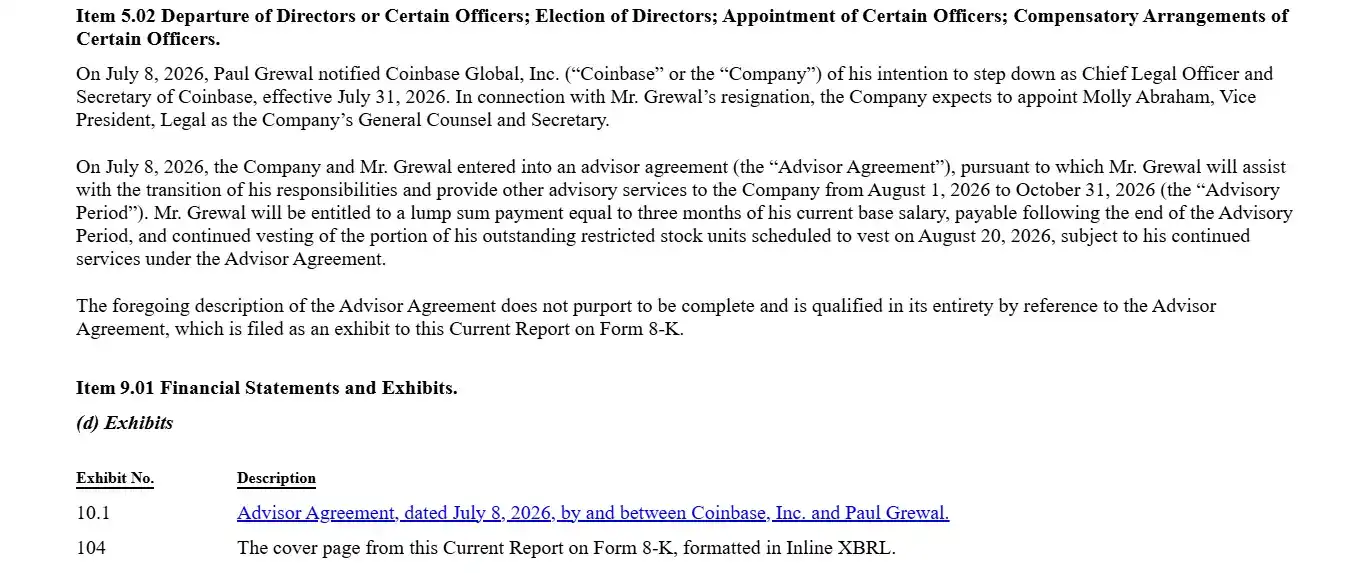
Coinbase has reshuffled five key leadership posts in roughly a month, remaking its legal, policy, technology, people, and product structure at a time when the company is under pressure to find its next growth engine.
Chief Legal Officer Paul Grewal will leave on July 31 for a startup. He will be succeeded by Molly Abraham, who was promoted internally to general counsel. Coinbase also created a new vice chair position and handed it to Ryan VanGrack, a former official with SEC and White House experience, to oversee policy and corporate affairs. Chief People Officer Lawrence Brock moved into an advisory role, institutional co-head Greg Tusar was reassigned to policy, and Base lead Jesse Pollak stepped back. On July 28, Coinbase named longtime executive Rob Witoff as chief technology officer after his prior role leading the Coinbase platform.
The timing is not incidental. Benchmark said weaker crypto trading activity led it to cut its forecast for Coinbase's second-quarter revenue. The report said spot trading volume on centralized exchanges fell about 28% in the second quarter, while Coinbase shares have pulled back by about 30% this year.
From fighting regulators in court to trying to shape the rules
Grewal's exit comes as several of Coinbase's major fights with regulators have been winding down. His defining legal battle was the SEC's securities case against Coinbase, filed in June 2023. The agency alleged that the company operated as an unregistered securities exchange, broker, and clearing agency. The case was widely viewed as a crucial test for whether the crypto industry could continue to operate legally in the United States. It ended in February 2025 when the SEC dropped the lawsuit and imposed no fine on Coinbase.
According to The Wall Street Journal, Coinbase and the SEC reached a settlement on July 22 in a Freedom of Information Act lawsuit. Under the deal, the SEC will pay $150,000 and revise its record-retention policies. The case exposed missing communications records covering nearly a year during Gary Gensler's tenure as chair.
That settlement followed a similar agreement with the Federal Deposit Insurance Corp. in February, meaning several of Coinbase's transparency-focused legal campaigns against regulators were nearing completion before Grewal's departure.
The succession choices point to a shift in emphasis. Abraham came from within the company. VanGrack, who now holds the newly created vice chair role, brings SEC and White House credentials and will focus on policy and external affairs. Tusar, whose background is in institutional business, has also been moved into policy work.
Public filings show Coinbase Chief Policy Officer Faryar Shirzad formally wrote to the Commodity Futures Trading Commission on July 27 about rulemaking for prediction markets, backing the proposed framework and seeking further coordination.
Still, moving from litigation to rulemaking has proved messy. A market structure bill that parts of the industry had hoped would deliver regulatory clarity has stalled in the Senate. Some observers have assigned part of the blame to Coinbase because restrictions on interest-bearing stablecoins directly affect the customer acquisition revenue-sharing arrangement between Coinbase and Circle. The company first opposed the bill loudly, then later pushed for it, and after those shifts the newer version ended up with tighter restrictions on active yield. That sequence drew scrutiny over Coinbase's policy posture.
CEO Brian Armstrong has gone so far as to say that if the legislation remains stalled for a long period, some of the company's business could move outside the United States.
Broader trading access expands while the Base story narrows
Coinbase's business changes have been just as concentrated, and they point to what the company calls Everything Exchange. The strategy was introduced in December 2025. Its premise is to use a unified account to combine trading across crypto, stocks, ETFs, prediction markets, and perpetual futures, turning Coinbase from a spot crypto venue into infrastructure linking the on-chain economy with traditional finance.
That vision began to move into products at scale in June 2026. On June 16, the company rolled out and launched a large batch of services at once:
- US stocks, ETFs, and index trading inside the main app, with support for transferring existing positions from external brokerages;
- tokenized US equities for non-US users, described by Coinbase as 1:1 backed by real shares and available for 24-hour trading;
- Pre-IPO perpetuals that let users trade around a company's valuation before listing, beginning with SpaceX and followed by Anthropic and OpenAI;
- index perpetuals bundling themes including AI, China, and defense;
- prediction markets through a partnership with regulated platform Kalshi, covering elections, rate decisions, and macro events.
Coinbase also embedded what it described as one of the first SEC-registered AI advisers, Coinbase Advisor.
Derivatives are a major part of the push. In May, the CFTC approved Coinbase as the first licensed venue able to offer global crypto perpetual futures to US customers. That opened a path for derivatives activity that had previously been more limited to offshore markets to return to the US.
The buildout continued in July. On July 21, Coinbase International Exchange listed S&P 500 index perpetuals with 24-hour trading. A day later, Coinbase's Canada head said publicly that the company was working to build a full-service exchange there spanning crypto assets, tokenized stocks, and prediction markets.
Against that expansion track sits a retrenchment at Base. In mid-July, Pollak said in a long post that he had handed day-to-day management of the Base App back to Coinbase, with well-known community figure Cobie taking over, while he returned to focus on the Base chain itself. He acknowledged that the company's two-year push around social and creator use cases had missed the mark. Prediction markets, perpetuals, and stablecoins were the products that gained traction, while the social experiments did not reach sustainable adoption.
Armstrong said Base's current priorities, in order, are trading, payments, and AI agents. He tied them together directly: payments require foreign exchange, and AI agents will also generate heavy demand for both trading and payments. Most resources, he said, are now concentrated on trading.

That retreat has been read as a temporary end to the consumer on-chain narrative.
Outside pressure is making the urgency harder to ignore. Token Terminal data shows Robinhood Chain's daily volume moved close to Base only a little more than 10 days after its mainnet launch, helped by a more direct distribution channel through tokenized US stocks and tens of millions of brokerage users.
AI is being used to remake operations and define new products
The CTO appointment also highlights a second major thread inside Coinbase: AI now sits on both the operating side and the product side.
Internally, AI is being used as a cost and productivity tool. After a workforce reduction of about 14% in May, Coinbase shifted toward leaner teams. Projects that once needed more than 10 people can now often be pushed forward by two or three, according to the report.
Coinbase says 95% to 100% of its code is now produced with AI assistance, up from about 40% in February. Each engineer is said to run an average of five to 10 AI agents at the same time, and the overall output is described as equivalent to around 1,200 full-time developers. The company's longer-range target goes much further: by 2030, it wants AI agents to handle a workload equivalent to 100,000 employees.
The streamlining is not uniform across the organization. Coinbase formally opened its Singapore office on July 22 and plans to increase headcount there from about 150 to about 200 by year-end. The fastest-growing roles are in engineering and institutional sales. The team is also exploring stablecoin wallets for AI agents.
Externally, AI is being framed as a product opportunity. On July 27, Armstrong wrote that he rejects the zero-sum view that companies working in crypto should pivot to AI. In his words, crypto is infrastructure, like electricity or the internet. It is not competing with the next major trend; it supports it.
Armstrong argued that AI agents cannot open bank accounts and cannot wait days for wire transfers to settle. They need programmable money that moves in real time, and that is what crypto can provide. He summarized Coinbase's direction as agentic finance and said agents could eventually generate trading and payment volumes larger than those of humans.
On delivery, the company said agentic traffic on Base documentation pages exceeded human traffic for the first time last month. It also rolled out updates across three user groups: merchants can accept USDC payments from AI agents through Coinbase Business; individuals can give natural-language instructions to agents to watch markets and execute on conditions, such as liquidating BTC if it falls below a specified price; and developers can integrate agent payments with three lines of code.
Real Vision founder Raoul Pal said billions of AI agents are on the way and will pay one another for compute, data, and services at a scale human markets have not seen before. He said the current financial system is too slow to support that and that Coinbase's agent payment rails have already been adopted by Google and Amazon.
The strategic shift is clear, but proof is still missing
Coinbase is placing a heavy bet on AI on both fronts, yet neither side is fully proven.
Inside the company, it remains unclear whether higher engineering efficiency can offset revenue pressure caused by weaker trading activity. There is still a long execution gap between the current operating model and the longer-term targets management has discussed.
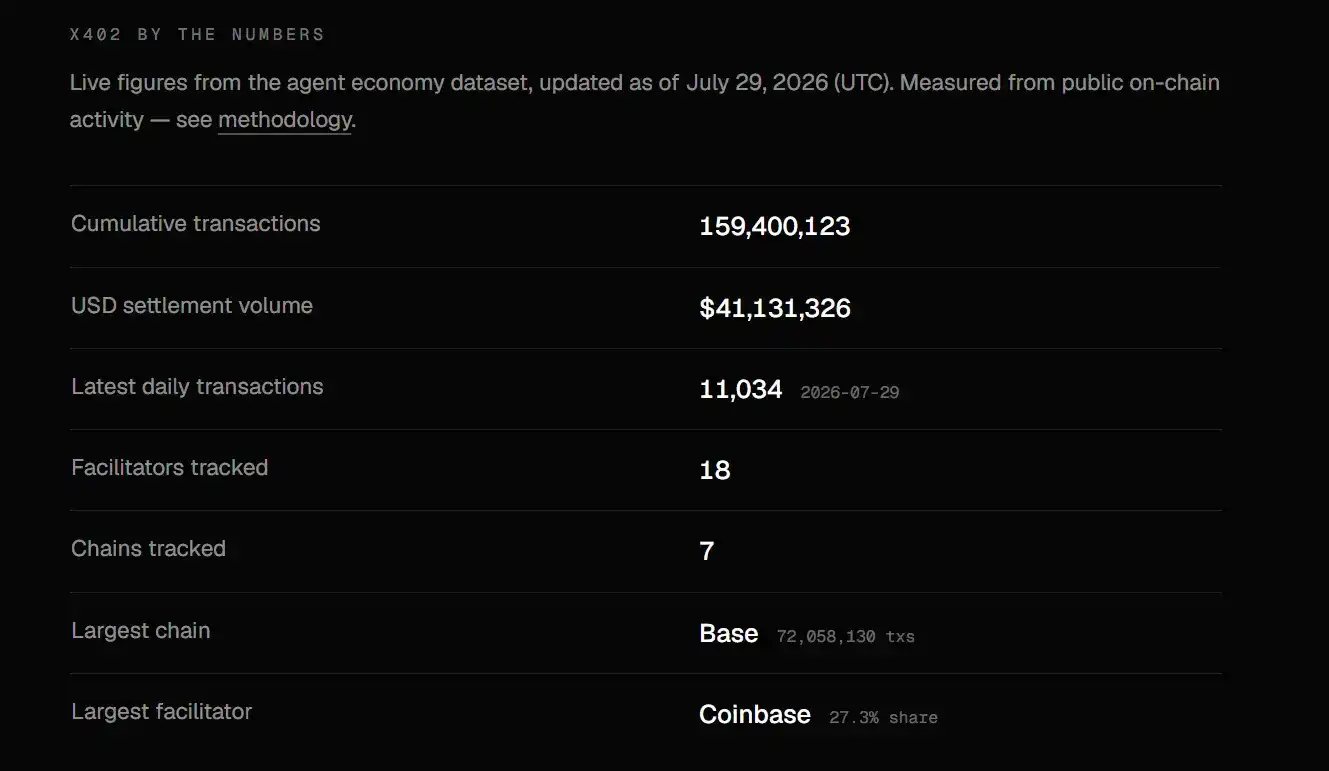
On the product side, agentic finance is still early. Public data cited from sources including agenteconomy.to shows x402 with about $159 million in cumulative transaction count, but only about $40 million to $50 million in cumulative transaction value. The report added that a meaningful share of early traffic came from meme-related testing and speculative activity, leaving a gap between the commercial narrative and actual business scale.
With trading volumes under pressure, major regulatory fights partly resolved, and AI capabilities rising quickly, Coinbase appears to be trying to reduce its dependence on a single crypto trading cycle. The company is widening its asset coverage, trying to raise operating efficiency, and positioning for payment and trading demand that could come from AI agents.
The leadership reshuffle addresses priorities and strategic focus. The harder question comes next: whether this mix can produce results during a weaker part of the cycle.