
CoinW said on July 21, 2026 that it is upgrading its platform token from CWT to CoinW Coin, or CWC, and presenting the new token as a utility asset for its ecosystem as well as a privileges layer for advanced Agentic trading features.
In the TechFlow piece, the move is not framed as a standalone token refresh. It is presented as CoinW’s answer to a larger shift in how centralized exchanges compete, where asset coverage is broadening, trading participants are changing, and a trading venue is no longer expected to function only as a place for spot or derivatives execution.
The article opens with CoinW’s recent brand activity. During the summer of 2026, after the World Cup, CoinW’s global brand ambassador Luka Modrić remained in focus, and the company also announced a partnership with UFC star Conor McGregor. TechFlow uses the contrast between the two athletes to describe CoinW’s current direction: Modrić is tied to control, coordination, and field-wide awareness, while McGregor represents boundary-pushing, active reinvention, and constant adaptation under pressure.
The old CEX playbook is under strain
According to the article, CoinW’s jump from CWT to CWC is rooted in a deeper change in the structure of exchange competition.
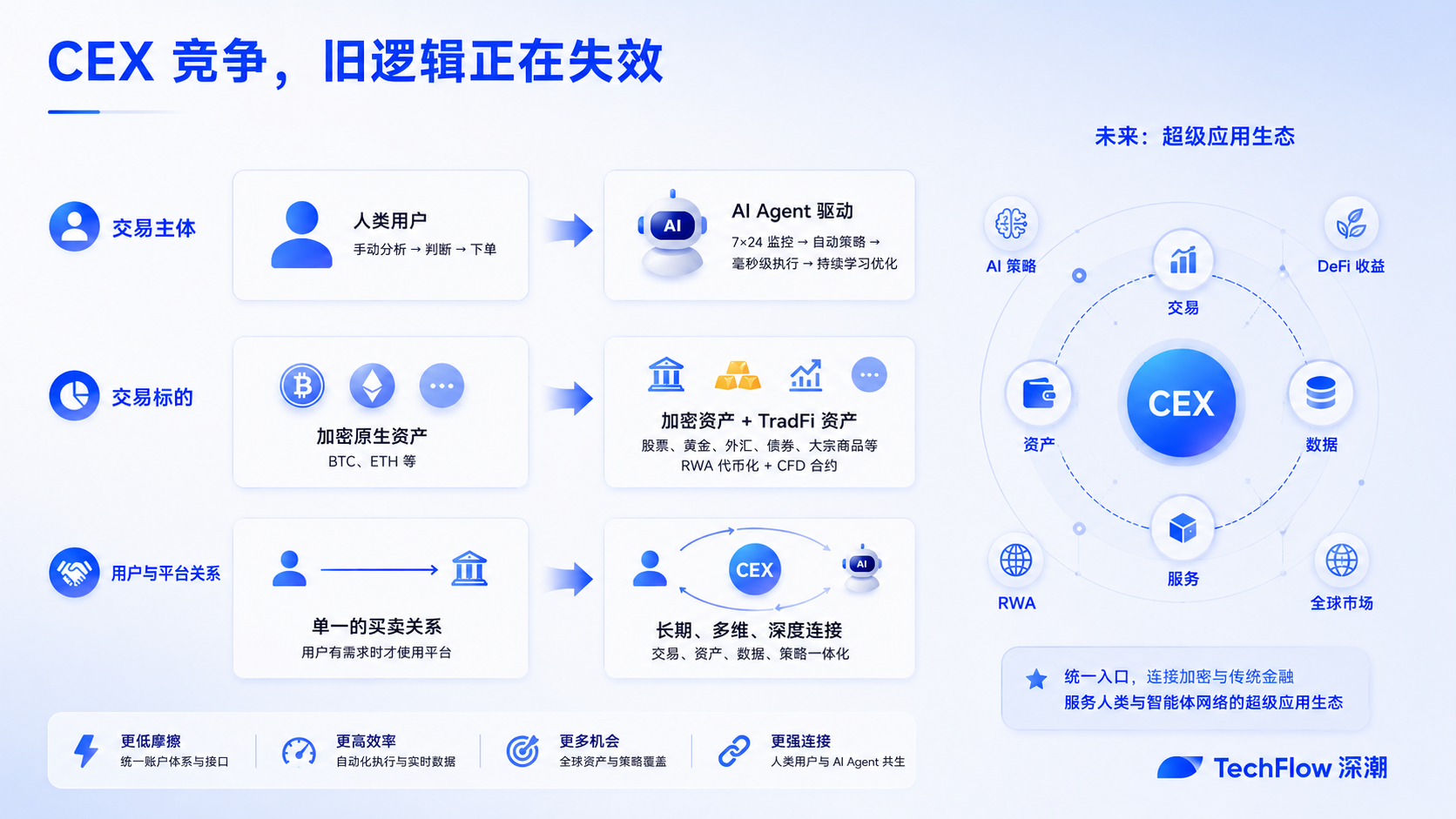
For much of the past decade, that structure was straightforward. Humans were the main traders. Crypto-native assets were the main products. The relationship between users and exchanges was largely transactional, centered on buying and selling. TechFlow argues that all three pillars are now loosening at the same time.
The first shift is in trading participants. Instead of relying only on charts, data dashboards, and manual decision-making, AI systems can now monitor market signals around the clock, generate strategies automatically, complete decision chains at millisecond speed, and continue adjusting as conditions change. If agents become major execution entities, the article says, exchanges will need to provide strategy infrastructure, high-quality data interfaces, and low-friction automation environments built for machine-driven trading.
The second shift is in tradable assets. TechFlow says the RWA process is accelerating, with stocks, gold, foreign exchange, bonds, and commodities moving on-chain in tokenized form and extending into CFD-based trading. Once an exchange supports crypto trading, global RWA allocation, AI strategy deployment, and DeFi yield management together, it stops being just a venue users open when they want to trade. It starts to resemble a broader financial operating layer for digital activity.
The third shift is in the relationship between users and platforms. The article says users do not want to move between multiple interfaces to manage assets. Institutions do not want to maintain several account systems for different strategies. Agents do not want fragmented interfaces for data access, execution, and position management. In that setting, TechFlow argues, the market is moving toward a single super entry point that can serve human users and agent networks at the same time while connecting crypto markets, traditional finance exposure, assets, data, and services inside one system.
CoinW’s path is described in three stages
TechFlow organizes CoinW’s last two years of work as a three-stage evolution toward what it calls a “crypto super app.”
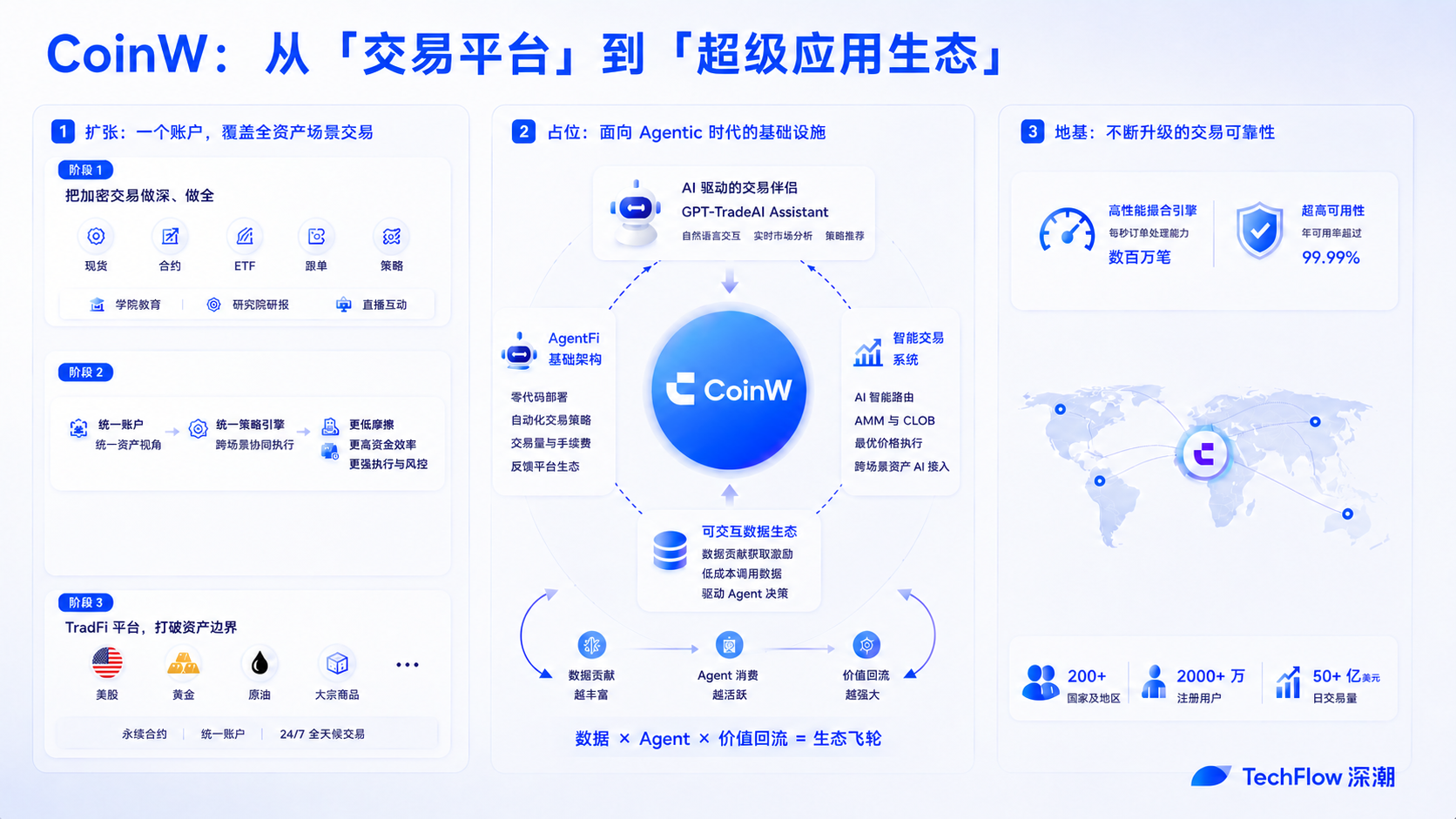
The first stage was depth inside crypto trading itself. After several years of iteration, the article says CoinW built a product line spanning spot, futures, ETFs, copy trading, and strategy trading. It also added educational courses, research output, and livestream interaction to deepen engagement with users. In this phase, the focus was broad coverage and service reliability for crypto-native trading.
That product expansion created a new issue. More systems also meant more fragmentation in assets, strategies, and user experience. TechFlow says this led CoinW into a second stage centered on one account and wider access to assets and strategies.
In September 2025, CoinW carried out what the article calls a full-stack ecosystem integration upgrade. With the centralized exchange as the core entry point, the company invested across several segments: on-chain Alpha trading and early asset discovery, decentralized derivatives infrastructure, and a prop trading platform aimed at professional strategy traders. The decentralized derivatives side included zero-Gas perpetual contracts, transparent on-chain matching, and high-yield liquidity pools. The prop trading side included simulated capital challenges and high profit-sharing ratios. TechFlow says all of those pieces were connected through the same account system and the same strategy engine.
That mattered because a unified account creates a unified asset view, while a unified strategy engine makes cross-scenario execution possible. After the integration, the article says, users no longer needed to split funds or switch accounts across multiple platforms. The result was lower friction, better capital efficiency, stronger strategy execution, and more complete risk management. In TechFlow’s description, this was the point where CoinW moved beyond being a single exchange and became a linked multi-track ecosystem.
The third stage came with broader asset coverage. In June 2026, CoinW launched a TradFi platform that brought in U.S. stocks, gold, crude oil, and commodities through perpetual contracts, while keeping a unified account structure and 24/7 trading. At that point, the article says, users could make both crypto and TradFi allocations through the same entry point, giving CoinW what TechFlow sees as the asset framework needed for a broader super app model.
Infrastructure for the Agentic era
TechFlow argues that AI agent execution is moving from concept to practice much faster than many expected and is spreading quickly into financial trading. On the technical side, it says large models are already capable of handling complex financial reasoning tasks. On the market side, quantitative firms and hedge funds have deployed agents in high-frequency trading. As user-facing AI agent products mature, that capability is also moving from institutions to retail users.
That creates a different infrastructure requirement for exchanges. Past platform design assumed a human end user with emotional swings, cognitive limits, and a need for charts or interface-led decision support. Agents need something else: standardized data interfaces, low-latency execution channels, programmable strategy environments, and infrastructure that works smoothly in a human-machine collaborative framework.
In the article’s telling, CoinW’s answer has been to refit itself into infrastructure that AI can call more directly. Last year, the company launched GPT-TradeAI Assistant, described as an AI-driven trading companion with natural language interaction, real-time market analysis, and strategy recommendations.
TechFlow also says CoinW built AgentFi infrastructure so users can deploy automated trading strategies without having programming skills. Trading volume and fees generated by agents are described as feeding back into the platform ecosystem, creating a growth loop driven by both humans and machines.
The report adds that CoinW’s intelligent trading system is set to use AI for routing and strategy optimization, automatically routing between AMM and CLOB venues to secure optimal price execution and to support AI access across asset scenarios.
At the data layer, the article describes an interactive data ecosystem designed to address the raw material problem in agent decision-making. In this open on-chain data center, users can earn incentives by contributing data and can also call database information at low cost to drive agent decisions. TechFlow describes the model as a three-part loop of data contribution, agent consumption, and value flowing back into the ecosystem. Richer data improves agent decisions, and more active agents increase the value of the platform ecosystem.
Execution reliability remains the base layer
However broad the upper-layer vision becomes, the article says the foundation still comes down to reliability in trading infrastructure.
TechFlow cites two operating metrics for CoinW. Its matching engine can handle peak order throughput in the millions per second, and annual availability is above 99.99%. The article says those numbers are meaningful not simply as technology benchmarks but as indicators of whether the platform can keep execution smooth during periods of extreme market volatility.
It also points to the current scale of the platform. CoinW says it serves users in more than 200 countries and regions, has over 20 million registered users, and records daily trading volume above $5 billion. In the article’s framing, those figures suggest the ecosystem now has enough scale and user density to support the network effects needed for broader ecosystem coordination.
TechFlow ties those metrics back to CoinW’s wider arc: from crypto-native products to full-asset TradFi coverage, from fragmented user experience to a unified ecosystem, and from manual trading to Agentic trading, with AI placed at the center across DeFi, CeFi, and TradFi.
CWC is positioned as more than a fee discount token
The token upgrade is then placed in the context of how exchange tokens have evolved over time. TechFlow says most platform tokens began as single-purpose trading discount tools and later developed into rights-bearing assets across larger ecosystems. BNB, OKB, and BGB are cited as examples. In their early stages, they were used mainly for trading fee discounts, and then expanded into use cases such as Launchpad access, staking, governance, and DeFi services.
Once an exchange stretches toward a broader super app model, the article argues, the design of a token as a simple coupon stops being enough. That is why, in TechFlow’s reading, CoinW’s decision to turn its platform token into CWC is not cosmetic but structural. The ecosystem needs a value connector that can reach deeper into more complex layers of behavior and utility, including AI strategy use, data services, RWA investing, and cross-asset coordination.
The report breaks CWC’s utility into three layers.
The first layer is immediate return in high-frequency trading scenarios. Users who pay spot trading fees with CWC receive a 20% discount, and token holdings can directly offset 50% of the trading volume requirement for VIP level upgrades. The point of this design, the article says, is to push CWC into the exchange’s core trading activity so demand for its use remains active and recurring.
The second layer widens utility across service scenarios inside the ecosystem. TechFlow says higher-tier holders can receive dedicated margin protection quota for futures trading and extra compensation rights. CWC holders can also receive priority access when new features go live. In this phase, utility extends from one corner of the platform into broader ecosystem-level connectivity.
The third layer ties CWC directly to AI trading. As CoinW continues building AI trading infrastructure, the article says the token will be embedded into the value chain of human-machine collaboration. That includes fee benefits in AI trading scenarios and priority unlocking for CWC holders once AI wealth management products are launched.
Taken together, the article says, the three layers are aimed at the same goal: wherever users are inside an increasingly rich ecosystem, they should still be able to feel a concrete benefit from holding CWC. In that sense, the token upgrade is portrayed as CoinW’s way of redesigning how value circulates across a platform that no longer wants to be defined only as an exchange.
Wade: CWC is part of a next-generation crypto super app push
Later in the piece, TechFlow compares CWC with larger exchange tokens. It says CWC is still at an early stage relative to BNB’s billion-level scale. The article does not present that gap as surprising, noting that leading platform tokens also took years of ecosystem expansion to reach their current position. At the same time, it says the path created by CWC remains worth watching, not because it guarantees a replication of any prior market-cap trajectory, but because it offers a test case for whether a token designed to serve an entire super app ecosystem can build value differently from one designed only to support trading.
TechFlow also highlights the AI angle as a key point. It says CWC was conceived from the start with AI trading scenarios and Agentic ecosystem connectivity in mind, which in the article’s reading may place it ahead of many platforms in preparing for what comes next.
CoinW CEO Wade is quoted as saying: “We believe future financial services will become increasingly intelligent, automated, and personalized. CoinW is building not just a trading platform, but an open ecosystem that can serve global users and future intelligent agent networks. CWC is an important part of this ecosystem and a significant step in our move toward the next generation of crypto super apps.”
TechFlow’s closing argument
The article ends by returning to CoinW’s two global brand ambassadors. Modrić is used as a symbol of broad vision, tempo control, and coordination inside a complex system. McGregor stands for reinvention, change, and pushing through a new cycle. TechFlow says CoinW’s choice of ambassadors mirrors its own direction.
Its broader point is that once AI reshapes who trades, once the boundary between TradFi and crypto keeps thinning, and once users are looking for an integrated digital financial infrastructure rather than a stand-alone exchange, the platforms most likely to matter will be the ones that can combine assets, data, AI capability, and user networks into a coordinated ecosystem.
Within that framework, the article treats the CWT-to-CWC upgrade as CoinW’s active bet on the start of the Agentic trading era. It closes without claiming the outcome is settled, but it presents the move as one more step in CoinW’s attempt to be recognized not only as an exchange, but as a crypto super app in its own right.
The disclaimer in the article says the content is for information only and does not constitute investment, financial, legal, or tax advice, nor an offer or solicitation to buy, sell, or hold any token or financial product. Digital asset and derivatives trading carry high risk and may lead to the total loss of principal. Functions, benefits, and related arrangements for tokens including CWC are subject to the platform’s official rules and may change at any time. The products and services described may also be unavailable or restricted in some countries or regions, and users are responsible for understanding and complying with local laws before participating.