

China’s commercial space stocks swung from euphoria to heavy selling within days, even after Long March 10B delivered a major technical milestone.
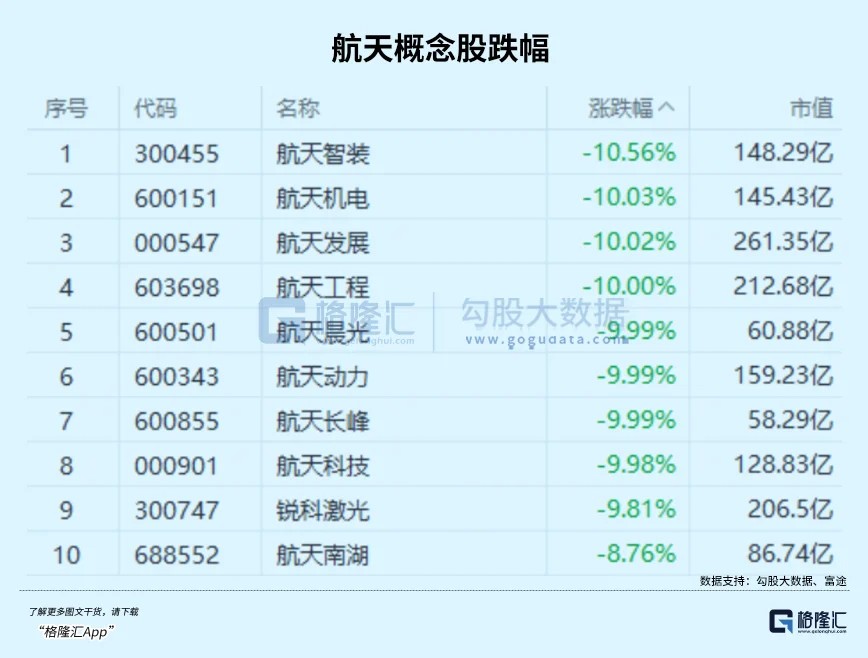
On July 13, the sector surged and then reversed, ending in a broad sell-off. The source article said Dianke Lantian fell more than 10%, while Aerospace Power, Sunway Communication and Tongyu Communication also moved lower. The Shenzhen Component Index and ChiNext Index both dropped more than 2% as money rotated back into AI names that had been market favorites earlier.
That reversal came right after the July 10 success of Long March 10B’s maiden flight and what the article described as the world’s first rocket net-based recovery. More than 30 stocks in the segment hit their daily limit, and China Spacesat and China Satcom, both trillion-yuan-class names by market value in the article’s framing, were pinned at limit-up.
A limit-up frenzy on Friday was followed by aggressive selling on Monday. The article asks what changed so fast.
Who is setting prices in the sector
The piece argues that this latest cycle of sharp selling, sharp gains and another pullback was driven less by the headline itself than by the structure of capital behind the trade.
According to the article, Long March 10B lifted off from the Hainan commercial launch site at 12:15 p.m. on July 10. The rocket was 63 meters long and had liftoff thrust of 890 tons. About six minutes after stage separation, the first stage returned vertically and was caught by a flexible blocking net on the recovery platform Navigator. The article says this marked China’s first controlled recovery of the first stage of a heavy-lift rocket and the world’s first net-based recovery, making China the second country after the United States to master the technology.
Even so, the market’s attention quickly shifted to quant trading.
Citing Securities Times, the article says public mutual funds and social security capital have long been underweight or even absent in commercial space. It notes that in names such as Sirui New Materials and Information Development, both up more than 100%, no public funds appeared among the top 10 tradable shareholders. Aerospace Power and Aerospace Development had some institutional participation, but total holdings were still limited.
In the article’s reading, that means institutional investors have not built a broad, systematic overweight position in the sector. Capital remains scattered. Without a long-term base of holdings, the group behaves like an unanchored trade: money crowds in on the way up, then disappears on the way down.
The article also says quant funds account for 20% to 30% of A-share turnover. In sectors without institutional core positions, that influence can be magnified. Its argument is that quant strategies are built around volatility arbitrage. A limit-up rally and a smash lower can be two sides of the same setup. When a hot theme appears, algorithms can push prices up before retail buyers join. Once retail flows arrive, the strategy flips and sells into them.
The article says the mechanism has worked especially smoothly in commercial space because there are not enough long-term counterparties to absorb selling pressure. In its wording, a sector where public funds are largely absent becomes one of the easiest places for violent reshuffling.
Aerospace Development is used as an example. On July 10, its Dragon Tiger list showed Shenzhen-Hong Kong Stock Connect, institutions and speculative trading desks in the top five buyers, while the fifth-largest seller was East Money’s Lhasa Tuanjie Road First branch. Institutions recorded net buying of RMB 85.71 million that day, while so-called Lhasa retail money posted net selling of RMB 18.06 million. The article adds that the stock has appeared on the list eight times in the past six months, and its average five-day decline after appearing was 10.66%. By that measure, money entering on a limit-up day lost more than 10% on average within five days.
The point, the article says, is not one stock but an entire sector that lacks long-term anchors and is repeatedly cut up by algorithmic trading rhythms.
That secondary-market instability stands in contrast to what the article describes as continued conviction in the primary market.
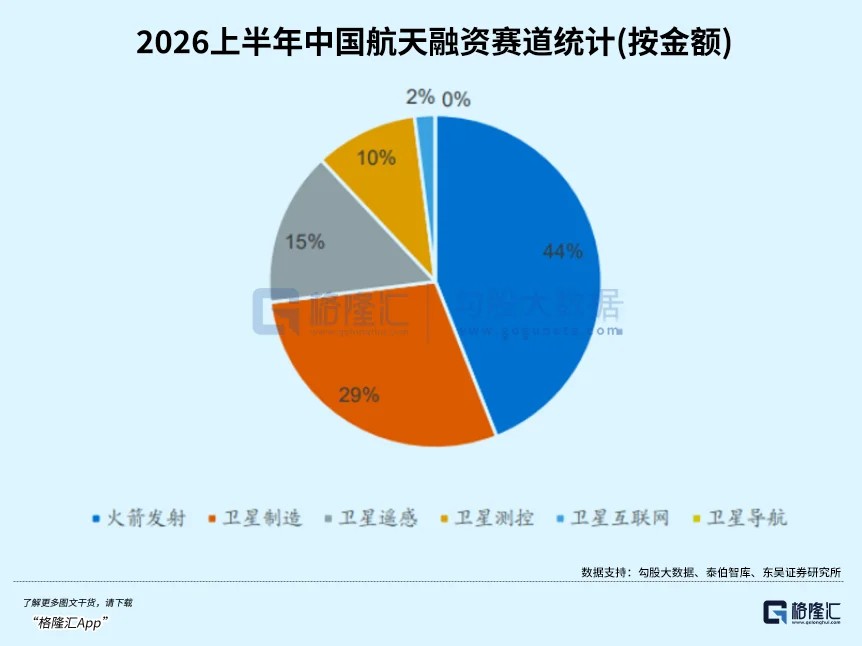
According to Taibo Think Tank, China’s commercial space industry disclosed 89 financing events in the first half of 2026, with total funding of RMB 15.13 billion. Rocket launch businesses accounted for 44% of that amount, making them the largest single destination for capital. The article says state and local guidance funds have become the main source of patient capital and that the sector is shifting from spontaneous exploration to nationally guided development.
It then points to SpaceX as the clearest example of a different valuation logic. The article says the company’s market value reached $1.77 trillion after its listing this year, while its 2025 net loss was $4.94 billion. In that framework, long-duration capital is pricing the future of the space economy rather than near-term earnings. The article cites a RMB 2.83 trillion market size estimate from CCID Think Tank, demand certainty for launching more than 10,000 satellites within five years and the first-come, first-served nature of orbital resources.
That is why, in the article’s view, primary-market investors can tolerate large losses if a company keeps advancing on reusability, user scale or orbital occupation. Secondary markets, by contrast, are still dominated by retail flows and quant models, which can drown out the industry’s real progress in short-term price action.
Three waves over the past two years
The article says the picture changes when the time frame is extended beyond a single trading day. Over the past two years, China’s commercial space sector has already gone through several distinct rallies.
The first wave came in early 2025. China submitted applications to the International Telecommunication Union for frequencies and orbital resources covering 203,000 satellites across 14 constellations. The article says China had never filed at that scale before. The market responded by trading the idea of a “China version of SpaceX.” China Spacesat’s price-to-earnings ratio climbed to 2,400 times, and China Satcom later warned in its own filing that a “pass-the-parcel effect” was very obvious. The article says the deeper significance was not the size of the rally, but that it pushed the idea of space as a scarce resource into the market’s collective pricing logic.
The second wave arrived in late 2025. The National Space Administration created a commercial space department, described in the article as the first national-level dedicated regulator for the field. The fifth listing standard on the STAR Market was also introduced, clearing financing obstacles for unprofitable rocket companies. LandSpace moved toward what was framed as the first A-share listing by a commercial space company. The driver had shifted from concept speculation to policy support.
But recovery tests for Zhuque-3 and Long March 12A failed, and because the technology was still unproven, the rally lost momentum.
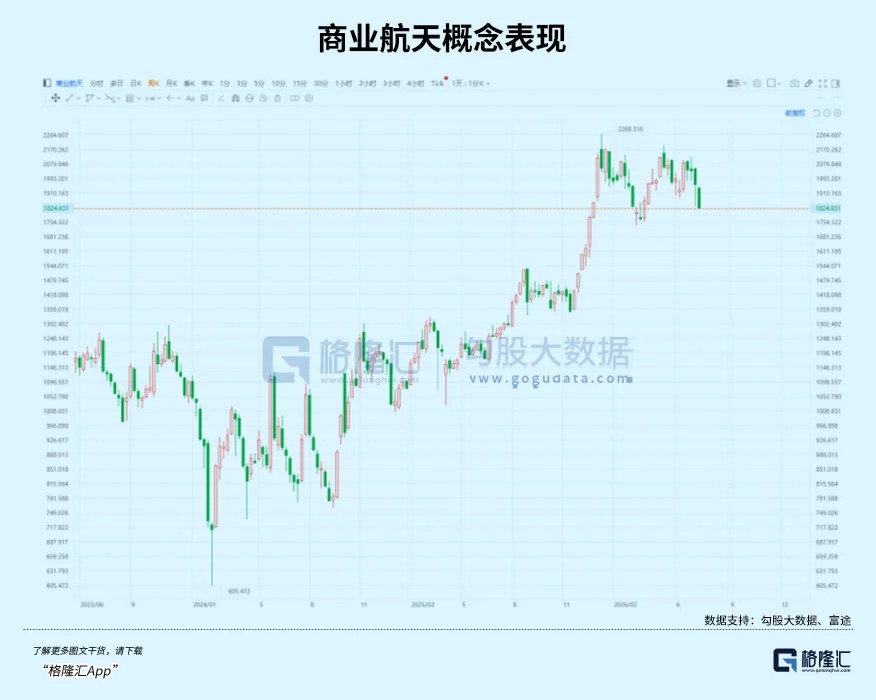
The third wave came in the spring of 2026. Reusable rockets entered a dense testing window. Zhuque-3 Yao-2 completed a static fire, Lijian-2 succeeded on its maiden flight, and Long March 10B had originally been scheduled for a first launch in April. At the same time, first-quarter earnings exposed the industry’s profit structure more clearly than before: upstream suppliers were making strong money while downstream businesses were deeply loss-making. By then, the driver had shifted again, from policy to technical validation.
That rally also ran into trouble after Tianlong-3 suffered a flight anomaly after ignition and lift-off, with its first launch ending in failure. The article says the April 3 explosion brought the market back down to earth.
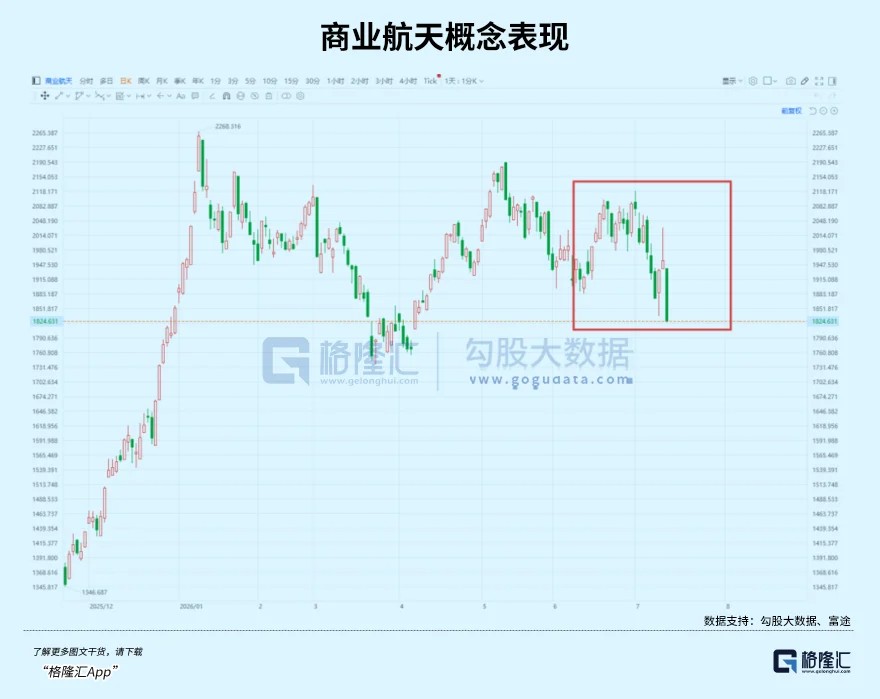
Before the latest rebound, the commercial space sector had already fallen 8% across the previous three trading sessions, with Shenjian Co. hitting limit-down and multiple names dropping more than 10%. Then came the July 10 launch from Hainan, which the article says completed the full loop of orbital insertion plus controlled recovery and made China the second country after the US to master heavy-lift reusable rocket technology.
The article stops short of saying a new rally is definitively under way. What it does say is that the sequence of sector drivers has become clear: concept, then policy, then technical validation.
A valuation framework under pressure
In the article’s telling, market pricing power has been running on a separate track. The first wave was led by speculative trading desks, the second by a resonance between those desks and retail investors, and the latest rounds have shown a much heavier quant influence.
The author argues that this gap cannot last forever because the industrial logic is becoming easier to express in straightforward arithmetic.
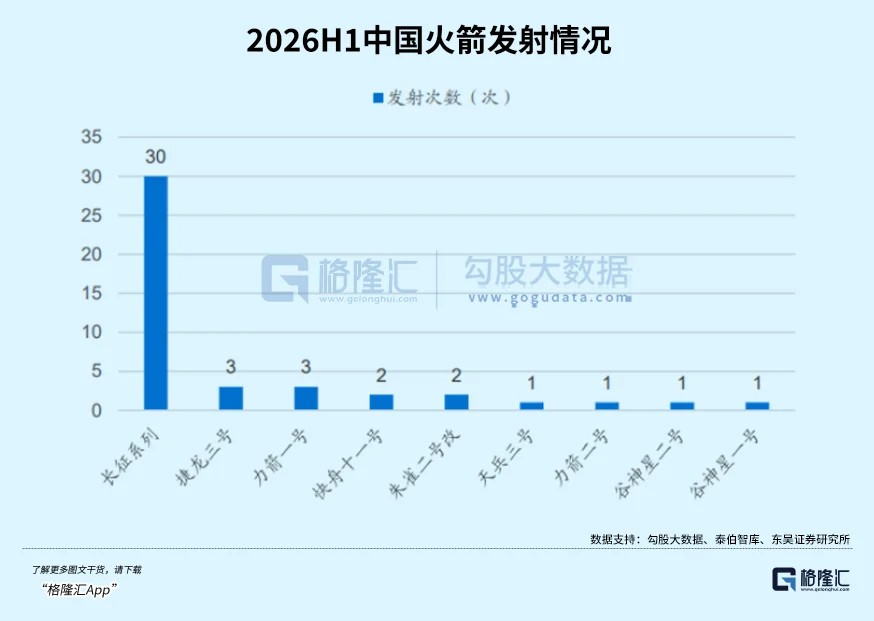
Take reusability. The article says the first-stage body accounts for more than 70% of a rocket’s cost. Recovering it means saving that portion of manufacturing expense. It says SpaceX’s Falcon 9, through 34 reuses, has pushed launch cost to orbit down to RMB 19,000 to RMB 28,000 per kilogram. Domestic launch quotes now stand at RMB 50,000 to RMB 100,000 per kilogram. LandSpace’s target for Zhuque-3 is below RMB 20,000 per kilogram. If reusability truly matures, industry estimates in the article put the eventual figure below RMB 1,000 per kilogram.
The supply-demand mismatch behind that is also simple. The GW constellation plans for 12,992 satellites. The Qianfan constellation plans for 13,904 plus 1,296 more. Combined planning exceeds 50,000 satellites. Against that, the country has only 18 commercial launch pads in operation, with another seven under construction. The article says the average wait is one month. Too many satellites and too few rockets turns launch capacity into a strategic resource.
It cites Yuanhe Chenkun’s report on low-earth-orbit satellite internet, which ranks investment priority in this order: complete rockets first, then satellite operators, then complete satellites, then satellite components. The logic is that whoever cracks recovery first and pushes down cost will control the master valve of the constellation market. The article says the private rocket field may ultimately support only two or three leading players.
The second half of the year will bring a concentrated stress test for that thesis.
The article lists several milestones. A successful recovery test for Zhuque-3 Yao-2 would make it the first liquid rocket from a private company to achieve orbital-class recovery. Zhishenxing-1 is nearing its maiden flight. Tianlong-3 is set to fly again in the second half after its April failure. Before year-end, Long March 10B is expected to attempt its first reused flight, moving from “recoverable” to “reusable.” The article says that step is no easier than the first launch itself.
Capital markets are accelerating in parallel. With SpaceX at a reported $1.77 trillion valuation after listing, the article says a reference line now exists for global commercial space. LandSpace’s STAR Market IPO has advanced to the inquiry stage, and CAS Space is moving behind it. Those Chinese rocket companies, once public, will face their first real test under open-market valuation.
Earnings are another checkpoint. On July 12, China Spacesat released a first-half profit forecast of RMB 30.5 million to RMB 36.5 million, returning to profit year over year. The article notes the contrast: a leading satellite manufacturer with a market value in the hundreds of billions of yuan range is generating just over RMB 30 million in half-year profit.
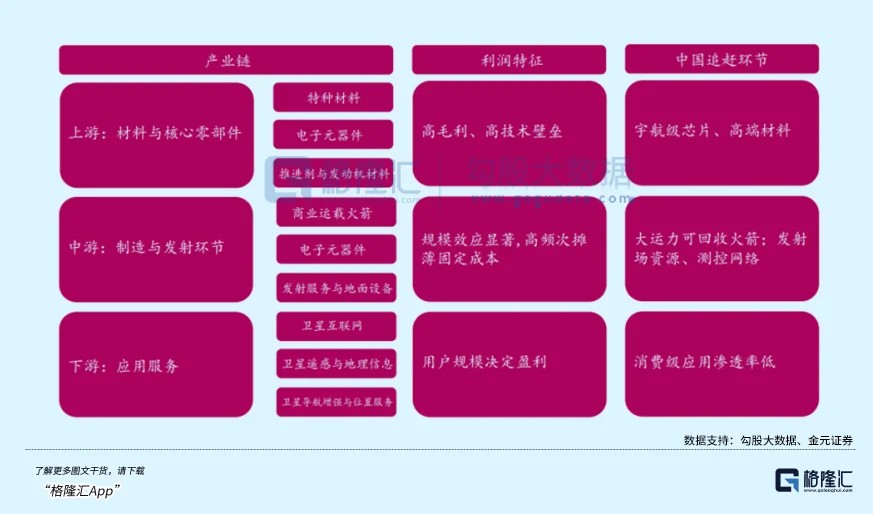
Upstream and downstream numbers look very different. Zhenlei Technology posted more than RMB 400 million in revenue in the first quarter, with a 31% profit margin. BLT’s first-quarter revenue rose 40.5% and net profit doubled. Downstream company Piesat saw first-quarter revenue plunge 86% and has already become *ST, according to the article.
Each of those catalysts matters in sequence: successful rocket validation, IPO progress, reused flights, large orders and earnings delivery. Together, they will shape both the strength of the industrial thesis and the timing of any shift in pricing power.
Industrial progress and market recognition are not on the same clock
The article ends with a simple distinction. Rockets lifting off and capital moving in do not happen on the same countdown.
It describes Long March 10B’s successful recovery as a historic breakthrough for China’s commercial space industry. The critical barrier for reusable technology has been crossed, and the path to lower launch costs is now visible. From an industry standpoint, that is a clear positive.
But a positive industry signal does not guarantee immediate market recognition. The article says it remains unclear whether capital has fully accepted that the sector has reached an inflection point. Volatility is still extreme. A Friday limit-up followed by a Monday plunge shows that quant-led pricing has not gone away. The profit split between profitable upstream suppliers and loss-making downstream companies has not narrowed either.
Its closing point is that investors looking at the commercial space trade need to recognize the distance that still separates an industrial inflection point from a pricing inflection point.