
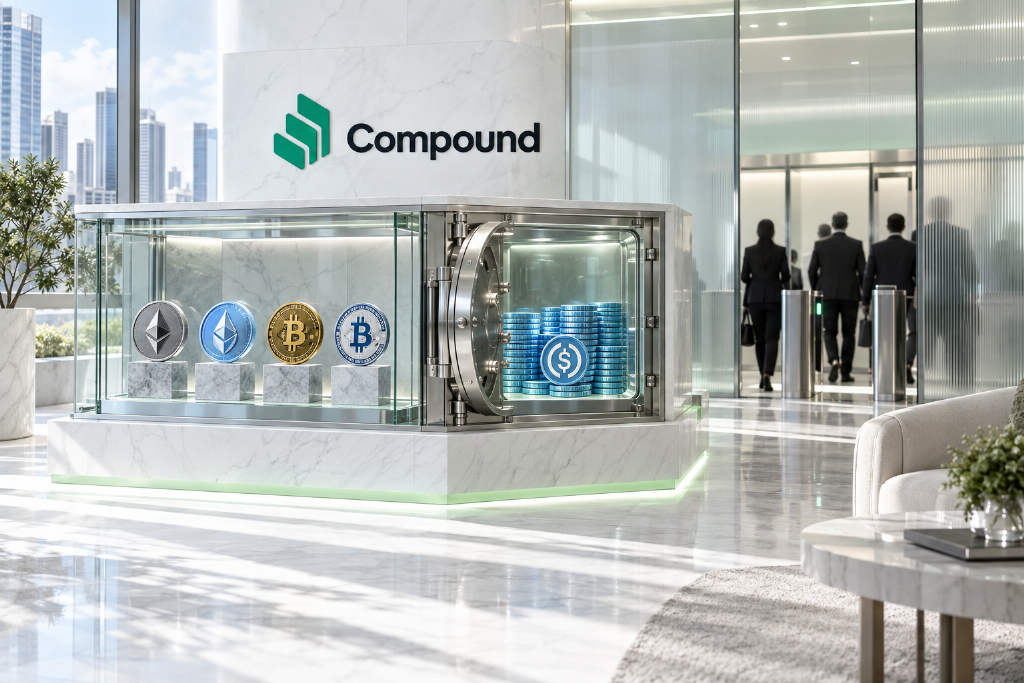
Compound Foundation has opened a lending market that only institutions can access, three weeks after relaunching the protocol around institutional credit.
The new Institutional Market splits Compound’s liquidity into two tracks. Whitelisted borrowers get a separate collateral set, their own loan-to-value ratios, and a named point of contact, ending the setup where a fund and a retail wallet borrow under the same parameters.
The launch is also the first product to go live under the $52 million program approved by Compound DAO in August, although most of that funding has not yet been transferred to the Foundation.
How the institutional market is structured
The market runs on Compound v3 and lends USDC against ETH, wstETH, WBTC, and cbBTC.
Compound has $1.53 billion in total value locked, with $638 million borrowed against it. The protocol ranks sixth among lending protocols on DefiLlama and is up 23% over the past 30 days. Ethereum accounts for $1.42 billion of that total, or 93%.
COMP trades at $20.88, up 9% over seven days, giving it a market capitalization of $212 million.
Aaron Schnarch, executive director of Compound Foundation, said: 「With today’s Institutional Market launch, we are taking the first step toward building infrastructure to meet institutional client demands, including better capital efficiency, clearly defined risk, and a much higher standard of service. We are encouraged by the market demand, and look forward to launching additional capabilities over the coming months.」
Launch day demand exceeded available allocation
Compound said the market was oversubscribed on its first day. DeFi Saver, K3/Nexo, KPK, and Yearn participated, though the company did not provide a figure for total subscriptions.
Marcelo Ruiz de Olano, co-founder and CEO of KPK, said: 「Compound is combining the capital efficiency of onchain markets with the level of service institutional participants expect. The ability to access more efficient borrowing while working directly with a team that understands institutional requirements makes this a compelling new market for us.」
Four collateral assets, one borrowing asset
The collateral list is short and liquid, covering two forms of ether and two forms of wrapped bitcoin.
Compound’s case is that a market holding only those four assets can support higher loan-to-value ratios than one that also has to price long-tail assets, with lenders capturing better economics as a result.
Eligibility starts at 100,000 USDC in deposits. Compound has also allocated 200,000 USDC in supplier incentives, to be distributed pro rata to whitelisted participants over three months, against a $20 million supply cap.
On Compound’s access page, ETH carries an 87% loan-to-value ratio, wstETH 85%, and WBTC and cbBTC 81%, with a $10 million borrow cap on each asset.
Liquidation thresholds, reserve factors, and whitelisting criteria have not been published. The release directs institutions to a request-access form.
The Foundation has described the product to delegates as an Institutional Comet built under v3.5, outside the V4 roadmap funded by the DAO, and intended to test an institutional use case.
Compound also says v3 has operated for four years without an exploit. That claim is presented as the company’s own statement.
Most of the $52 million budget remains in reserve
The Foundation relaunched on Aug. 17 with a $52 million budget and four hires from Coinbase, Anchorage, NEAR, and Maple.
Schnarch previously served as chief operating officer of Anchorage Digital and chief executive of Coinbase Custody.
The two-year budget allocates $28 million to operations and $24 million to growth. So far, only $14 million has been transferred to the Foundation’s multisig, while the other $38 million remains in reserve pending milestones that include a staffed engineering team and a production v3 integration kit.
Shipping an institutional product three weeks after the relaunch marks the first milestone completed in public. Whether the remaining $38 million is released will be decided by the DAO, not the Foundation.
Where Compound stands in lending
In its standard protocol description, Compound says it has handled approximately $480 billion in deposits and borrowing volume since 2018.
Within the lending sector, Aave stands at $17.5 billion and Morpho Blue at $9.6 billion. The category as a whole holds $50.2 billion across 639 protocols, with Compound accounting for 3.1% of the total.
Compound helped define the onchain lending model in 2018, but now holds less than one-tenth of Aave’s deposits. The institutional market is its attempt to regain scale through terms and service, rather than competing on rates alone.
Compound said this market is the first in a planned series built around different collateral types and borrower profiles.