
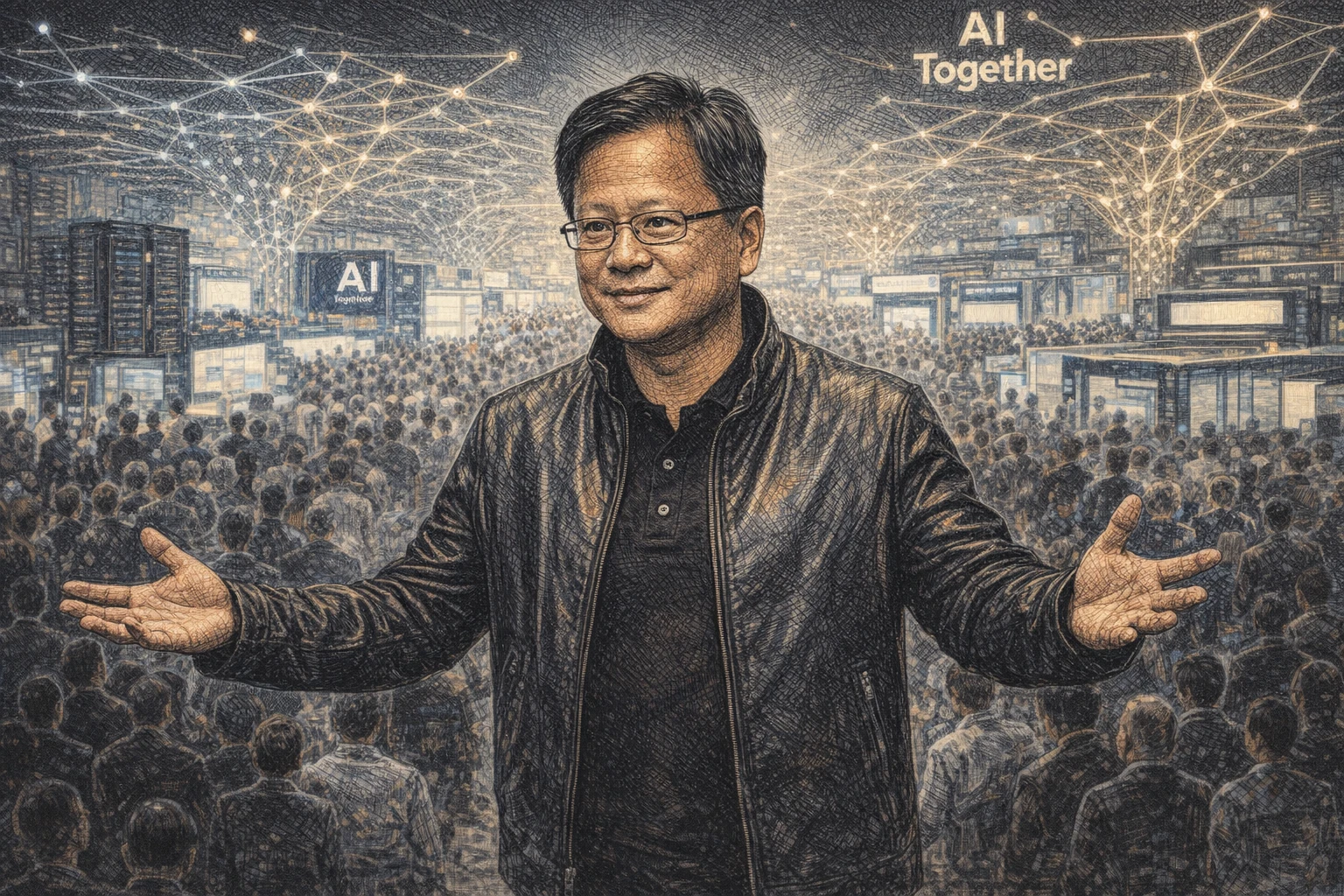
COMPUTEX 2026 will take place from June 2 to June 5, 2026 at Taipei Nangang Exhibition Center (TaiNEX 1 & 2), with additional venues at TWTC Hall 1 and TICC. Themed “AI Together,” this edition boasts 1,500 exhibitors from 33 countries and over 6,000 booths, making it the largest in the show’s history. NVIDIA CEO Jensen Huang will deliver the GTC Taipei keynote on June 1, one day before the exhibition opens.
Jensen Huang’s GTC Taipei: Vera Rubin & Robotics Roadmap
Huang’s speech at Taipei Music Center will focus on NVIDIA’s latest AI infrastructure blueprint, including the Vera Rubin architecture and advancements in robotics platforms. The event will be live-streamed. For cloud providers, ODM manufacturers, and Taiwan stock investors, Huang’s remarks effectively shape the order direction for the next two quarters.
Confirmed CEO Keynote Schedule
Other top executives follow: June 1 afternoon – Qualcomm CEO Cristiano Amon; June 2 morning – Marvell CEO Matt Murphy (with Jensen Huang), afternoon – Intel CEO Lip-Bu Tan; June 3 morning – NXP CEO Rafael Sotomayor. The COMPUTEX Forum runs concurrently at TICC, covering robotics, generative AI, data security, with 30+ speakers from NVIDIA, Microsoft, Google DeepMind.
Five Technology Pillars: From Liquid-Cooled Racks to AI PC
1. AI Servers & Rack-Scale Supercomputing: NVIDIA showcases the Vera Rubin NVL72, integrating 72 Rubin GPUs and 36 Vera CPUs into a liquid-cooled rack. Hon Hai is the main compute tray manufacturer. AMD counters with its Helios rack solution.
2. Liquid Cooling: As GPU power density rises, traditional air cooling hits limits. Compal, Hon Hai, and other ODMs highlight liquid cooling systems and CPO (Co-Packaged Optics).
3. Humanoid Robots: NVIDIA’s Jetson Thor platform, based on Blackwell, delivers 2,070 FP4 TFLOPS, enabling onboard AI processing without cloud dependency. Hon Hai and Pegatron display robotic solutions.
4. AI PC: Local inference eliminates cloud latency and enhances data privacy. Qualcomm Snapdragon X, Intel Core Ultra, and AMD mobile platforms compete for dominance.
5. High-Speed Networking (CPO): Inter-GPU bandwidth often bottlenecks AI clusters. Marvell leads in CPO, and Jensen Huang’s joint appearance with its CEO underscores the strategic importance of optical connectivity.
Taiwan AI Supply Chain: Analyst Observations
Top three ODMs: Hon Hai ~44% market share (3,700 racks), Quanta ~2,100 racks, Wistron ~1,300-1,400 racks. Analysts believe share prices have not fully priced in order visibility. Other mentioned names include TSMC, Gigabyte, Wiwynn, cooling-related firms, and Kinsus. This is market observation, not investment advice.
Visitor Guide: Professional & Public Access
Professionals (June 2-4): Free online pre-registration required. One badge grants access to both TaiNEX and InnoVEX. Must be 18+.Public (June 5 only): Ticket purchase required, 18+ only. TaiNEX closes at 15:30, TWTC at 16:30. Arrive early; prioritize robot and liquid-cooling exhibits. Metro: Nangang Exhibition Center Station (Bannan/Wenhu lines).