Consumer RWA moves beyond financial assets
As tokenization expands from Treasuries and funds into coffee, tea, creative goods, tickets and membership benefits, the central question is no longer whether the market has found another investment category. It is how producers, brands, platforms and consumers can form a complete value loop, and where consumer real-world assets sit in relation to e-commerce, loyalty programs and digital collectibles.
Tokenization has long been dominated by financial assets such as U.S. Treasuries, money-market funds and private credit. Data from rwa.xyz shows that, as of 2026, on-chain tokenized real-world assets excluding stablecoins had reached roughly $33 billion to $39 billion, nearly doubling over one year. Financial assets still account for most of that market. A separate track is now taking shape around the tokenization of coffee, tea, creative products, tickets and membership rights. This is commonly described as consumer RWA.
Consumer RWA is often mistaken for another investment product or reduced to putting loyalty points on a blockchain. Earlier discussions in the series examined its research position and four core rights: rights to the product, redemption, use and participation. The more practical issue is how those rights differ from existing commercial systems and how the participants can make them enforceable throughout their lifecycle.
The right behind the token matters
Two tokens can be issued through the same blockchain while creating entirely different legal and commercial relationships. Suppose a coffee chain needs upfront capital to expand. It could tokenize the future income of its coffee machines and let holders share in financial returns. Or it could issue certificates that consumers pay for in advance and later redeem for coffee. Both structures give the brand money before delivery, but the rights attached to the certificates and the issuer’s obligations are fundamentally different.
The first is an investment relationship. The second is a fulfillment relationship. The test is not the technology used. It is what right the certificate represents, what obligation the issuer accepts and what relationship the two sides have established.
Accounting treatment offers a supporting distinction. Under International Financial Reporting Standard 15, advance payments from consumers are generally recognized as contract liabilities before the relevant goods or services are delivered. In substance, the issuer has a performance obligation rather than a financial liability.
This is not a semantic exercise. In 2026, the word tokenization still carries a strong financial association. If a consumer project adopts a narrative centered on scarcity, appreciation and rush buying, it can turn a redemption certificate into something presented like a yield product. That may distort the legal character of the consumer good and invite questions about whether the product has securities characteristics. The first dividing line for consumer RWA is whether it digitizes a consumer right or wraps a speculative instrument in a consumer-facing design.
How the four-party value loop works
Consumer RWA requires four parties to work together. Producers supply product and batch data. Brands define the value proposition and the rights attached to it. Platforms register, verify, transfer and redeem those rights. Consumers claim, use and provide feedback on them. A loop is complete only when every participant has a clear input and a verifiable output: the producer provides deliverable inventory, the brand provides ongoing service, the platform provides status records and logs, and the consumer provides a real demand signal.
Consider a generalized specialty coffee example. A brand plans to issue 500 redemption rights. Before launch, a review finds that only 480 units can be locked as available inventory, while the remaining 20 depend on replenishment. The brand can issue 480 first or wait until all 500 units are available. If it issues 480, the cap must be adjusted at the same time. If it still issues 500, the 20 units that have not entered inventory cannot be displayed as available for redemption.
No complex technical problem is involved. The question is whether the facts match the responsibility being presented to consumers. That is where a value loop matters: it lets a brand see the real limit of its supply capacity before expanding its promotion.
A sound project should be able to draw a responsibility map:
- Who promises: the content and validity period of the right;
- Who proves: inventory, batch and inspection information;
- Who executes: delivery and service;
- Who records: status changes and operational logs;
- Who handles exceptions: support tickets and escalation procedures.
If two parties are both presented as the final owner of one action, or if an action has no owner, the loop is not complete. When an exception occurs, the break will surface in front of the consumer.
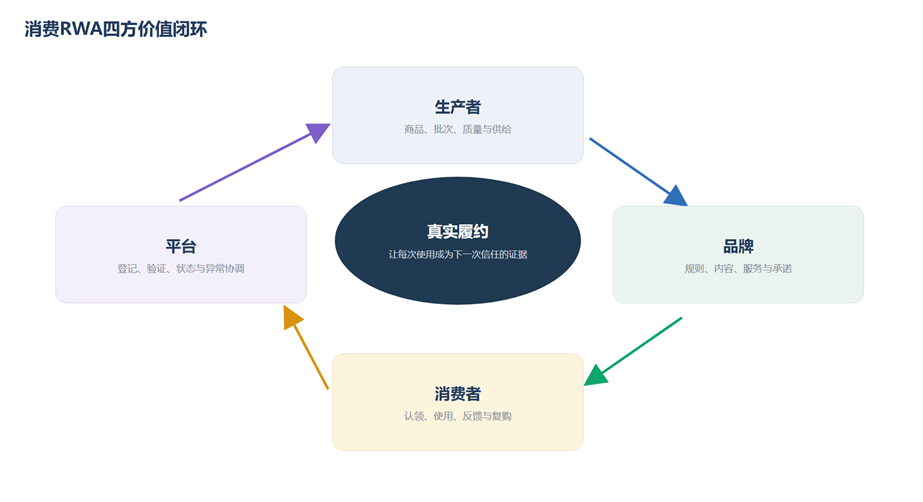
Five groups of metrics can be used to assess the loop. Data completeness reflects basic trustworthiness. The claim rate reflects whether users understand the product. Fulfillment completion and exception-closure rates reflect operational capability. Repeat purchases and participation reflect longer-term value. User judgment is usually formed during redemption, delivery and after-sales service rather than on the issuance page. Sales figures show market interest; redemption quality says more about project maturity.
AI can amplify both the value and the weaknesses of this structure. An agent can use claim speed to flag a need for replenishment, use historical redemption rates to forecast scheduling, and use support tickets to locate the stage where a problem occurred. But software can execute only responsibilities that have already been defined. It cannot decide who should carry an unresolved responsibility. If inventory, owners and exception rules have not been organized, automation will simply magnify the error faster.
Different systems, similar interfaces
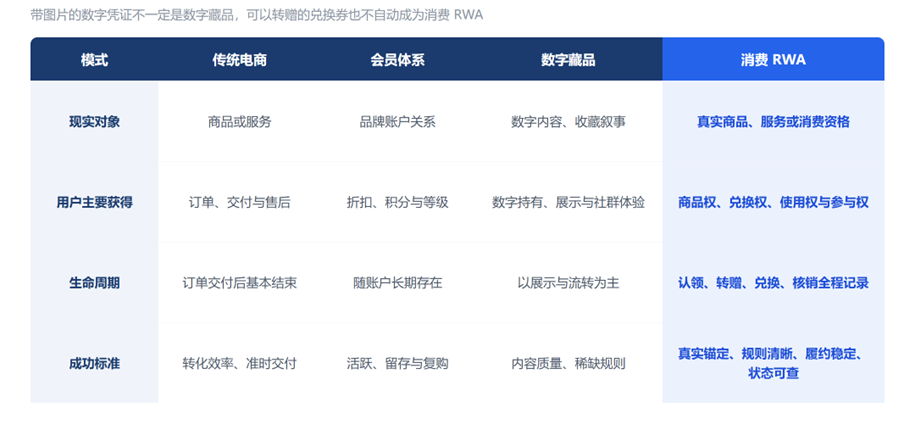
Consumer RWA is easy to misclassify because the interface can look like another business model. A digital certificate with an image is not automatically a collectible. A transferable coupon does not become consumer RWA merely because it can be sent to another person. Three questions matter: Is it anchored to a real product or service? Does it carry an enforceable right? Does its status continue to change throughout its lifecycle?
The four models have distinct jobs. E-commerce handles discovery, ordering and delivery, with transaction efficiency as its strength. Loyalty programs handle repeat purchases and tiered service, with account operations as their strength. Digital collectibles focus on the collection and display of digital content, together with community narratives. Consumer RWA puts the physical or real-world object, the right represented by the certificate and the fulfillment process into one lifecycle.
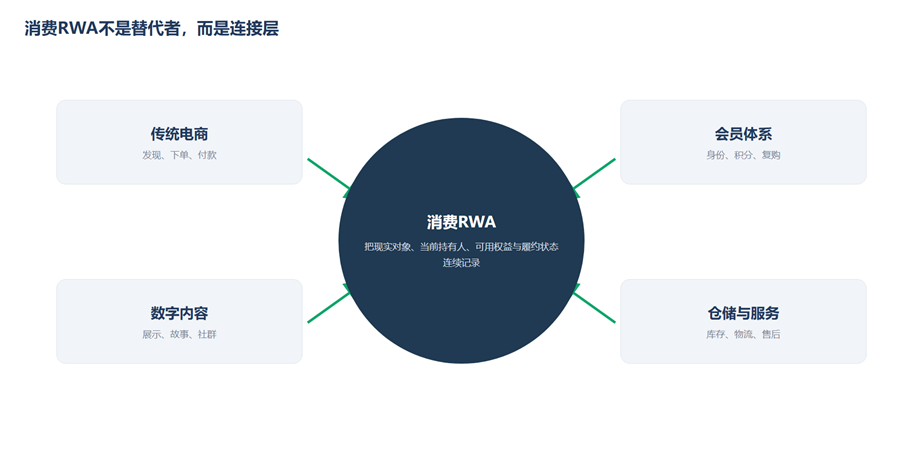
A single brand can operate all three systems at once. E-commerce can remain the buying and selling entrance. A loyalty program can manage long-term identity. Consumer RWA can maintain the continuous record of a specific right as it is claimed, transferred, redeemed and handled through after-sales service. These systems do not have to replace one another; they can be connected.
The difference is especially clear from the consumer’s side. After delivery, an e-commerce order mainly moves into an after-sales process. Loyalty points often have a limited connection to one particular product. A digital collectible is frequently used for display. A consumer RWA right should always answer four questions: Where is the product? How much of the right remains? What should the holder do next? Who should handle a problem?
One practical test is to remove the tokenization language. Cover up the token name, price curve and technical terminology, and look only at the product, the right, the evidence, the usage steps and the after-sales process. If the remaining offer is still attractive, it has a consumer foundation. If only price movement remains, it is a speculative instrument with a different interface.
Odyssey and RTFKT put the focus back on fulfillment
Public cases show where a collectibles-first narrative can reach its limits. Starbucks launched the beta version of its Odyssey program in December 2022, issuing NFT membership badges on Polygon. The program was once viewed as a benchmark for traditional brands using Web3 marketing, but it was ultimately shut down at the end of March 2024.
RTFKT, the digital fashion brand acquired by Nike at the end of 2021, announced in December 2024 that it would close its Web3 services. It was sold in December 2025.
The two projects shared a central feature: their value anchors were built mainly around the collection of digital content and community narratives, not around consumer rights that could be fulfilled over time. Once market excitement faded, the valuation logic of display-oriented assets was difficult to sustain on its own. The lesson for consumer RWA is direct. Images can form part of a certificate interface, but they cannot replace inventory, service capacity or an accountable party. The value of the project must return to real goods and enforceable rights.
Regulatory developments are also supporting the continued recording of product identity. Under the European Union’s Batteries and Waste Batteries Regulation, electric-vehicle batteries and certain other categories will be required to carry a digital battery passport from February 18, 2027. Under the Ecodesign for Sustainable Products Regulation, digital product passports will gradually expand to textiles and other categories through delegated acts.
At the standards level, W3C Verifiable Credentials, GS1 Digital Link and EPCIS 2.0 supply-chain event records are helping form a common technical language for product digitization. Consumer RWA and these developments address the same underlying need: real-world products require an information structure that can be verified over time and used across different parts of the supply chain. The difference is the source of the push. Compliance applications are driven by regulation, while consumer applications are driven by brand relationships and fulfillment experiences.
A connection layer between commerce and ownership
Consumer RWA is best understood not as a replacement for e-commerce, loyalty programs or digital collectibles, but as a connection layer. It can link forward to commerce and payments, link backward to inventory, logistics, customer service and event systems, and use verifiable certificates in the middle to preserve the long-term relationship between a product and its holder.
Transfer is a typical use case. Once an item has been given to someone else, the original order still belongs to the buyer while the actual holder has changed. A connection layer is needed for a brand to direct after-sales service and event eligibility to the current holder accurately.
This position becomes more relevant as agent-based commerce develops. When an AI agent reads product specifications, right expiration dates and fulfillment evaluations on behalf of a user, the rights must be machine-readable and verifiable for consumer automation to work. Industry infrastructure efforts already include the machine-payment standard x402 and various agent identity and reputation protocols. The direction is consistent: programs acting for people, not only human-operated browsers, will call product information.
Four limits remain
- Off-chain trust cannot be avoided. An on-chain record cannot guarantee off-chain delivery. Warehousing, logistics and redemption remain centralized processes. Trust depends on governance, review and accountability rather than on the blockchain alone.
- The regulatory boundary is still developing. Jurisdictions may classify tokenized certificates differently. Describing a consumer certificate as a yield product can directly raise securities-regulation issues. Project design should keep a clear distinction between what the customer paid and what the customer received.
- The cost may not be economical. For a product that needs only a simple one-time discount, a conventional digital coupon may be cheaper than putting the right on-chain. The tool should follow the complexity of the business, not the other way around.
- User understanding remains a real barrier. Consumers may not understand tokens. They understand what they can use and who will solve a problem. The more effectively the interface hides unnecessary technical detail, the more likely the product is to be used.
Author and disclaimer
Tony Fu is the founder and chief executive officer of RWA.LTD and a visiting professor at the University of Hong Kong and the Chinese University of Hong Kong. His work focuses on consumer RWA, blockchain technology and innovative applications of digital commerce.
Disclaimer: Markets carry risks, and investors should exercise caution. This article does not constitute investment advice. Readers should determine whether any opinion, view or conclusion in the article suits their own circumstances. Anyone investing on this basis assumes responsibility for the outcome.