
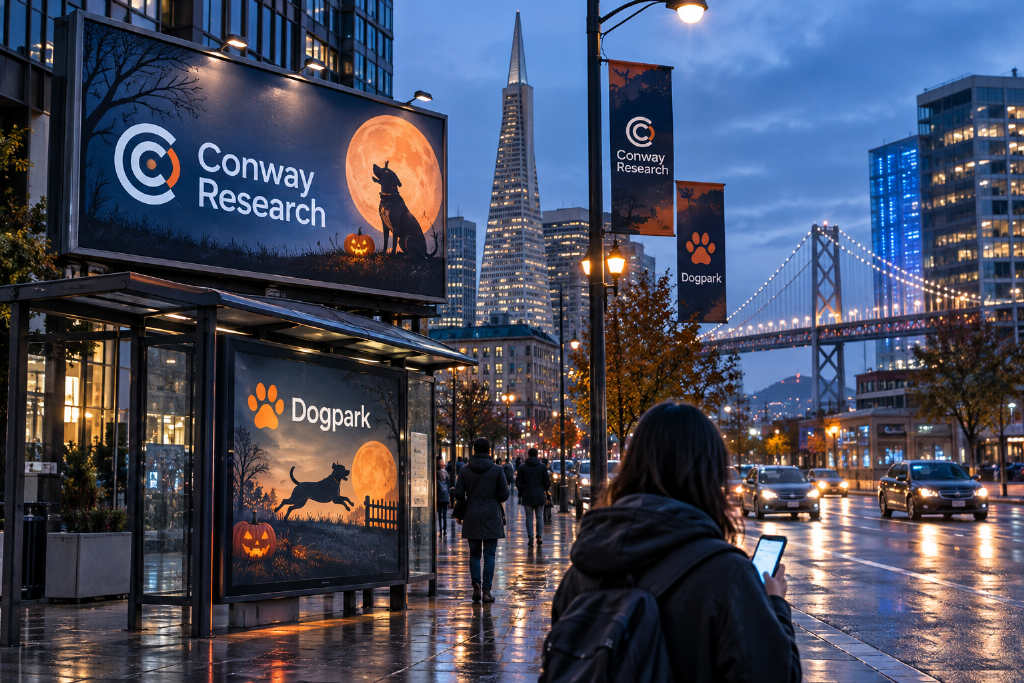
Conway Research, an AI startup backed by Andreessen Horowitz (a16z) and Khosla Ventures, is using a high-profile outdoor advertising push to challenge cloud AI companies including OpenAI and Anthropic.
Founder Sigil Wen said in an X post on Nov. 3 that he had bought a large number of ad placements across the San Francisco Bay Area because he was angry about how major AI companies collect user data. He wrote, 「Big AI is stealing our data」, and urged users to switch to local AI that runs entirely on personal devices instead of depending on data centers, cloud servers, and VPS infrastructure.
198 placements across the Bay Area
In his latest post, Wen said the Bay Area ad buy was meant as a direct challenge to large AI companies. He argued that cloud AI systems and servers face hacking risks and called on users to choose local computing rather than rely on data centers, servers, and Linux VPS setups.
According to information previously released by Underdog, the campaign covers 160 public transit shelters in San Francisco and 38 billboards along U.S. Route 101, bringing the total to 198 ad placements. Conway arranged the campaign as a Halloween marketing event to celebrate the launch of Dogpark.
The promotion also includes an interactive ad hunt. People who find an Underdog ad and scan the QR code can get a chance to receive early access to Dogpark, along with a campaign reward called Bone.
In the company’s public Halloween promo video, Underdog uses a dog as its brand character. The story shows it escaping ghosts that represent large cloud AI companies and heading to a place called Dogpark, where different local AI systems can interact and learn each other’s skills.
Conway’s local AI thesis
The article says Wen has criticized the privacy practices of cloud AI before. Chain News had previously reported that a16z led Conway Research’s seed round, backing Wen’s long-term focus on local AI.
According to the report, Wen moved to San Francisco at age 17 and lived and built products with AI researchers including Andrej Karpathy. He previously got GPT-2 running on an Apple Watch and also helped deploy OpenAI Whisper on the iPhone. In 2025, he received the Thiel Fellowship established by Peter Thiel.
Underdog’s core idea is to let personal AI run inference directly on consumer devices such as phones and laptops, without sending private conversations, emails, documents, and schedules to the cloud.
Conway has also put forward what it calls 「Underdog's Law」, the idea that frontier AI capabilities that require large data centers today may become possible on personal devices six months later. The company has released local AI models including Saluki 27B and continues to work on speech recognition and on-device inference.
The report adds that the claim about catching up with frontier models within six months remains Conway’s own technical vision and has not become a broadly validated industry rule.
Security claims still need outside review
In a follow-up post, Wen said Underdog had hired a security team with strong offensive and defensive experience. He also said users could still use Underdog even with Wi‑Fi turned off.
Conway’s competition with larger AI companies is not limited to model capability. The company is also emphasizing privacy, data ownership, and security. At the same time, the article notes that local computing does not mean absolute safety. Even if an AI model does not need to connect to the cloud, personal devices can still be exposed to malware, operating system vulnerabilities, privilege abuse, or supply-chain attacks.
The report also says Underdog’s claims about its security team and the effectiveness of its protections still need independent review.
Dogpark aims to connect local AI systems
Dogpark is also being positioned as a network where local AI systems can share capabilities and techniques. That suggests Conway is not only building an offline chatbot. It is also trying to give individuals their own AI while keeping open the possibility that different agents can collaborate and exchange knowledge.



