
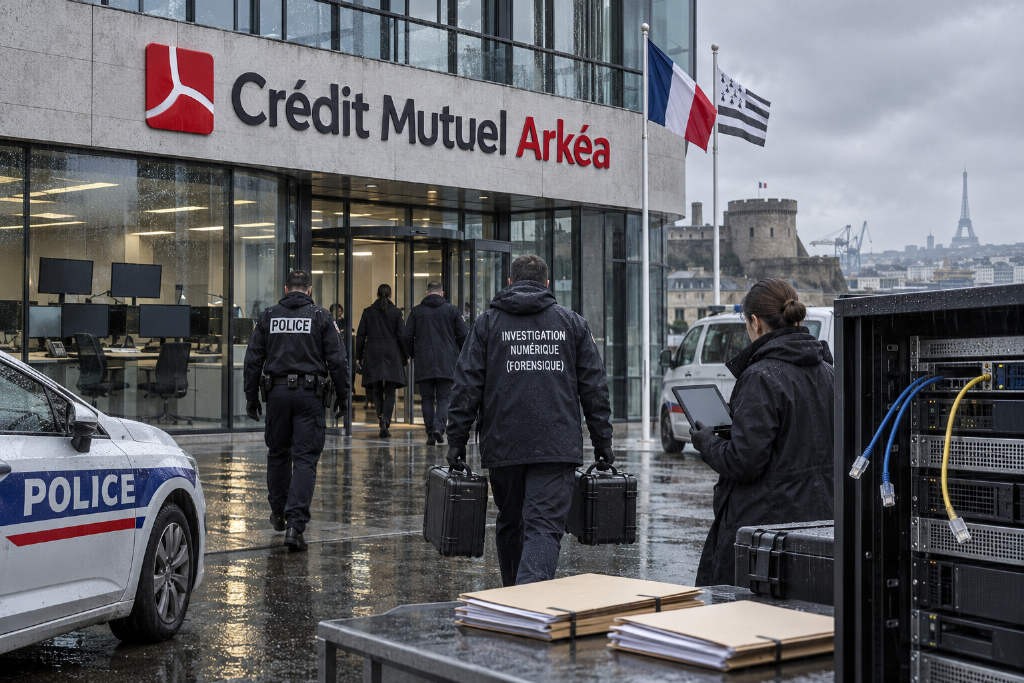
French bank Credit Mutuel Arkea said Wednesday that a cyberattack allowed hackers to carry out fraudulent transfers from the bank’s own account. On-chain investigator ZachXBT has put the losses at more than $133 million, though the bank has not confirmed that figure.
The Brittany-based lender said the situation was under control, operations were resuming, and customer assets were not affected. It also suspended some transactions as a precaution. In a translation published by Reuters, the bank said on its website: 「This incident has had no impact on customer assets and has only caused a delay in the execution of certain transfers.」
How the bank says the attack happened
In a follow-up question-and-answer note, Credit Mutuel Arkea said the attackers came through the platform of one of its service providers and reached the bank directly. The bank said they used the bank’s own account to send transactions to other banks, which may then have allowed the money to be converted into cryptocurrency through specialized platforms.
It said no customer accounts at its federations or subsidiaries were used. The bank also rejected French press reports that the attackers entered through Fortuneo, its online banking arm. According to Credit Mutuel Arkea, this was a sophisticated external attack, not the result of human error.
Loss figure remains unsettled
The bank has not provided a final number. Asked whether 118 million euros, or about $133 million, had been stolen, it said it does not confirm that amount and can only validate the order of magnitude.
Credit Mutuel Arkea said part of the funds involved has been frozen and that other recovery steps are in progress. It added that the sums involved are 「absolutely not large enough」 to threaten its financial health or soundness.
AFP reported that the bank’s provisional estimate put the attack at about 100 million euros. Reuters reported earlier Wednesday that the bank said its losses were below $133 million. A spokesperson told Reuters that it was still too early to give a final figure.
What ZachXBT said on-chain
ZachXBT first flagged the incident on Monday without naming the victim. In a Telegram post, he wrote that an EU entity was suspected of losing more than $106 million from multiple centralized exchange accounts on Nov. 1, with the funds withdrawn as USDC and USDT.
He said the funds were then swapped for ether and moved across several chains. In a later update, he said he had identified another $27 million or more in exchange withdrawals, taking the total to above $133 million.
A subsequent post named Credit Mutuel Arkea as the alleged victim. ZachXBT wrote that the attack lasted for multiple days and said he suspects the amount stolen is larger if over-the-counter activity is included.
The bank has not confirmed his figure or his timeline. It also has not said when the attack began, who was responsible, or whether any data was taken.
Investigation and customer warning
Credit Mutuel Arkea said it is working with judicial and police authorities to determine the origin of the attack and how it was carried out. The bank said it informed its supervisors once the attack was detected.
It also warned customers that phishing attempts are possible after the incident.
Bank profile and wider context
Credit Mutuel Arkea, which groups the Credit Mutuel federations of Brittany and the Southwest, is part of the wider Credit Mutuel group. Reuters reported that it has 5.8 million clients and 211.5 billion euros, or about $238 billion, in assets. AFP reported that the bank posted net profit of 230 million euros in the first half of the year.
The incident came less than a week after the record $6.34 billion Binance hack, which blockchain analysis firms have linked to North Korea. In his first post, ZachXBT said he was highly confident this case was not the work of North Korea’s Lazarus Group.
Brazil’s Mercado Bitcoin also froze deposits and withdrawals this week after a security incident. How much Credit Mutuel Arkea can recover, and what the final loss will be, remains unresolved.
This report first appeared on Bitcoin Magazine and was written by Micah Zimmerman.



