
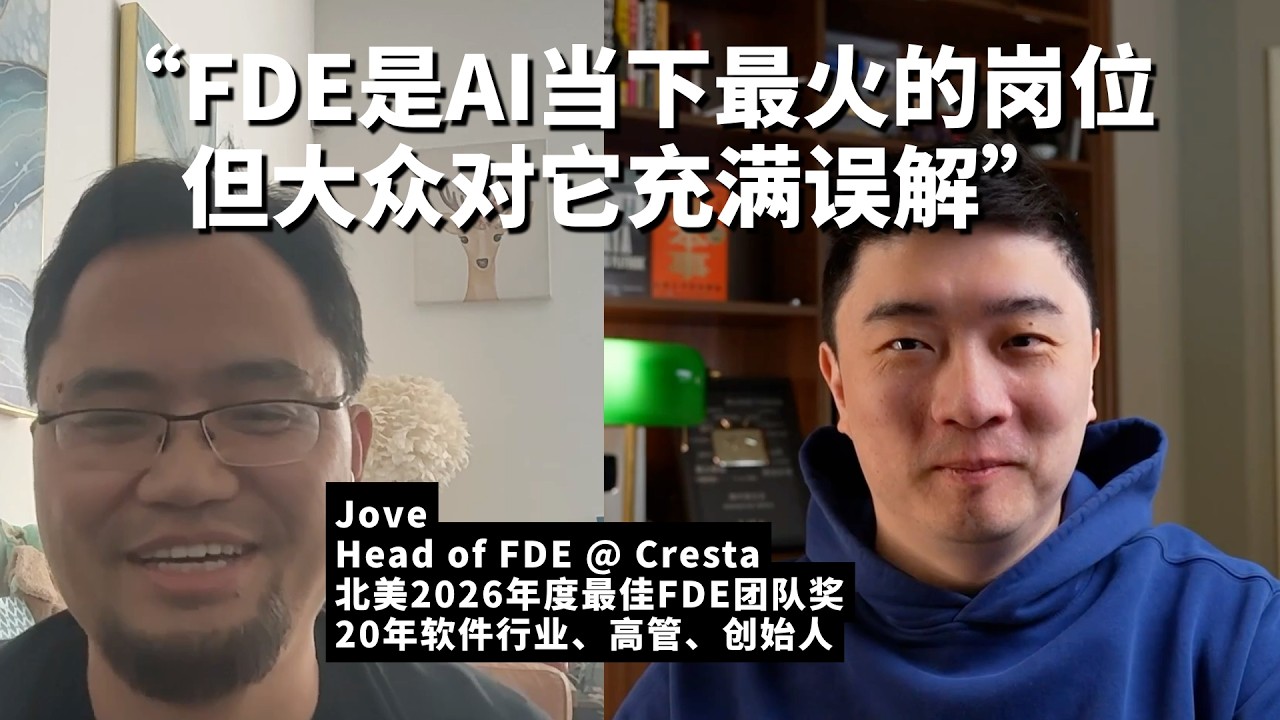
Forward Deployed Engineering is being treated as one of the most important jobs in AI by companies such as OpenAI and Anthropic, yet many engineers at large tech firms still do not know what the role is. That gap was one of the central themes in a podcast conversation featuring Jove Zhong, head of Forward Deployed Engineering at Cresta, an AI call-center company.
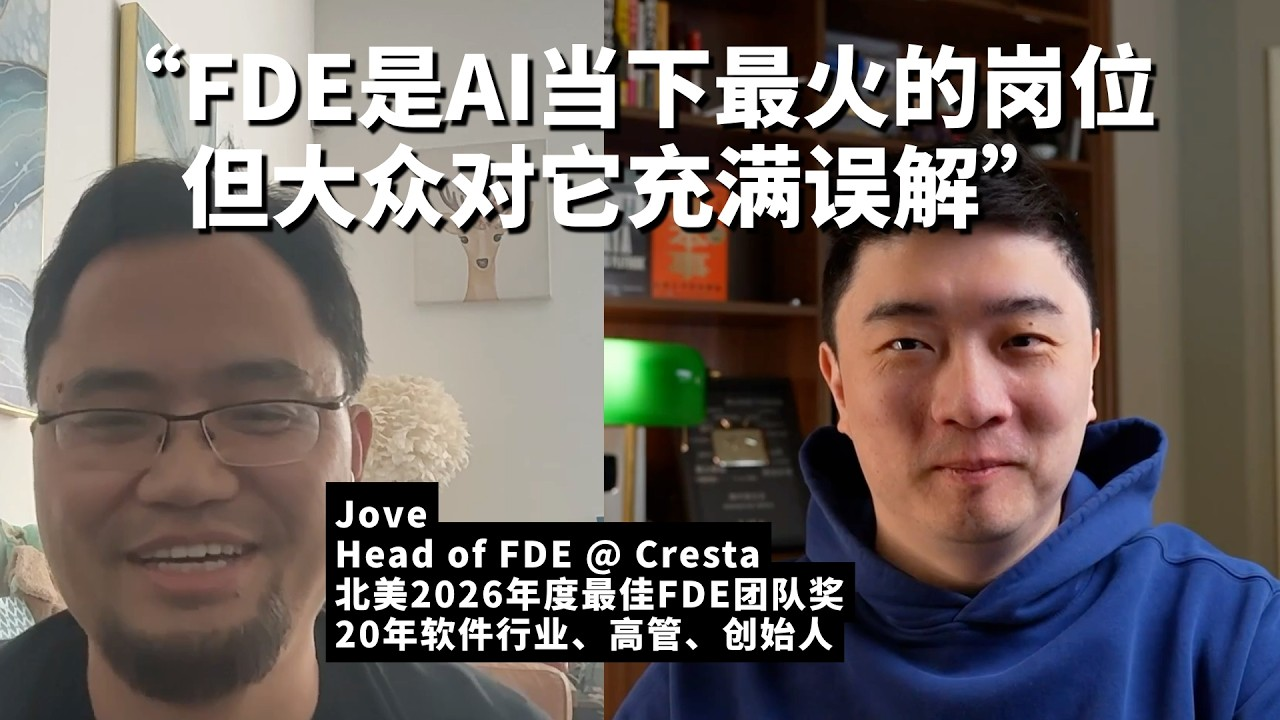
Zhong said the role has changed in a fundamental way in the AI Agent era. In his words, earlier forms of FDE often looked little different from on-site engineering, outsourcing, or consulting. AI Agent FDE is something else. It requires people who can understand deployment problems end to end, build trust with customers face to face, and carry the lessons from production back into the product organization.
From a few people to 30, with a goal of 100 this year
Zhong currently leads the FDE team at Cresta. He said the group had only a handful of people when he took it over, has now grown to 30, and is targeting 100 this year through worldwide hiring. Recruitment is still centered on North America, though Europe and APAC are also part of the plan.
Cresta, he said, has been around for nine years and has long focused on customer experience, with call centers at the core of its business. Its customers include Marriott and United Airlines. The company started by improving human-agent workflows and has now moved more directly into AI Agent deployment as that market has opened up.
For Zhong, FDE is one of the most effective ways to turn AI into something customers will actually pay for. He framed the job as a practical layer between model capability and business adoption.
Why he traces the model back to Palantir
Zhong said he became more familiar with FDE as a category during Palantir’s rise. He described Palantir as the creator of the model, shaped by a very specific kind of work. In those early years, many military customers did not clearly state what they wanted at the start. Teams had to go on site, sit close to the data, and work directly with users before the real needs became visible.
That setup led Palantir to form two kinds of teams: one made up of highly technical engineers working forward with the customer, and another made up of business-side operators who understood the workflow of missions or emergency response. Zhong said that when people talk about FDE in the usual sense, they still mean a deeply technical role.
Why AI Agent FDE is different from traditional on-site engineering
Zhong argued that the distinction becomes clear only in the context of AI agents. In a traditional enterprise setup built around ETL, data transformation, or network construction, it can be difficult to draw a hard line between FDE and other forms of technical delivery. In AI, that line is much clearer.
Today, many companies can buy access to leading models. They can also use speech tools such as ElevenLabs and Deepgram. But model access does not mean they know how to build an AI system that fits their business. That is where the FDE comes in.
He described the job as taking a customer’s business logic and combining it with everything available on the AI Agent platform to build a system that works for that exact use case, complete with guardrails, tests, and evaluations. Customers may know how to build a website or a mobile app. Building an AI agent is a different engineering problem. Hallucination control, low-latency and accurate RAG or knowledge-base retrieval, and shifting model behavior all create a set of issues that are hard to see if you have not worked through them before.
That is why Cresta uses an FDE model instead of asking customers to build this expertise on their own. Even if they eventually could, Zhong said, they might spend six months or a year getting there while competitors move ahead.
He also pointed to the customer-facing part of the role. Inside the team, he said, there is a phrase: “Talk about API over IPA.” The point is that strong FDEs are not only technical. They can build rapport quickly with CEOs, CTOs, and API leads, because they speak the same language as engineers and can explain both what the customer wants and where the platform’s limits are.
“Forward Deployed CTO” and “Forward Deployed CEO”
Zhong used a simple analogy to describe the internal structure at Cresta. FDE, he said, is like a Forward Deployed CTO. FDPM, or Forward Deployed Product Manager, is like a Forward Deployed CEO.
Cresta built an FDPM team alongside FDE, partly inspired by Palantir. The reasoning was straightforward. The FDE role demands too much if every responsibility is stacked into one person. It asks for deep AI and engineering knowledge, customer communication, business understanding, and the ability to move quickly under delivery pressure.
FDPMs do not need to be as technical, but they handle the business logic, acceptance criteria, risk management, and project timing. Zhong said many customer organizations are not well aligned internally on what they want, and different people may hold different versions of the SOP in their heads. It is not efficient to have FDEs in every meeting just to untangle that. FDPMs can sort those issues out, while FDEs focus on technical execution, solid testing, and feeding field lessons back into the company’s product work.
In his description, FDEs own AI best practices, SDKs, toolkits, and CLI development. FDPMs handle requirements, risk reporting, and in some cases upsell opportunities, such as expanding a deployment from three use cases to six. Splitting the work in this way makes hiring more realistic.
At Cresta, FDE sits inside product engineering
Zhong was explicit that Cresta does not treat FDE as a pure service function. In his view, that would miss the point of the role.
He said the baseline requirement for an FDE is that the person must be an engineer. During interviews, Cresta includes a round where the candidate writes a simple Python program without using AI. It is not a LeetCode test. The goal is simply to verify that the person can actually program. Another round looks at engineering practice, including knowledge of unit testing, end-to-end testing, and layered system design.
Without technical grounding, he said, someone might produce something that appears to work while missing the deeper problems. He gave the example of a login page that seems functional but keeps too much logic in the front end, making it easy for a user to manipulate the DOM tree or see things they should not. A person without engineering discipline may not notice that the system lacks basic best practice.
Consulting experience can help. Zhong mentioned firms such as Accenture and McKinsey as examples. Still, he warned against bringing over old habits such as judging the work by deal size or charging by time. Cresta sees FDE as forward deployed product engineering, part of product engineering itself. One of the job’s central responsibilities is to prove product-market fit through real AI Agent deployments and then improve the product: REST APIs, microservices, UI, CLI, and documentation.
He said his team reports up through the same engineering structure as teams working on microservices or Kubernetes infrastructure, all the way to the VP of Engineering and then the CEO. Some companies place FDE under customer success, professional services, or pre-sales. Cresta does not, because it wants to become a platform company with an AI Agent platform that can support many kinds of use cases.
The ideal end state, he said, is that easier work gets automated away through platform improvements, while FDEs become more specialized over time, turning into payment experts, networking experts, or RAG experts who handle only the harder cases. That, in his view, keeps the company from drifting into a consulting model built on repetitive labor.
Customers buy outcomes, not model access
Zhong returned several times to the same point: models are not the hardest part. Outcomes are.
He compared FDEs to baristas. A customer can buy an expensive coffee machine and high-quality beans, but that does not mean they can make a good cup of coffee. The same logic applies to AI. A customer does not really want access to a model. The customer wants a good AI Agent experience.
He gave a voice AI example around VAD, or voice activity detection. In a live call, the system needs to know when it can acknowledge a speaker, when it should avoid interrupting, how to handle pauses while someone is reciting a phone number or email address, and what to do in noisy conditions. Different methods can be silence-based, LLM-based, or built around semantic understanding. For a restaurant owner or an IT team, learning these details is a major lift.
What the customer actually cares about is more practical: whether the brand voice should sound young or formal, how menu items should be described, and how VIP reservations should be handled. The FDE’s job is to apply best practice quickly and make the system work. Zhong said that by building for one restaurant and then another, the team accumulates vertical know-how over time and can end up understanding parts of the business as well as, or better than, the customer.
He used another analogy from omakase dining. The customer does not need to know exactly what ingredients are being used that day. The customer is paying for the confidence that the best ingredients and the best technical judgment will produce a great experience. The same applies to AI models. Good models can be bought. That does not answer the question of how to use them well.
He offered a small but concrete example: when mapping a complex relationship, should the information be written as a Markdown table or as a large set of bullet points? One option might save tokens. Another might reduce execution mistakes. Those choices are not trivial. He also noted that versions such as ChatGPT 5.1, 5.2, 5.3, and 5.4 can behave differently, which means FDEs need to spend real time studying best practice rather than assuming a model upgrade is mechanical.
Cresta’s market: from human-agent support to AI handling some calls on its own
Zhong said Cresta was founded in 2017 and has spent nine years focused on customer experience, especially call centers. In the era of human support, one of the biggest pain points was training. A new agent taking a call has to make the right disclosures, such as telling a customer that the call is being recorded, and also has to pick up the conversation history if the call has been transferred. Those are all areas where AI can help human agents work more effectively.
Now, he said, the company is doing more than assistance. Not every customer interaction needs a human response. During Black Friday, for example, companies may hire large numbers of temporary workers and then let them go once the peak is over. Turnover in that sector is already high. If someone calls because they lost a credit card and need a replacement mailed out, that can often be completed fully by AI.
Customers such as Marriott and United Airlines have used Cresta for years in call-center and human-agent settings. Adding an AI Agent product is more like an upsell on top of an existing relationship, starting with lower-hanging use cases.
Zhong said the company wants more phone and chat interactions to be improved by AI. No one wants to spend 30 minutes waiting on hold, or call in for two purposes only to be transferred for the second one and wait all over again.
When asked about the top application tracks in AI, he listed three: coding, multimedia, and enterprise AI, especially voice AI and AI agents. Coding has already shown strong market demand through products such as Cursor, Claude Code, and Codex. Multimedia includes music, image, and video generation, where large companies are spending heavily. Enterprise AI stands out because business demand is broad. In his view, if you ask 100 business owners, more than 50% will want some form of enterprise AI if it can cut labor cost and reduce wait times.
He added that the team is increasingly seeing customers that do not have a classic call center but still need an “AI receptionist.” That can apply to a dentist, a cafe, a flower shop, or even an individual. The AI can answer the phone, sort the request, schedule an appointment, and send a text or summary to the owner.
What Cresta looks for when hiring FDEs
Zhong said he is not hiring juniors for the role. In his view, FDE candidates should generally have more than three years of work experience and already be strong engineers. Founder, co-founder, and founding engineer backgrounds are a plus. So are consulting backgrounds and customer-facing experience, especially if the candidate is comfortable with customer communication and negotiation.
The clearest requirement, though, is AI Agent experience. Zhong said many resumes describe the applicant as an AI engineer who is good with Claude Code or Codex. He dismissed that as table stakes. At this stage, he said, any engineer who cannot use Claude Code is already behind, just as someone who cannot type would be. What matters is whether the candidate has actually built AI agents.
He referred to a six-level framework for AI products introduced by the host, ranging from prompt wrappers to grounded AI, tool-using AI, and LLM workflows. For Cresta’s voice AI customer-service work, level four, the LLM workflow stage, is already enough to matter. The reason is practical. Many tasks are executional. If a customer wants to cancel a ticket, the system should cancel it. If the customer wants a refund, the system should process the refund. It should not be asking the customer to decide whether the refund should be 50% or 30%. The system has to work from the knowledge base and SOP with low-latency tool calls.
Cresta’s interview process includes a 90-minute practical exercise. Candidates use Claude Code or Cursor, along with an API and knowledge base supplied by the company, to build an agent and show that it is high quality. That means designing tests and evaluations and handling edge cases. Zhong said this reveals much more than general conversation or toy projects.
Why failed founders and concise communicators stand out
Trust-building is another major filter in his hiring process. Zhong said a candidate who has lived through failure can be especially valuable if that person can explain what was learned from it: when they spoke too much, when they jumped to conclusions too early, and how they learned to understand customer motivation and shape a proposal accordingly.
He pointed to a specific red flag. If he asks a question in an interview and the answer runs for six or ten minutes, that is usually a serious negative. The issue is not just length. It signals poor control over information density. In his view, listing ten points is often less effective than clearly explaining two or three. Someone who feels compelled to pour out every thought at once is not showing the communication judgment he wants in an FDE.
The host added a similar view: people who genuinely win trust tend to have two traits. They listen, and they do not let their ego dominate the interaction. If a customer feels that a person cares more about being right than about getting the job done, trust breaks down quickly.
Why the role may become more valuable as models keep changing
Zhong also argued that the economics of the role improve as AI systems evolve faster. Earlier in his career at IBM and EMC, the common mindset in enterprise software was simple: if it is not broken, do not change it, especially in on-premise environments.
That logic does not hold in AI Agent systems. If you do not update, the model may stop being usable, or the API may no longer work in the same way. He gave a straightforward example: if a team was using version 4.1 and that version is no longer viable, it has to move to 5.x. Whether the engagement is structured around a 20% service fee, a new use case, or a new statement of work, the vendor has to stay involved and keep improving the system with the best available model or the most appropriate one. It is not a one-time sale.
For companies, he said, that is actually a positive dynamic because it naturally pushes the business toward an ARR subscription model. Cresta does not offer on-premise deployment at all. It is SaaS only. Combined with the fact that the platform keeps incorporating the best available voice engines and models, the subscription relationship becomes a more natural fit. Customers do not keep asking when the product can be installed locally so they can cut the vendor loose, because the value now comes from continuous updates.
The host made one more point: FDE is difficult to replace with AI. In the past, one narrow skill could support a career. That is no longer enough. What is harder to replace are people who take responsibility for outcomes and stay close to the result. Zhong agreed. AI can change its answer when the prompt changes. It cannot take responsibility for the result in the way a human operator can.
North America and China are not the same market for FDE
Zhong ended with a cautious comparison between North America and China. His view was that the basic idea of the model is sound, but where it is planted matters.
In North America, labor is expensive, customers are more willing to pay for outcomes, and SaaS is more mature. Put those together, he said, and the FDE model is easier to make work in AI Agent deployments. At the same time, he does not think the approach is a natural fit for every kind of project, especially things such as database implementation, data cleanup, or government-related work with more complex delivery structures.
On China, he was more skeptical. He said he feels for practitioners there because SaaS still faces several structural issues, with the enterprise market being one of the most important. In his view, there is not yet a sufficiently strong customer base to support the same FDE model in the way North America can. His conclusion was restrained but clear: in North America, FDE is already a relatively mature and effective solution. In China, it is still hard to say.
What emerged from the discussion was the outline of a role that sits between customer outcomes and product iteration. It is not conventional outsourcing, not just pre-sales, and not merely technical support. For Cresta, the point of FDE is not to explain how advanced the model is. It is to make AI real enough that customers keep paying for it.