

Large crypto trades are increasingly moving away from public order books and into dark pools and over-the-counter channels, weakening the value of exchange screens as a read on institutional positioning.

sFOX said dark-pool volume kept rising through the second quarter. It was barely visible in April, then reached 15% of total monthly volume by June. In May alone, dark-pool turnover hit $147 million. The company’s July 30 report also said 77.7% of institutional flow on its platform was matched through OTC desks, while only 18.4% went to public exchanges.
Diana Pires of sFOX told CryptoSlate the shift is structural and resembles the way equity and foreign-exchange markets were reshaped years ago.
Why institutions are shifting to crypto dark pools
A large order posted on a public book leaves a visible footprint. Other traders can spot the pattern, trade ahead of it, or push the price the other way before the full order is completed, which raises slippage.
Pires said firms such as Jane Street and Citadel have a strong reason to hide their execution trail. Once the market identifies how they trade, other participants can position against them.
That is why more crypto orders are now being executed through dark pools, OTC desks, and platforms that can split one order across more than a dozen venues at the same time. sFOX alone is connected to more than 40 exchanges and OTC desks, and its institutional clients trade through an average of 14 to 19 of those channels each month.
After taking a large order, an OTC desk can break it into smaller pieces and distribute them across venues, reducing the odds that one visible trade causes a sharp move in price.
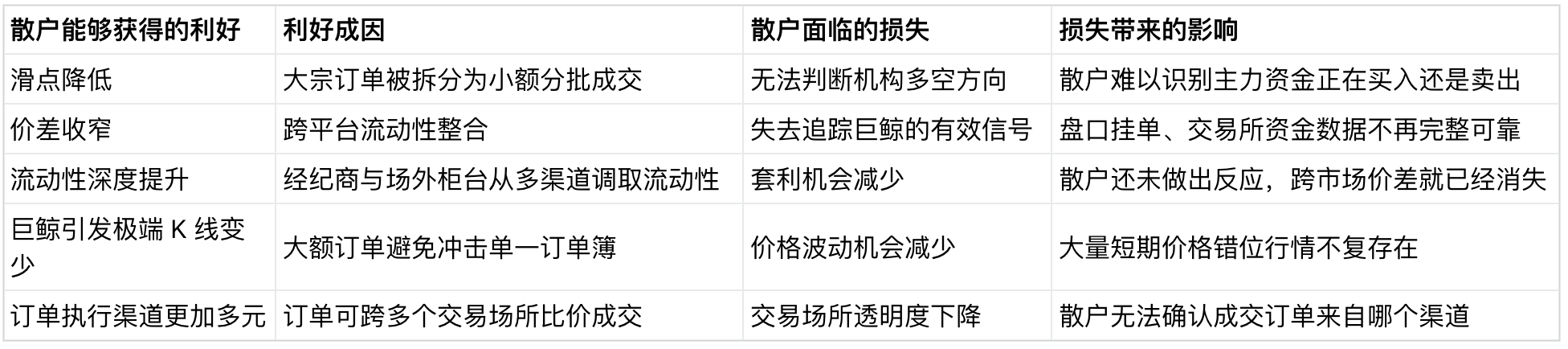
Pires described the core logic of crypto dark pools in simple terms: a platform privately takes on a large position, then sends smaller slices into exchanges, where the individual orders cause little disturbance to the book. In her view, that flow can also add depth to public books and tighten bid-ask spreads.
She said public order books used to reflect most real trading activity, but now capture only a small share of it. A quiet exchange screen does not mean institutions are inactive. A large buyer can accumulate for weeks without posting a visible bid, and a large seller can reduce exposure at scale without creating obvious sell pressure on the book.
The edge in tracking whales is being removed by design
Bitcoin and crypto traders once had a built-in edge relative to participants in many other markets: they could keep watching exchange balances, large visible orders, and major on-chain holdings.
Pires said dark pools are built in a way that strips out that advantage. Trading venues, OTC desks, and brokers can see underlying fund flows, but that information is shielded by regulatory rules and client agreements, leaving retail traders unable to tell whether institutions are buying or selling.
Simple cross-market arbitrage is also fading. In the past, information moved more slowly than capital, giving traders time to buy on one exchange and sell on another. Pires said prime brokers and aggregation platforms now scan dozens of venues at once and close those gaps before retail traders can act, causing such opportunities to shrink year by year.
She expects the crypto market to move closer to the structure seen in equities, where individual investors no longer connect directly to exchanges but instead trade through brokers that search multiple venues for the best available price.
Retail accounts often do not trade enough to reach an exchange’s minimum fee tier. Brokers that aggregate large institutional flow can get there much more easily. Pires said that gap is likely to keep pushing ordinary traders toward brokers, though she does not expect the shift to be driven by regulation in the same way it was in equities.

Two possible market paths
Optimistic case
In the more optimistic scenario, order aggregation platforms and major trading venues handle retail orders in the same way they process institutional flow. Spreads keep narrowing, slippage falls, and large orders are less likely to punch through thin books.
Trading opportunities that leave public exchanges could shift elsewhere. On-chain and DeFi markets still retain public data on large holdings, giving traders who want to position around volatility other places to participate. At the same time, more regulated and compliance-focused trading markets could become steadier.
Pessimistic case
In the less favorable scenario, transparency disappears for ordinary traders faster than the expected execution improvements arrive. Retail and mid-sized investors would lose the ability to judge what institutional money is doing.
Spread improvement and higher-quality order routing would still be reserved for larger clients with enough scale to access prime brokers and aggregation platforms. Signals from public exchanges would keep weakening, and traders who rely on reading visible order books would be the first to feel the change.
Public exchange data no longer shows the whole market
Whatever path the market takes, the practical takeaway is the same. Traders may need to stop treating volume on any single exchange as a full picture of the market, compare total trading costs across channels instead of looking only at listed fee schedules, and use limit orders where book depth is thin in order to reduce the impact of market orders.
Beneath a calm-looking order book, large institutional trades may still be taking place. As the crypto market matures, execution may improve while interpretation gets harder. Retail traders may face fewer sudden whale-driven shocks, but they may also lose sight of the most valuable signals about where large money is moving.