

Capital kept moving to trading and infrastructure
Funding activity in crypto remained centered on exchanges, compliance, and digital-asset infrastructure, echoing the broader capital pattern seen across 2026. CryptoRank data in the report showed prediction markets had the highest average round size this year at $118 million, followed by exchanges at $76.2 million, blockchains at $47.8 million, and compliance at $29.4 million.
Traditional financial firms were also more visible in the latest batch of deals. Japan’s SBI Holdings appeared in two of the week’s largest transactions, backing Gauntlet and EDX Markets.
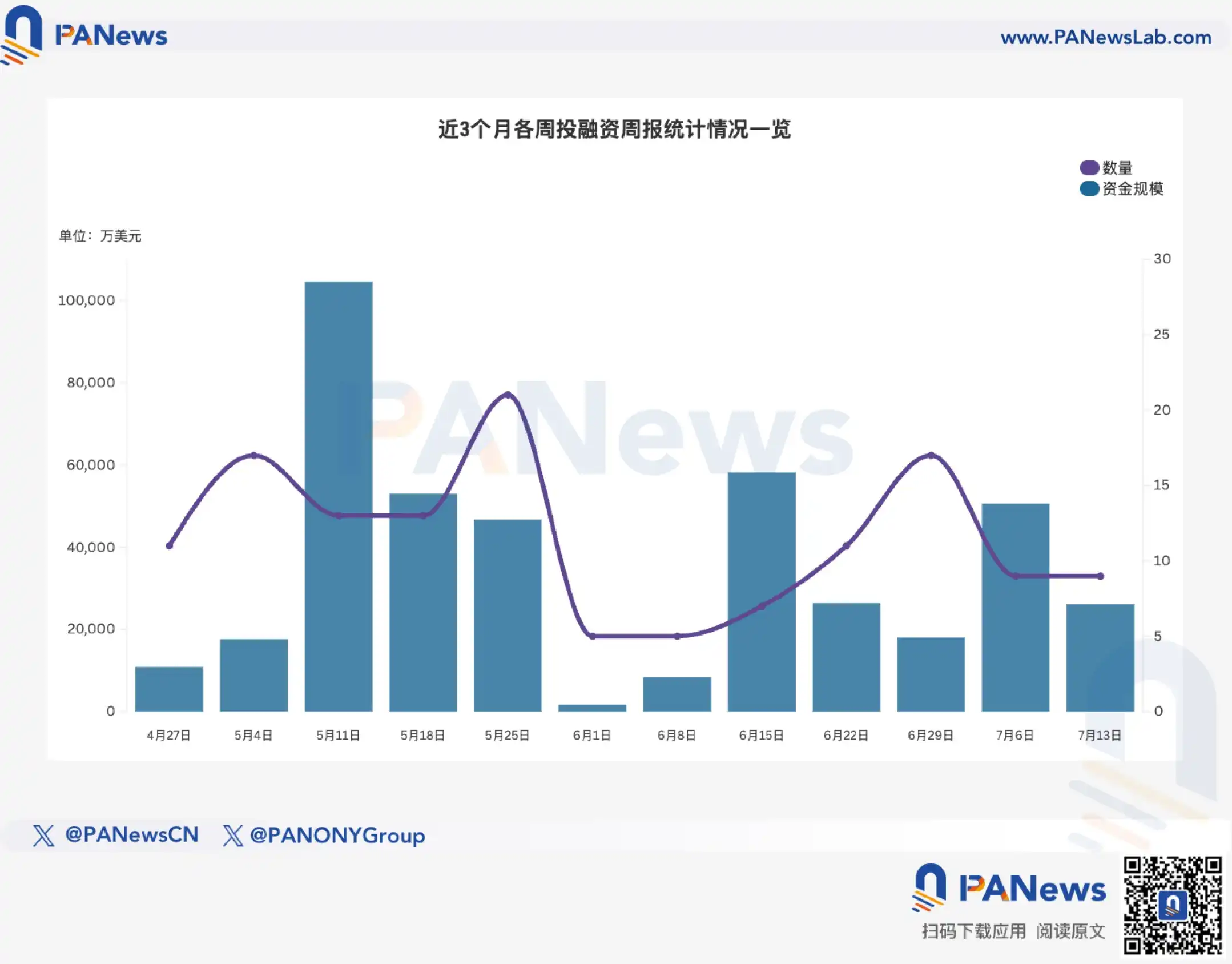
According to PANews’ incomplete count, the global blockchain sector logged nine financing events during July 6-12, with total funding above $261 million. One deal was in DeFi, four in infrastructure and tools, three in centralized finance, and one in Web3 plus AI.
The report contrasted that pace with AI, where several deals exceeded $100 million during the week. Prime Intellect raised $130 million in Series A, Norm secured $120 million, and Gradium said its total financing had surpassed $100 million.
Gauntlet lands $125 million from SBI
DeFi risk management and asset allocation platform Gauntlet raised $125 million from SBI Holdings in an exclusive round. The deal was much larger than Gauntlet’s 2022 Series B, which was nearly $24 million at an about $1 billion valuation.
SBI is a Tokyo-listed financial group with a market capitalization above $10 billion and has previously invested in Ripple, Circle, and Morpho. Gauntlet was founded by former Wall Street quantitative analyst Tarun Chitra. It started by offering stress testing and risk analysis for DeFi protocols, then shifted toward vault curation, evaluating risk across DeFi yield vault strategies. Its clients include Apollo, Coinbase, and stablecoin issuer Circle.
Infrastructure and tools drew four deals
QIZ Security raised $17 million in seed funding
QIZ Security said it raised $17 million in a seed round co-led by Bessemer Venture Partners and Merlin Ventures, with Evolution Equity Partners, Qbeat Ventures, Singtel Innov8, and Qino Cyber Capital also participating.
The company describes itself as a platform for cryptographic asset and post-quantum cryptography management. It offers continuous cryptographic asset discovery, risk modeling, and governance for large customers in finance, telecom, healthcare, and critical infrastructure. The report said the platform is designed to help clients prepare for a potential quantum-computing “Q-Day” that could arrive as early as 2029. QIZ Security is also working with Cisco, AWS, Google, CrowdStrike, Deloitte, EY, and IBM on enterprise migration plans for quantum-safe security.
TrueDAO secured $10 million in strategic funding
TrueDAO announced a $10 million strategic round led by Brevan Howard Digital, with Zee Prime Capital and Jump Capital among the investors.
The company said the money will go to core AI protocol development, AI-based risk control and stress-testing systems, security audits and real-time monitoring, bug bounties, global compliance reviews, and ecosystem partnerships. TrueDAO positions itself as modular cross-chain decentralized financial infrastructure covering liquidity and reserve management, risk alerts, yield distribution, and governance support. It plans to roll out a testnet, developer tools, and ecosystem integrations, while protocol operations and reserve data will be disclosed in stages. Timing for launch and token incentives will depend on official announcements and regulatory requirements.
KOR Protocol raised $7.5 million in Series A
KOR Protocol, an on-chain clearing platform focused on entertainment, completed a $7.5 million Series A with participation from 1kx and Blockchain Capital at a $100 million valuation.
The funding will be used for platform development, ecosystem growth, and partner integration. The project also plans to launch a token. Built on Coinbase Layer 2, KOR provides verification, routing, and settlement infrastructure for creative assets tied to music, film, and other media. By registering assets on-chain, it matches creators with brands, platforms, and distributors and supports programmable revenue splitting with stablecoins such as USDC.
Elliptic received investment from Circle Ventures
Blockchain analytics company Elliptic said in a post on X that Circle Ventures had invested in the company. No amount was disclosed.
The investment came after Elliptic’s $120 million Series D in May, which was led by One Peak and included Nasdaq Ventures, Deutsche Bank, and British Business Bank. Circle also joined Elliptic’s Agentic Design Partner Program, which brings together infrastructure providers, compliance leaders, and technical teams to build agent-based compliance solutions.

Centralized finance deals featured EDX, Mercado Bitcoin, and M1X Global
EDX Markets closed a $76 million Series C
Crypto exchange EDX Markets, which is backed by Wall Street firms, said it had raised $76 million in Series C funding led by SBI Holdings. The capital will be used to expand institutional digital-asset trading, clearing, and settlement capabilities, speed up product development, and support global growth.
The report noted that SBI had previously launched the trust-bank-backed yen stablecoin JPYSC and plans to handle dollar stablecoins including RLUSD and USDC in Japan. The EDX investment was described as part of SBI’s broader push into compliant digital-asset infrastructure.
Earlier this year, EDX launched its crypto-as-a-service product EDX FlowConnect and filed an application with the Office of the Comptroller of the Currency to establish EDX Trust, a regulated custody and clearing entity for institutional custody, clearing, settlement, and risk management.
Tether invested $20 million in Mercado Bitcoin
Tether said it invested $20 million in the strategic growth round of Latin American on-chain financial services platform Mercado Bitcoin. The funding will support expansion across tokenization, stablecoin payments, credit, on-chain capital markets, and compliant digital financial services.
Founded in 2013, Mercado Bitcoin has 4.5 million users, has issued more than BRL 2 billion in tokenized assets, and holds more than 10 financial licenses across Brazil and Europe. Tether said the investment would support on-chain financial infrastructure in Brazil and the wider Latin American market and accelerate mainstream use of stablecoins and tokenized assets.
M1X Global raised a $5.5 million seed round
M1X Global completed a $5.5 million seed round led by Paradigm, with participation from Breed VC. Its total funding has now reached $8.5 million.
The company had previously raised $3 million in an angel round in March from investors including former Coinbase CTO Balaji Srinivasan and Cumberland Labs CEO Tama Churchouse.
M1X Global is building sovereign financial infrastructure and has worked with the Republic of the Marshall Islands to issue USDM1. The product is a tokenized dollar-denominated sovereign debt instrument backed one-to-one by U.S. Treasuries and issued natively by a sovereign state on a public blockchain. USDM1 was first issued on Stellar and is now also tradable on Canton and Solana.
Web3 and AI payments
PayGo, an HTTP-native payment infrastructure project based on the x402 open standard, announced a strategic financing round backed by United Overseas Bank, Signum Capital, and Ledger Capital.
The project is built natively on the ENI blockchain. Its core product uses the HTTP 402 “Payment Required” status code to provide instant request-level stablecoin settlement for APIs, AI agents, and the machine economy without accounts, subscriptions, or API keys. It supports USDT and USDC, while PAYG serves as the governance token.
M&A developments
Nium acquired Cypher
Cross-border payments infrastructure company Nium said it acquired crypto-native non-custodial wallet and card issuer Cypher. The deal expands Nium’s capabilities in compliant fund movement and settlement infrastructure between fiat and digital assets.
Cypher was founded by Kuberan Marimuthu, known as Kube, and was backed by Y Combinator and Coinbase Ventures. The company spent the last four years building products at the intersection of on-chain systems and banking rails. Kube has joined Nium as vice president of digital assets, and Cypher’s engineering team also moved over.
Mirae Asset unit cleared to buy 92.06% of Korbit
South Korean regulators approved Mirae Asset Consulting, an affiliate of Mirae Asset Group, to acquire a 92.06% stake in crypto exchange Korbit for about KRW 133.4 billion, or roughly $98 million.
The report said the transaction marks the first completed acquisition of a virtual-asset exchange by a traditional South Korean financial group. Regulators said Korbit’s relatively small market share means the deal is unlikely to create anti-competitive effects in securities or asset management, and is also unlikely to materially affect future competition related to products such as digital-asset ETFs.
AI and robotics funding also stayed active
Prime Intellect raised $130 million
Decentralized AI protocol Prime Intellect announced a $130 million Series A led by Radical Ventures, with NVIDIA Ventures, Intel Capital, Dell Technologies Capital, and existing investors participating. Total funding has surpassed $150 million.
Founded in 2024, the company is building what it calls an open superintelligence stack, offering enterprises full-stack AI agent development infrastructure spanning compute, large-scale reinforcement learning, sandboxing, evaluation, and deployment. Its customers include more than 6,000 enterprises and startups such as Ramp and Zapier, and the company said annualized revenue exceeds $100 million. It plans to expand compute clusters and reinforcement learning efforts and keep investing in long-horizon agents, recursive language models, and continual learning.
Norm raised $120 million
AI legal services startup Norm raised $120 million at a post-money valuation of about $1.2 billion. The round was led by Khosla Ventures, with Blackstone, Bain Capital Ventures, and Coatue Management also investing. Total funding now exceeds $260 million.
Founded in 2023, Norm differs from software vendors that sell tools to law firms. It built its own law firm, Norm Law, and sells legal services directly to clients through teams of lawyers and AI engineers, charging based on outcomes instead of billable hours. The company is also building compliance agents described in the report as “AI regulating AI” for regulated sectors such as finance and healthcare. The new funds will be used to expand engineering and legal teams and strengthen the related systems.
Gradium topped $100 million in total funding
Paris-based voice AI startup Gradium said total financing has passed $100 million, and that Nvidia joined as a new shareholder in the latest seed extension.
Gradium said it had launched products including real-time speech-to-text, text-to-speech, Gradium Translate, and Phonon over the past few months. The company also plans to open a new office in San Francisco to be closer to the local startup ecosystem and speed up hiring.
Marker emerged with a $13 million seed round
London-based AI writing startup Marker came out of stealth and announced a $13 million seed round led by Index Ventures, with Local Globe participating.
Angel investors in the round included Writely co-founder Steve Newman, Slack co-founder Cal Henderson, and Hugging Face’s Thomas Wolf. Marker was co-founded by a former DeepMind creative lead. The company said early users have already used the platform to write blog posts, Substack newsletters, business documents, memos, and novels.
CEO Steinback said, “We are at a critical moment where people can choose the future of writing; I believe people will choose options that value the craft of writing, not the low-quality content that is badly eroding what writing is.”
Mowito raised $3 million pre-seed
Physical AI startup Mowito raised $3 million in a pre-seed round led by Version One Ventures, with All In Capital, Unisol, and iSeed participating. AI researcher Soumith Chintala and founders from Foundry Robotics, Coformer.ai, and Better Capital also joined as angel investors.
Founded in 2024 by Puru Rastogi, Adityanag Nagesh, and Safar V, Mowito is building foundation models for industrial robotic arms. Its approach is to train robots through human demonstrations instead of explicit coding, aiming to remove software programming bottlenecks in manufacturing automation. When production lines change, engineers do not need to rewrite control code.