

Crypto traders often react to price first and look for reasons later. This year, one of the most popular explanations for token moves has been revenue.
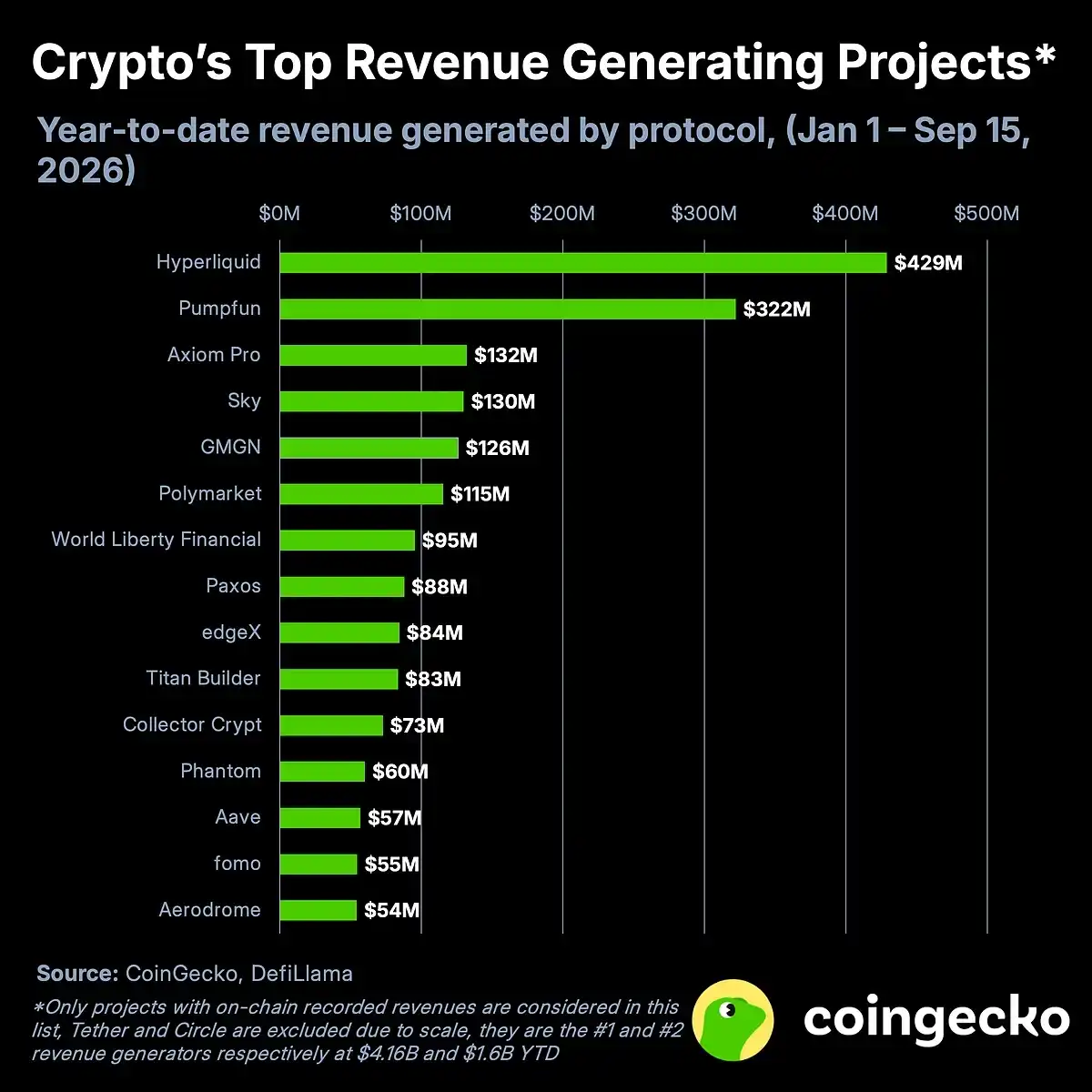
Over the past year, the market has leaned heavily on protocol revenue as a valuation shortcut, borrowing price-to-earnings logic from traditional finance and trying to apply it to crypto assets. CoinGecko’s 2026 revenue ranking offered a compelling set of numbers: in the first eight and a half months of the year, crypto issuers excluding stablecoin issuers generated a combined $3.4 billion in revenue, and the top 15 captured 56% of that total.
Set those revenue figures next to token performance over the same period, though, and the picture changes. Protocols may be generating substantial cash flow while some token holders in the secondary market are still sitting through a prolonged decline.
Top earners show where demand is strongest
The highest-ranked projects suggest that, in a market defined by competition over existing liquidity, the strongest real demand is concentrated in two areas: leveraged trading and aggressive speculation.
Hyperliquid ranked first with $429 million in revenue this year, while Pump.fun came second with $322 million. Together, the two accounted for 22.1% of total network-wide revenue in the ranking.
One of the more notable takeaways was not limited to base-layer protocols. Axiom Pro and GMGN, ranked third and fifth, posted $132 million and $126 million in revenue, respectively.
Neither project is a traditional on-chain smart contract protocol. They are trading terminals. Axiom Pro built its business by connecting to Hyperliquid and offering easier access to derivatives trading. GMGN drew users by tapping into the Memecoin trading wave tied to Pump.fun and Robinhood.
The ranking points to a clear shift in value capture. Fat front ends are taking a direct share of the real trading fees paid by users, and traffic gateways are now monetizing better than most long-established DeFi protocols.
Many high-revenue projects are not investable through a token
For traders trying to buy into revenue-generating protocols, the ranking carries an important caveat. Nearly half of the top 15 projects either do not have a token that can absorb those revenue expectations or have revenue structures that are not connected to an on-chain token at all.
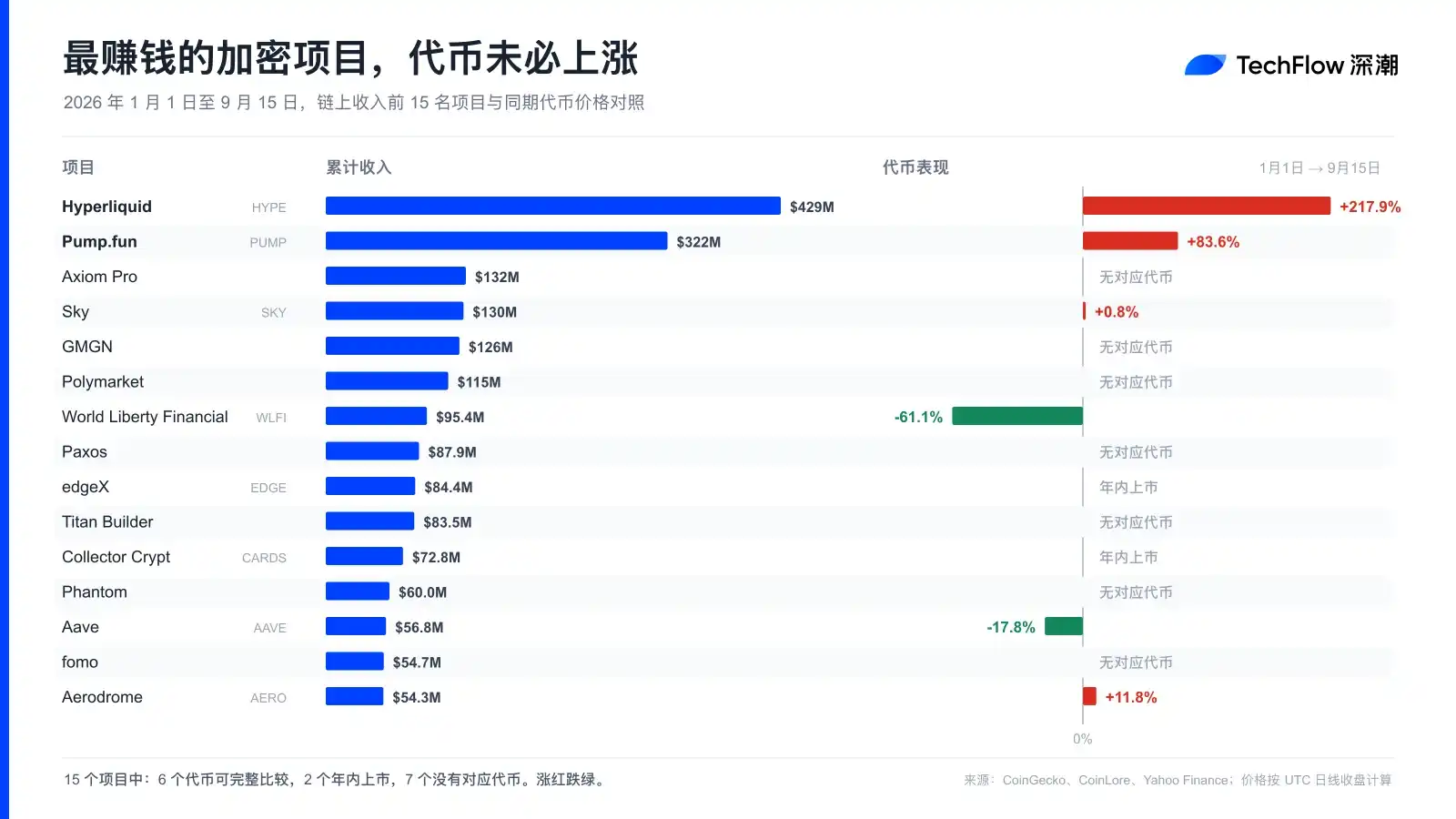
Paxos, ranked eighth with $87.93 million in revenue, and World Liberty Financial, ranked seventh with $95.37 million, are examples. Their large revenue streams are essentially off-chain net interest spreads, meaning profits generated from the yield on real-world assets. That net profit belongs to the issuing entity, and on-chain token holders do not have a claim on those distributions.
The same issue appears in projects such as Phantom and Titan Builder. Phantom, a wallet project, ranked 12th. Titan Builder, an MEV business, ranked 10th. Both have strong cash-flow models and do not need token issuance as a financing tool, so there is no token in the secondary market that naturally prices in those revenues.
High revenue does not guarantee token gains
Even when a project has issued a token, revenue is still only one part of the valuation picture.
Year to date, HYPE has climbed about 218% and PUMP has gained about 83.6%. But Sky, which generated close to $130 million in revenue, was up only 0.8% over the same period. Aave, with $56.81 million in revenue, fell 17.8%. World Liberty Financial’s WLFI dropped more than 61%.
The gap comes from a break in value capture. Charging fees is one thing. Where the money ends up is another. If tens of millions of dollars in revenue simply accumulate in a project treasury and are not turned into real buy pressure through buybacks, token burns, or distributions to stakers, that revenue does little to support the token price.
FDV and unlock pressure can outweigh the revenue story
Another problem is dilution. Many high-revenue projects are still in high-inflation phases and carry elevated fully diluted valuations, or FDV, while large amounts of unlocked supply continue to enter the secondary market.
When fresh sell pressure from token unlocks is larger than the buy pressure created by revenue-funded repurchases, reported dollar revenue is not enough to stop a token from falling.
The broader message from the ranking is straightforward. Revenue on a dashboard is not a valuation answer by itself. Before paying up for a high-revenue protocol, traders need to look at how that revenue is generated, where it flows, and, most importantly, whether token holders actually share in it.