
Recent security incidents involving hardware wallets have revived debate over whether crypto self-custody is suitable for beginners. Executives across the industry are split on the question, while alternatives such as multisignature wallets and seedless backup systems come with their own trade-offs in security and usability.
Safe Labs CEO Rahul Rumalla told Cointelegraph, 「We don’t expect every driver to be a mechanic, and we shouldn’t expect everyone who wants to own their assets to become a security expert.」
Making self-custody easier to use could matter for broader Bitcoin adoption, since the ability to 「be your own bank」 remains one of the asset’s defining ideas.
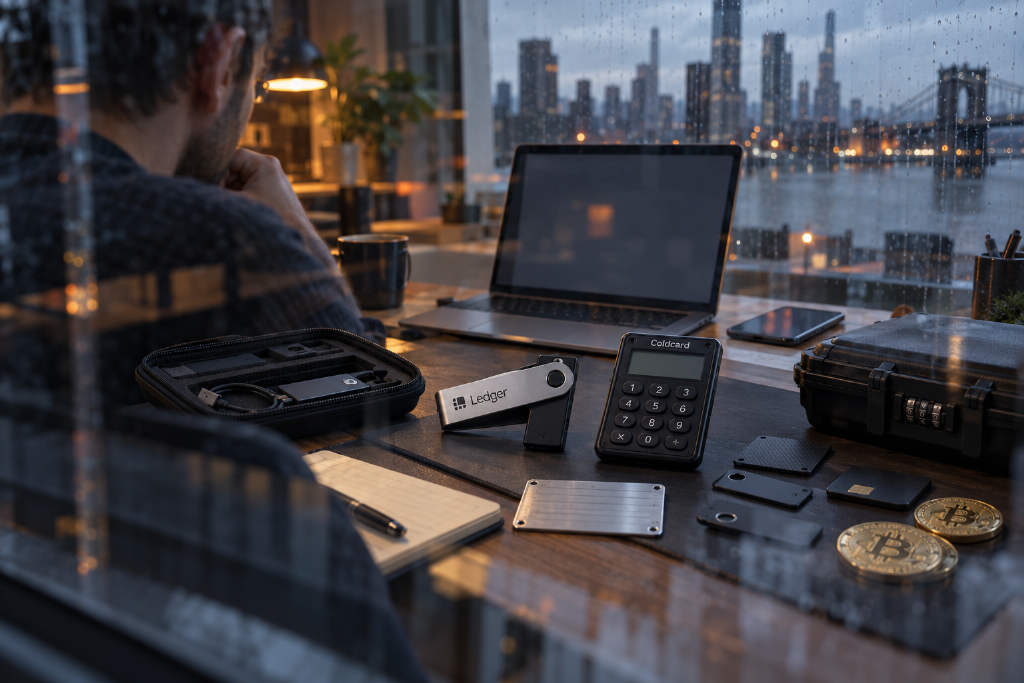
Recent incidents tied to Ledger and Coldcard have also highlighted weaknesses in hardware wallets, which are widely recommended as one of the safest ways to hold crypto because private keys stay offline.
Implants in some Ledger devices stole recovery phrases, while a Coldcard firmware bug allowed attackers to recreate private keys and steal funds.
Michael Tanguma, CEO of Bitcoin custody provider Onramp, compared Bitcoin custody to personal computers in the 1970s, when users needed technical skills to assemble and operate them.
「Self-custody was never designed with newcomers in mind,」 he told Cointelegraph.
Tanguma said simpler designs helped computers reach a wider audience, and that Bitcoin custody now faces a similar challenge.
Trezor Model One, described as the world’s first hardware wallet, was released in 2014. Source: Trezor.
Multisig raises security, but adds complexity
Rumalla disagreed with the idea that self-custody was not built for ordinary users. He said self-custody was 「always meant for everyone」 and added that 「being able to own and control your assets is the whole point of crypto.」
He also said self-custody 「does not mean doing everything yourself.」
Multisignature, or multisig, wallets require multiple keys to authorize transactions, but that structure can be difficult for beginners to manage.
Justin Hutzler, chief technology officer of Synergy Network, said, 「Traditional multisig implementations can introduce additional complexity involving signer coordination, key backups, recovery procedures, and transaction approvals.」
BitGo has illustrated the difference between single-signature and multisig setups.
Even so, multiple approvals do not stop every kind of attack.
Rumalla said several signers could still approve a malicious transaction if they were all misled by the same compromised interface.
Seedless wallets remove one problem and create others
Tangem said its seedless design simplifies self-custody by removing the need to manage a recovery phrase. In exchange, users must protect the physical devices that provide access to their funds.
A private key is generated on one card, with backup copies stored on as many as two additional devices. Tangem confirmed to Cointelegraph that if a user loses every device, access to the funds would be permanently lost.
The company said it had received no reports of users losing all of their cards.
But keeping the cards safe does not protect users from approving a malicious transaction. Zach Herbert, CEO of rival hardware wallet maker Foundation, said seedless backups can preserve self-custody, but criticized Tangem for lacking a built-in screen, leaving users dependent on their smartphones to verify transaction details.
「An attacker does not need to extract your private key if they can trick you into authorizing a transaction that empties your wallet,」 he said.



