
For years, many crypto governance tokens have been criticized as “air tokens” because they lacked effective mechanisms for capturing value. As some on-chain protocols have begun to show real earning power, token economics are entering a structural reset.
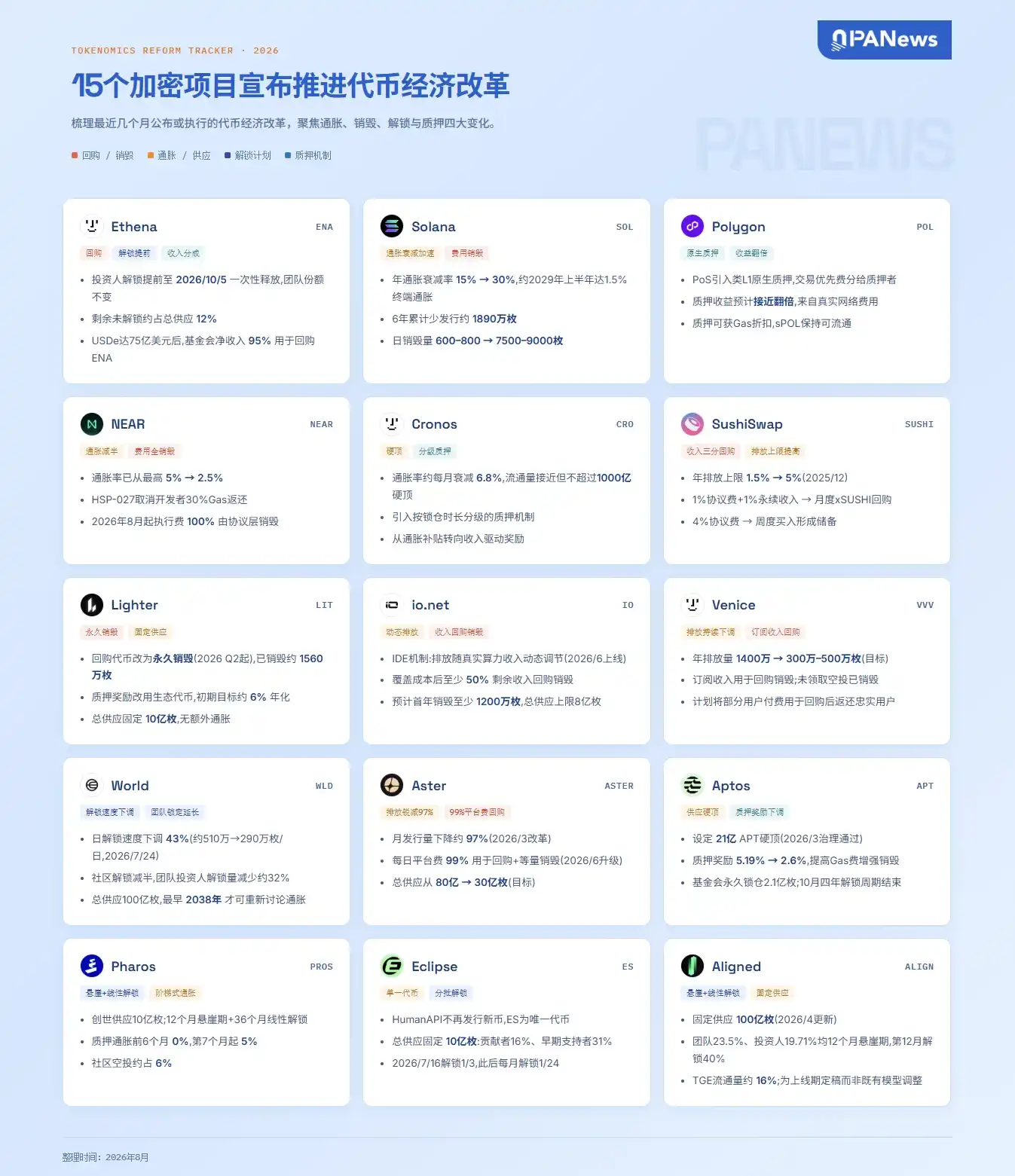
PANews counted 15 major crypto projects, including Ethena, Solana and Polygon, that are rewriting their token models. Their proposals cover lower inflation, buybacks and burns, changes to unlock schedules and upgraded staking systems. The common objective is to redesign token supply and demand while creating a more direct connection between protocol revenue and token value.
Data from Allium Labs points to the same shift. By the end of August this year, crypto projects had bought back nearly $640 million worth of their tokens. That was above the $545 million recorded during the same period last year, while the total for all of 2024 was only $366,000.
The focus of token economics is moving from how to issue more tokens to how to reduce supply and create real demand.
Four reform paths across 15 projects
According to PANews, 15 well-known projects spanning public blockchains, DeFi, AI and DePIN have proposed token-economic changes through community proposals and governance votes in recent months. Their measures fall into four broad groups: cutting inflation, conducting buybacks and burns, optimizing unlocks, and upgrading staking.
Public blockchains target inflation and supply growth
For Solana, NEAR and Aptos, the central issue is controlling supply and reducing reliance on newly issued tokens as an expansion subsidy.
Solana’s SIMD-550 governance proposal doubled the annual inflation decay rate to 30%, accelerating the network’s path toward a terminal inflation rate of 1.5%. The proposal is expected to reduce SOL issuance by nearly 18.9 million tokens over the next six years.
NEAR cut its inflation cap in half to 2.5% and removed the Gas subsidy returned to developers. All execution fees will instead be rigidly burned at the protocol layer. Aptos introduced a hard cap on supply, addressing market concerns about continued large-scale dilution at the supply level.
Together, these measures show infrastructure projects trying to rely less on issuance-based subsidies and more on actual on-chain demand to balance token supply and demand.
Applications connect revenue with token demand
Lighter, Aster, io.net, Venice and SushiSwap are taking a different route by embedding protocol revenue into the token supply-and-demand curve.
Lighter and Aster are converting most of their platform trading fees into secondary-market buying and burns to ease token inflation. io.net introduced a dynamic release mechanism linked to actual computing revenue. After operating costs are deducted, more than 50% of the surplus will be used for buybacks and burns.
Venice is directing part of its AI inference subscription revenue toward buybacks, testing a route for off-chain cash flow to reach token value. SushiSwap reworked its fee-allocation matrix, separating part of its protocol fees and perpetual-futures revenue for secondary-market buybacks and an operating treasury reserve. The structure is designed to retain both short-term buying and longer-term funds.
The underlying approach is to move tokens beyond their role as governance credentials and make them vehicles for sharing in business growth.
Unlock changes aim to address selling pressure
Projects are also restructuring unlocks to respond to the potential selling pressure created by early holders.
Ethena is taking a “shorter pain” approach. It will release the remaining investor allocation in a single event on October 5 this year, while leaving the team allocation unchanged. The project has also set a plan to begin using 95% of net revenue for buybacks once USDe reaches a target scale of $7.5 billion. The stated aim is to remove the expectation of prolonged weakness caused by monthly unlocks.
World is trading time for a slower release curve. It cut the daily token release rate by 43%, pushing the inflation issue out to 2038 and using a lower release rate to reduce the market shock.
New projects such as Aligned and Pharos are addressing the issue at launch. They set a cliff lockup period lasting as long as 12 months at the beginning of their TGE, followed by staged, tiered unlocks. During the cold-start period, staking inflation is compressed to zero to limit selling pressure when liquidity is thin.
Staking rewards shift toward business revenue
Polygon and Cronos are rebuilding their staking systems and seeking to replace inflation-funded rewards with revenue from actual activity.
Polygon plans to introduce native staking within its PoS architecture and distribute part of the network’s priority fees to stakers. Staking returns would then be supported by real network throughput rather than inflation subsidies. The plan also includes sPOL to release liquidity.
Cronos plans to introduce tiered staking weights tied directly to mandatory lock-up periods. The source of incentives would shift to ecosystem business revenue, encouraging longer-term capital to remain in the ecosystem and limiting short-term secondary-market float.
Buybacks are widespread, but they do not guarantee gains
More than half of the 15 projects include token buybacks or burns. The practice is becoming one of the most widely adopted tools in token-economic reform.
The sharp increase in buyback activity this year suggests that major decentralized protocols are borrowing from the capital-allocation logic of traditional equity markets. By buying back profits and removing supply, projects seek to increase the unit economic value of their tokens. Protocols with substantial cash flow are using revenue-based buybacks to create buying support.
Hyperliquid and pump.fun together account for nearly 90% of crypto project buyback volume.
Hyperliquid has been the more aggressive of the two. About 99% of its protocol fees are used by the Assistance Fund to buy back HYPE and permanently burn it. So far, the Assistance Fund has accumulated roughly $1.1 billion to $1.3 billion in buybacks, equal to 4.7% of total token supply. HYPE has also repeatedly set new highs, rising above $80.
pump.fun allocates 50% of its revenue to buybacks and burns. It has burned about $445 million, equal to 16.35% of total PUMP supply. At the time covered by the source, PUMP’s market price was broadly unchanged from when the buyback program began.
Matt Hougan, chief investment officer at Bitwise, said the crypto market is going through a “revenue revolution.” He said the main issue that has long prevented traditional institutional capital from allocating at scale to crypto assets was the lack of measurable cash-flow returns from tokens. Once protocols such as Hyperliquid and Uniswap create mechanisms that link network prosperity with token deflation, token holders can share more directly in protocol growth, he said.
Market performance shows that buybacks have produced some strong examples, but the mechanism alone is not enough to determine a token’s price.
As of the time covered by the source, the tokens of Chainlink, Jupiter and LayerZero, which also operate buyback programs, were down about 50%, 70% and 45%, respectively, from the time their buybacks began. Hyperliquid’s distinguishing feature is that its protocol has continued to grow while buying back tokens, creating a positive flywheel rather than simply using money to support the market price.
Elton Shehdula, head of research at Allium Labs, said buybacks can reduce circulating supply and create demand, but they cannot replace organic protocol-revenue growth or guarantee long-term token appreciation.
The examples of Chainlink and Jupiter show that tokens can continue to fall even when buybacks are in place if business growth slows or the competitive environment worsens.
Token economics is becoming a business design exercise
The current reform wave is an attempt to redefine the role of tokens inside crypto business models. In the past, tokens served as fundraising tools, growth incentives and governance credentials. More projects are now trying to make them vehicles for protocol revenue.
The limitation is clear: without stable cash flow, buybacks may remain a matter of expectations. Deflation does not automatically create value. If users, trading volume and revenue keep declining, a token can weaken even as its supply shrinks.
Future assessments of token models may focus less on how much is issued, unlocked or offered through APY, and more on revenue, distribution, buybacks, net issuance and whether those arrangements can last.
The fact that Hyperliquid and pump.fun account for nearly 90% of buyback volume also shows how concentrated the shift toward value capture remains. Most projects still have no direct link between revenue and token value.
Every token-economic reform will ultimately face the same question: does a higher token price come from a smaller supply, or from a larger pie?