
Crypto is no longer a frontier field. It is turning into a business.
That is the core argument in a July 28 article published by TechFlowPost, written by Matti and translated by Chopper for Foresight News. The piece says a common market view has taken hold: crypto has become an outlet for excess liquidity. Many people are leaving the sector, and the main reason, the author argues, is simple. The financial returns produced by the industry have fallen far short of the expectations built over the past decade, and the vision many people believed in was never delivered.
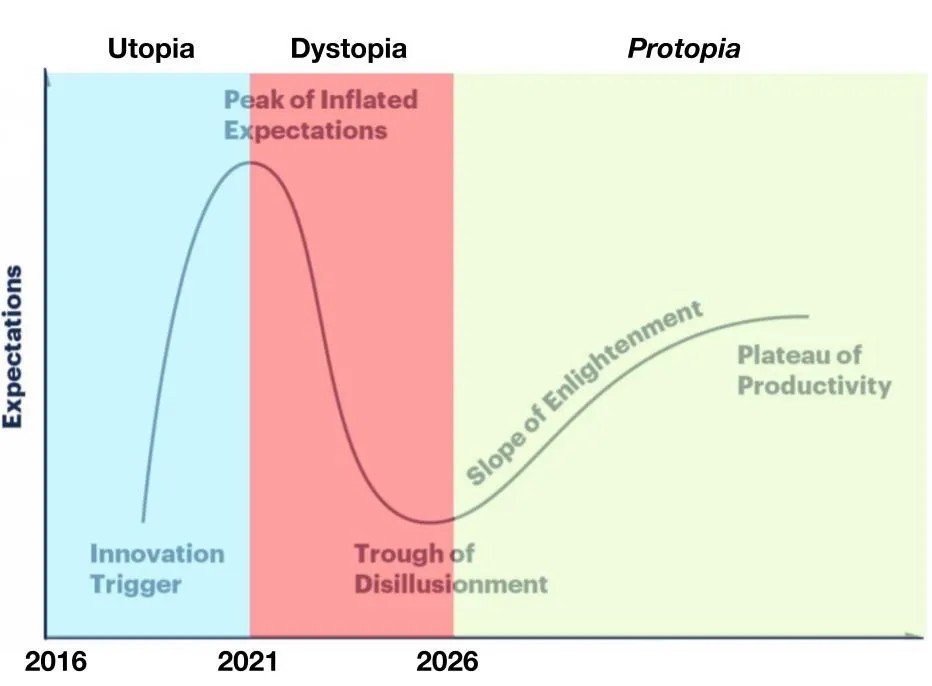
In the article’s telling, this bear market marks the close of an era. The real question is not just what prices did, but what exactly people feel they have lost. Looking back, the boom of 2021 is described as an illusion. Using the Gartner Hype Cycle as a frame, the author places that year at the peak of inflated expectations.
Now comes the comedown. The article says this phase is forcing the industry back to first principles: reassessing token value, hardening the security of decentralized finance protocols, and finding new applications where crypto can create real value.
There is an irony here, the author writes: “the only fact we have clearly seen is that uncertainty remains everywhere.” In that view, the industry never identified the true source of its failures, which is why it keeps replaying the same cyclical and reflexive waves of speculation.
Capital flooded in, and the industry started looking for problems to fit its tools
The article traces that pattern back through several market phases, including 2017 and 2021. The industry, it argues, fell into a familiar trap: if all you have is a hammer, everything looks like a nail. Once large amounts of capital entered the space, crypto became a “solution” in search of problems.
The author leans on a historical observation as well. Genius is scarce, but as long as credulous participants exist, scams will keep appearing. That, the piece says, may make crypto assets one of the most reflexive asset classes in history. At the center of the frenzy was the ability of tokens to trade very early in a project’s life cycle. Once that feature became overused, the bubble eventually broke under its own weight.
The article says the split between exploration and extraction was already visible in 2024. Faced with a choice between pursuing innovation and cashing out, the industry chose the latter. Incentives kept pushing participants toward short-term profit maximization, and two years later the consequences are now being felt.
On innovation, the author says he long believed that necessity drives invention, but has arrived at a revised view: curiosity drives invention, while necessity drives engineering. The recent run of DeFi hacks is presented as a signal that reality is forcing engineering upgrades. At the same time, it opens a window to revisit early designs, keep iterating, and rethink token models as part of that process.
Curiosity, however, cannot be manufactured from the outside. It comes from genuine interest rather than pure profit seeking. Returns can coexist with curiosity, the article says, but they cannot serve as the prerequisite for frontier innovation.
What broke was not only the fantasy, but also the culture around it
The piece says the collapse of the fantasy has been accompanied by a cultural shift. More people now recognize a basic point: crypto is no longer in its earliest stage. For strong builders and investors, that is a challenge, not an impassable barrier.
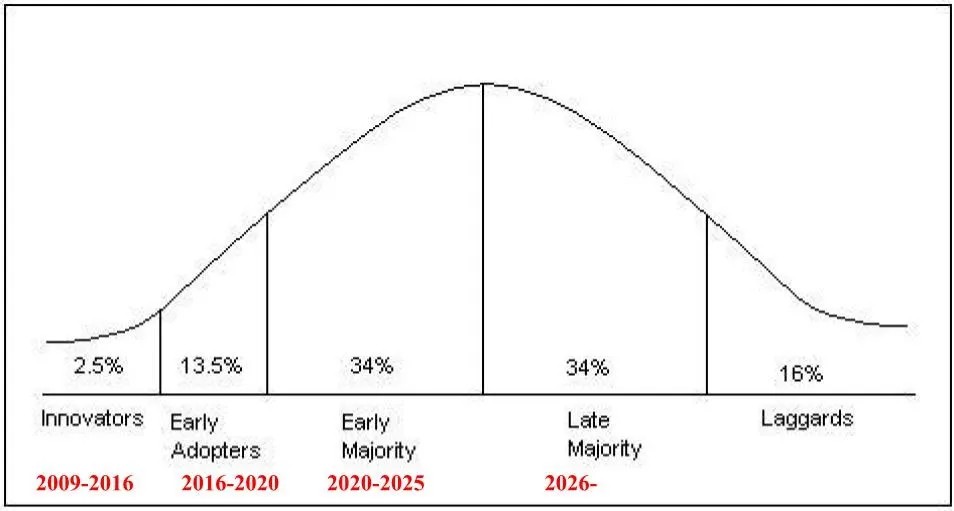
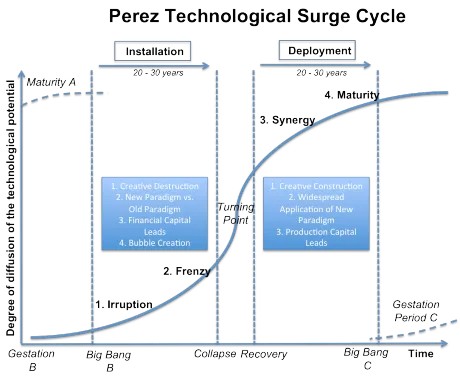
Overlay the technology adoption curve with the hype cycle, and the trough of disillusionment lands around the middle. The author links that point to the “turning point” described in the work of Carlota Perez.
The core challenge, the article says, has not changed. Crypto is trying to rebuild finance from the ground up. That was never going to be easy. The process was always likely to involve repeated iteration, repeated failure, and repeated encounters with reality.
In one sense, the industry has returned to the starting line. That does not mean earlier efforts were worthless. Even in a stalled market, the author says, asymmetric investment opportunities still exist. At the individual level, there is still room to shape what comes next.
The bigger risk now, in his view, is throwing away the worthwhile parts while keeping the worst habits, then rejecting the whole field outright. Even some of the most committed believers and evangelists are leaving. The market once imagined a future measured in the hundreds of trillions, but what actually materialized was only about 200 digital asset treasury companies.
Crypto VC is not dead, the author argues. The exceptional years are.
The article pushes back on claims that crypto venture capital is dead or close to death. The broader venture industry itself is under pressure, it says, as DPI has missed expectations and fundraising has become much harder.
Within crypto, limited partners that grew used to high returns every four-year cycle are leaving disappointed. But the author draws a line between disappointment and structural death. The outsize gains recorded from 2016 to 2021 were an exception in venture capital, not the baseline.
During that stretch, crypto was packaged as both a revolution and a new asset class. Huge amounts of capital entered a market that was still immature, far beyond what the industry could productively absorb. The frenzy peaked in 2021, then gave way to a long clearing process in which short-term speculation dominated. Only now, the article says, is the sector entering a period of consolidation.
The piece cites the book Manias and Mimics, quoting a line that says revolutions can still materialize — Britain is still covered in railways — but the utopia imagined by participants in the mania never becomes real.
From cypherpunk roots to Wall Street and regulators
What matters even more, the author writes, is the ideological reversal. The original cypherpunk subculture that helped give rise to Bitcoin is now moving toward Wall Street and regulators, with the industry’s future increasingly tied to policymakers.
That is not merely ironic, in the article’s view. It is a familiar feature of bubble cycles. The piece points to Google as an example: the company once warned that advertising could damage search quality, then went on to build an enormous business empire on advertising.
The article also quotes a longer passage from Manias and Mimics: “This is one of the most extreme cases of ideological reversal in history. To find similar cases, one could look back to Martin Luther, a devout Catholic cleric who ultimately split the church, or Napoleon, who joined a movement against monarchical absolutism and eventually became a dictator himself. These are not anomalies. If you devote yourself to destroying a powerful system, you often end up building another, even stronger one. And that new system, subject to the same laws of evolution, reproduces many of the traits of the order it replaced.”
From there, the author reaches a blunt conclusion: crypto has abandoned its utopian dream. The revolution did not arrive on schedule. Instead, the industry is being absorbed into the existing system — or, depending on one’s vantage point, assimilated or corrupted by it. After 2021, once the market had become a speculative casino, the article says this kind of compromise became the only workable path left.
Five categories now define the commercial phase
The same Carlota Perez framework is used to explain the transition. The utopian vision belongs to the early installation period; the collapse of the fantasy marks the turning point; what follows is a deployment phase shaped by more rational implementation. Investment strategy, the article says, must change with the phase.
In that setting, crypto is no longer a frontier track. It is becoming a business. The author does not treat that as inherently good or bad. It is what maturity looks like.
New crypto projects, he writes, now fall broadly into five groups:
- Stablecoins
- Prediction markets
- Tokenized assets / RWA
- Perpetual futures
- Artificial intelligence and intelligent agents
To some extent, the article says, crypto is swallowing fintech. From another angle, fintech is assimilating crypto. Either way, it looks very different from the DeFi revolution many people had imagined. The industry now needs to find a killer application beyond stablecoins while staying within regulatory boundaries.
Even so, the author says companies with long-term staying power can still emerge from crypto over the coming years, and that his focus remains on finding top founders and building strong products.
A reconciliation: change may arrive quietly
The article closes with two views the author says he holds at once. First, crypto is changing the underlying way value is stored and transferred. Second, crypto is turning into a commercial sector that operates within existing financial rules.
His attempt to reconcile those ideas is this: crypto may seep into everyday life in ways that are hard to notice at first. Transformations often happen quietly and only become obvious in retrospect. The deepest changes rarely arrive with slogans about hundred-trillion-dollar outcomes. More often, they are embedded into existing systems and absorbed into common understanding over time.
The author also says the industry tends to be more creative under adversity and less creative when everyone is watching. People driven by genuine curiosity will rethink everything and rebuild from scratch. There is still much left to build, and still much worth committing to. “I still believe,” he writes.