
Source: 51 Insights | Marc Baumann, translated by TechFlow. In a commentary republished by WuBlockchain, the author argues that crypto’s default way of backing infrastructure for the past 15 years — buying tokens — no longer works the way the industry once promised.
The piece traces that promise back to the “fat protocol thesis,” formalized in 2016. The idea was simple: applications would be commoditized, protocols would capture value, and tokens would function as an investor’s share of the protocol. If the network won, token holders would win. The author’s view is blunt: that deal has broken down.
Record tokenized stock trading did not lift SOL
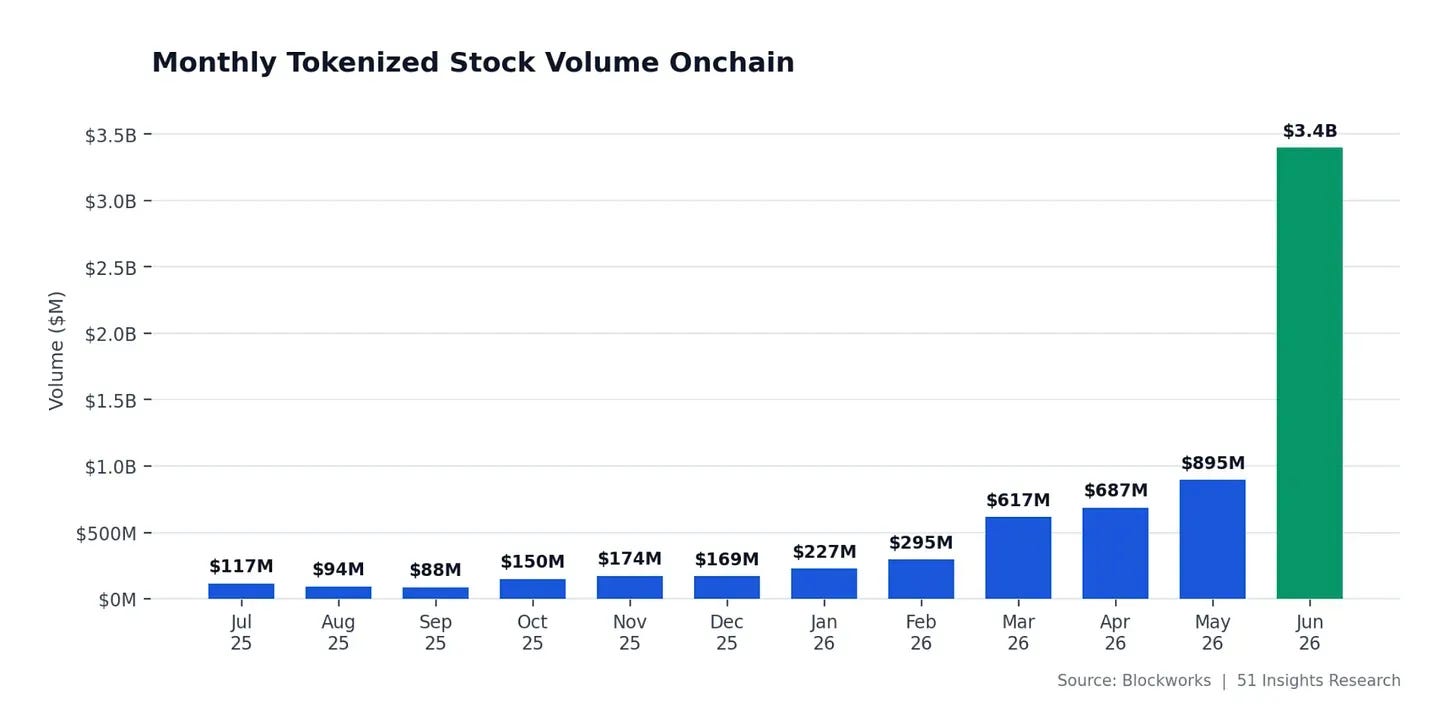
The article opens with June data. Onchain tokenized stock trading reached a record $3.86 billion in June, up 145% from the previous month. The main trigger, according to the piece, was SpaceX. On June 12, SpaceX listed on Nasdaq and raised $7.5 billion, and tokenized SpaceX stock went live on Solana the same day.
Tokenized SPCX alone generated $1.19 billion in trading volume, or about 31% of all tokenized stock trading that month. Solana handled roughly 96% of that volume. By June 23, tokenized assets had, for the first time, exceeded meme coins in Solana’s daily spot trading share. Active addresses retested yearly highs, and throughput moved close to record levels.
Yet the article says SOL traded at about $77. That was down by half over the previous year, 73% below its peak, and at its lowest level since December 2023 in mid-June. The author frames the contrast this way: the most-used network in the fastest-growing category of crypto was being priced as if it were in decline.
Mainstream explanations cited in the piece include the bear market, ETF outflows, and simple patience. The author offers a different reading. In this account, what broke was not just the cycle but the link between usage and token value itself. Value creation, the article argues, has moved away from the token layer and into the equity of infrastructure companies — companies that often do not have tokens at all.
The biggest value events are landing in equity
To support that claim, the article points to several deals and capital-market events:
- Stripe acquired Bridge for $1.1 billion in February 2025.
- Mastercard signed an agreement in March to acquire BVNK for as much as $1.8 billion. The piece adds that Coinbase had previously come close to buying BVNK for about $2 billion, but that deal fell apart in November.
- Kraken agreed in December 2025 to acquire Backed Finance, the issuer behind xStocks, as part of preparations for a 2026 IPO.
- Securitize is listing its common stock on the New York Stock Exchange and tokenized that stock on Solana on its first trading day.
None of these value events happened in a token, the author writes. All of them happened in equity.
Why equity is capturing the economics
The explanation given is legal and financial rather than ideological. Equity comes with enforceable claims on cash flow. Most tokens do not.
When $3.86 billion in tokenized stocks traded on Solana, the network earned only fractions of a cent per transaction because near-zero fees were part of the product design. Mint and redemption spreads, custody fees, and market-making profits did not accrue to the token. They flowed to issuers, brokers, and exchanges. In the author’s framing, tokens got the headline while companies got the revenue.
Ethereum settlement captured $1,538 from Robinhood’s chain
The article then turns to Robinhood. On July 1, Robinhood launched its own chain, a Layer 2 built on the Arbitrum stack, to offer tokenized stocks to customers in more than 120 countries. Within a week, the chain was processing $568 million in daily trading volume.
ARK Invest’s Lorenzo Valente later published a revenue breakdown cited in the piece. Since launch, the chain had generated about $816,000 in total revenue. Robinhood kept roughly 89%, Arbitrum took 10%, and Ethereum earned just $1,538 for settlement.
The author uses that split to challenge the fat protocol thesis directly. If the base layer is supposed to capture the value, then here the base layer captured $1,538, or 0.15%. The actual financial instrument tied to the success of Robinhood’s chain, the article argues, is HOOD on Nasdaq. There is no Robinhood chain token, and, in the author’s view, no one is missing one.
A telecom-era comparison
The commentary extends the argument with an internet analogy. TCP/IP, HTTP, and SMTP created enormous value, but they did not capture much of it. The value flowed to businesses built on top of them: Google, Amazon, Netflix, and Airbnb.
In the late 1990s, telecom operators laid more than 80 million miles of fiber in an attempt to own internet growth. George Gilder was cited as saying there would be “no losers” in a trillion-dollar market. Within a year, the piece says, two operators he backed had gone bankrupt. More than $500 billion was wiped out, 216 telecom companies failed, and 85% of fiber remained dark even in 2005. That dark fiber later made bandwidth cheap enough for companies like YouTube to exist. Pipes created value. Companies on top captured it. The author says Layer 1 crypto is replaying the same trade.
The structural flaw in token financing
The article also argues that a large share of token projects from the last decade would not have been financeable in traditional markets because they lacked revenue, lacked enforceable claims on future revenue, and lacked a credible plan to produce either.
In equity markets, the author says, such companies would not get funded. In crypto, many did, because tokens solved one problem that securities do not: they let early investors exit before a company actually creates value.

Binance Research was cited as documenting this in 2024. At listing, only 13% of token supply was circulating on average, while about $155 billion in locked supply was scheduled to enter the market between 2024 and 2030. Venture funds could buy at private-market prices and sell into lightly regulated secondary markets after a one-year cliff instead of waiting 7 to 10 years, as equity investors often do. The buyers on the other side, the article says, were retail investors.
Even some venture investors have acknowledged the issue. Dragonfly’s Haseeb Qureshi was quoted as describing price discovery for such listings as happening in private markets that were “manipulated, delusional, or both.” The article stresses that this does not require fraud. The structure is disclosed and legal. That is precisely what makes it damaging in the author’s view: it pays people not to build.
Celestia and Polkadot as case studies
The piece then points to Celestia and Polkadot. Celestia’s TIA launched with 8% annual inflation and peaked near $20.85 in February 2024. On October 30, 2024, a cliff unlock released 176 million tokens, nearly doubling circulating supply. Early backers sold over the counter, buyers hedged with perpetuals, and roughly 409 million more tokens were set to unlock through early 2027.
The article says TIA now trades below $0.40, down about 98% from its high. The network activity supposedly tied to those emissions has been weak by comparison. In one recent 24-hour period, the entire network recorded just $89 in fees. Not $89 million. Eighty-nine dollars, against a market capitalization close to $370 million.
Celestia is presented not as an outlier but as a pattern. Polkadot, once a top-five asset in 2021 with a valuation above $50 billion, is used as another example. On June 28, DOT hit an all-time low of $0.7993, six years after launch. The token was said to be trading below $0.90, down about 98% from its peak and even below its 2020 launch price.
The article notes that this happened even after Polkadot did what holders had long asked for. In March, it set a hard cap of 2.1 billion DOT and cut issuance by more than half. In the same month, it received a spot ETF listed on Nasdaq. It also remained near the top of developer activity rankings. Fundamentals improved, the author argues, but price still made new lows because price was never truly tied to fundamentals in the first place.
Even Solana did not fully convert usage into price
Solana is described as the strongest counterexample and, for that reason, the most telling one. SOL has real fee capture, real staking economics, and some of the deepest usage in the industry. Even so, during a period when tokenized equities and onchain activity were setting records, the token still decoupled.
If the best token cannot convert record usage into price, the article says, weaker tokens have little case left to make.
Public investors often cannot access the value layer
That leaves what the author calls an uncomfortable asymmetry. The layer public investors can buy usually does not capture the economics. The layer that does capture the economics often sits inside private companies and is absorbed by firms such as Stripe, Mastercard, or Kraken before public investors get access.
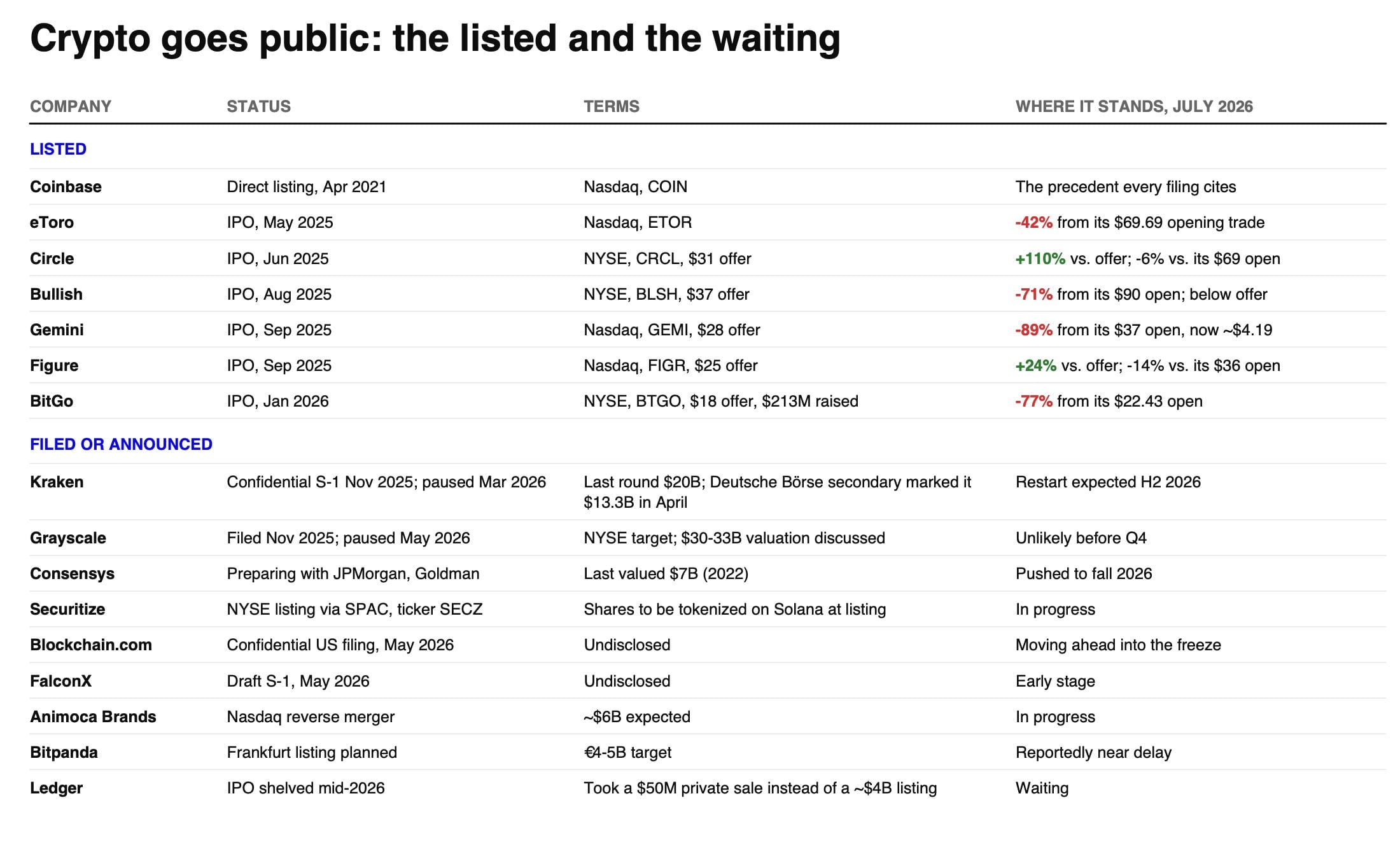
Even IPOs are not a cure-all. Crypto companies raised $3.4 billion through IPOs in 2025, and a 2026 pipeline is forming, the article says. Public markets then applied the same scrutiny. Gemini fell 89% from its opening price, BitGo dropped 77%, and Bullish lost 71%.
By contrast, businesses with recurring revenue tied to actual usage held up better. Circle was still trading about 110% above its issue price, while Figure was about 24% above issue. Equity is not a magic wrapper, the author writes. It is a claim on cash flow, and where that cash flow is real, the claim can hold up even in a harsh crypto market.
A bear market as an audit
The final section describes the bear market as an audit. Each drawdown separates a claim on something tangible from a claim on attention. It does this across asset classes, not just tokens, which is why even exchange stocks tied to trading-volume leverage have also been repriced sharply.
In the author’s reading, a decade of crypto capital formation is being marked to market, and the market is placing value where there is a legal claim on real cash flow.
The article acknowledges counterarguments
The author does leave room for objections. Tokens can be programmable claims, and fee switches, buybacks, and revenue sharing could reconnect usage and price. The piece also says Solana’s Alpenglow upgrade, along with a genuine regulatory framework, could help do that.
Dragonfly’s Haseeb Qureshi is also cited as noting that a 13% circulating supply at launch was normal in the previous cycle as well, so the structure itself is not new. What may be new is that marginal buyers are no longer showing up. The divergence could also be a beta issue. Tokenized RWA has risen 40% year to date, while the broader crypto market is down about 20%, meaning the gap could narrow if macro conditions turn.
Still, the author’s bet is that any compression will be limited because the gap is contractual rather than cyclical. The fat protocol thesis said value would pool at the protocol layer and the token would represent an investor’s share. What this cycle has shown, the article concludes, is that value is pooling in entities with legal claims — and those claims have been sitting on cap tables, not in tokens.