
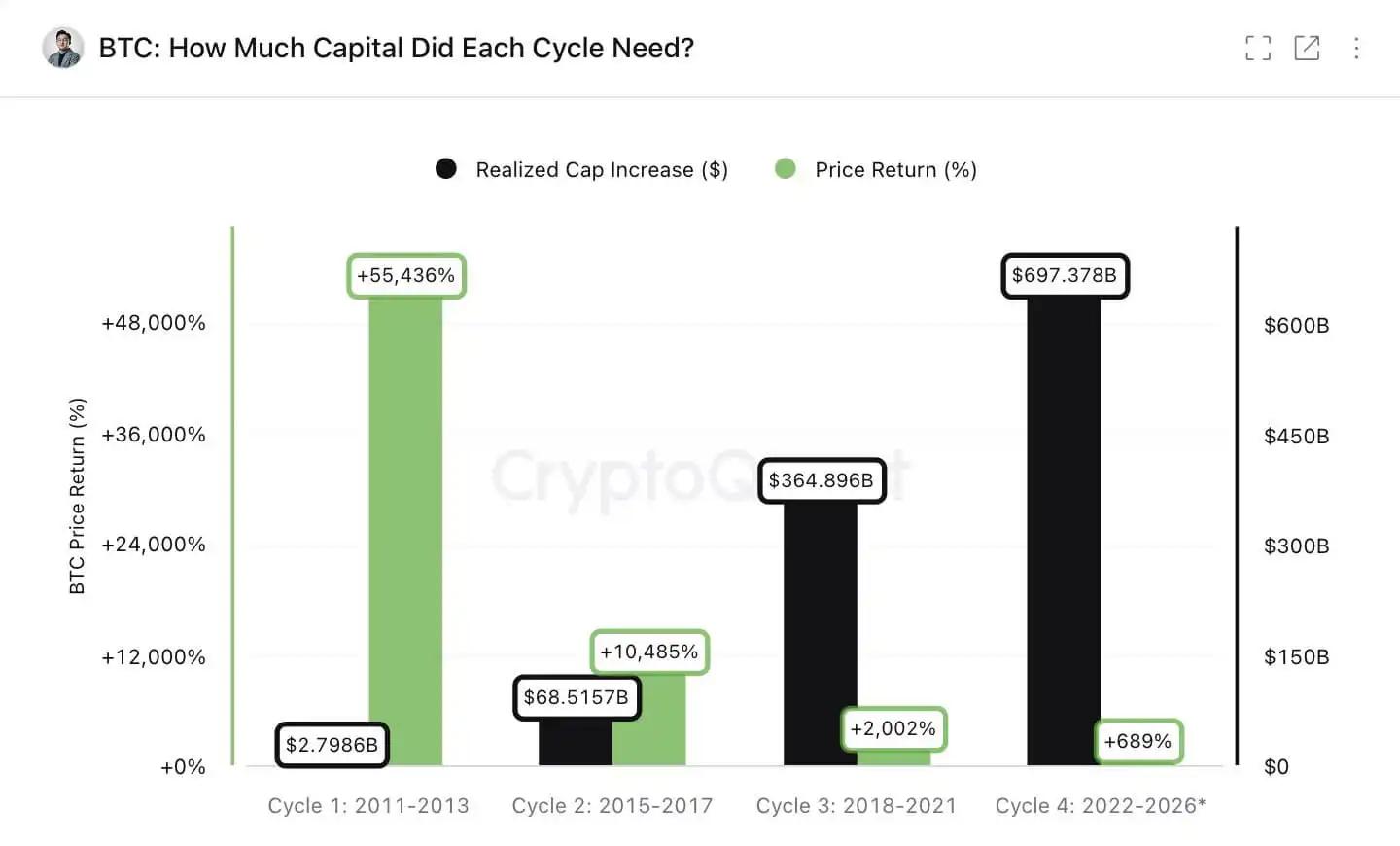
CryptoQuant founder and CEO Ki Young Ju says Bitcoin has reached a stage where its sheer market size has materially changed how price moves are generated. In earlier cycles, relatively small additions of capital could produce explosive upside. That is no longer the case. His core argument is that Bitcoin’s next major rally will depend less on whether investors believe in the asset and more on whether large pools of capital are willing to allocate meaningful money to it on a sustained basis.
The article notes that BTC is trading around $63,000, down roughly 50% from the peak above $126,000 seen in October last year. Against that backdrop, the key issue is not simple bullish sentiment, but whether institutional adoption is deep enough to offset Bitcoin’s declining price sensitivity as the market grows larger.
A larger Bitcoin market has changed the math of each cycle
Ju compares Bitcoin’s realized capitalization growth across several bull cycles with the price appreciation that followed. Realized cap, typically calculated using the price at which coins last moved on-chain, is widely used as a proxy for how much capital the network has effectively absorbed. His conclusion is straightforward: as Bitcoin matures, each incremental dollar has less impact on price.
According to his figures, the 2011 cycle saw about $2.7 billion in net capital inflows associated with roughly 55,000% price appreciation. In the current cycle, Bitcoin has absorbed around $697 billion, yet the price gain has been only about 689%. The same trend appears in smaller increments as well. Ju says that in 2011, around $5 million of fresh capital could double Bitcoin’s price. In the current cycle, that figure has risen to about $101 billion.
That does not invalidate the bullish case for BTC. It does, however, change the type of demand required to sustain it. In Ju’s view, another major rally remains possible if Bitcoin becomes more deeply embedded as a macro asset allocation rather than being driven primarily by retail speculation or short-term trading flows.
ETF outflows weaken the near-term institutional demand story
This shift matters at a time when the most visible institutional access vehicle for Bitcoin is under pressure. U.S. spot Bitcoin ETFs, launched in 2024, broadened access by giving wealth advisors, hedge funds, and traditional investors a regulated route into the asset. But recent flow data has turned negative, undermining the argument that institutional demand is already strong enough to support another large upward repricing.
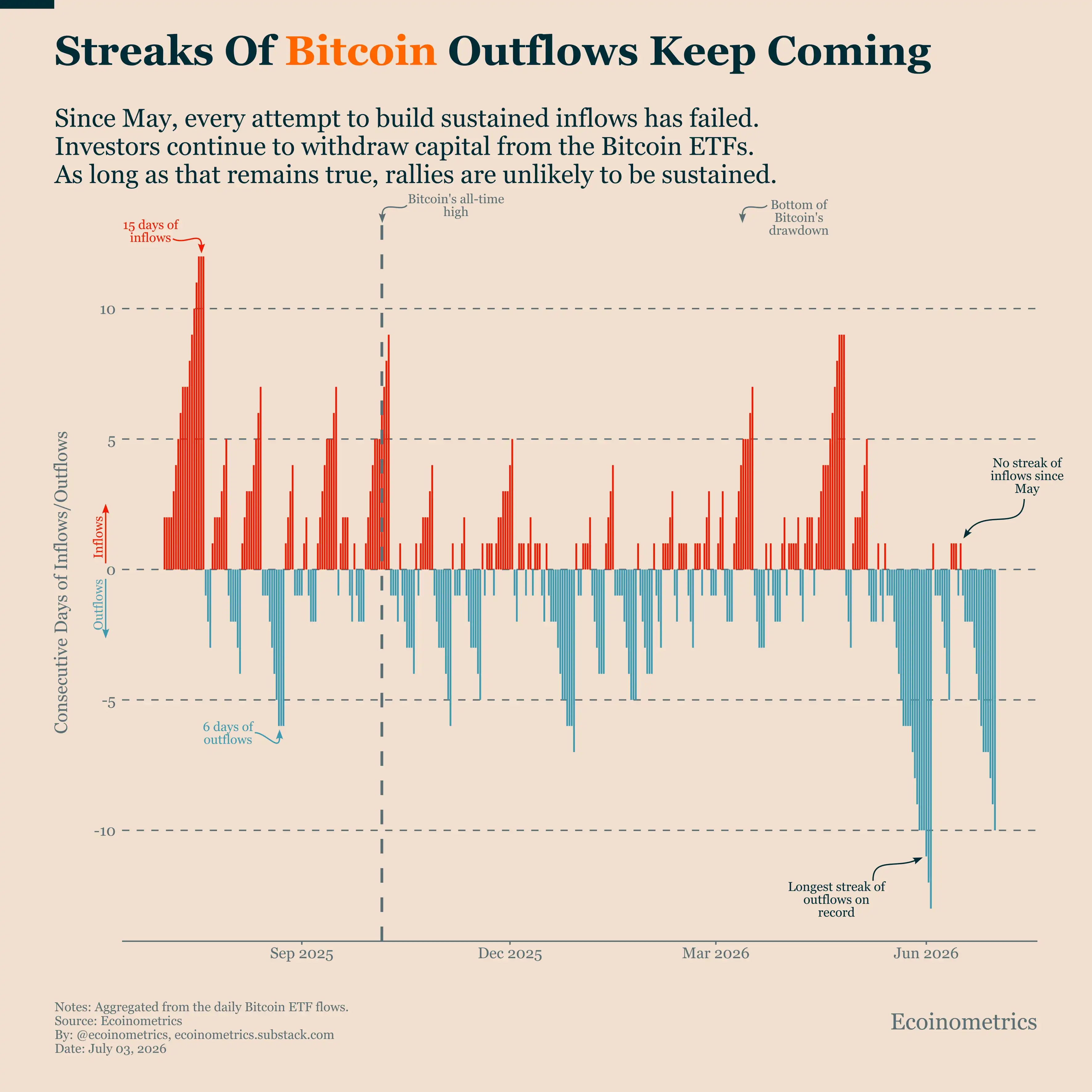
Data cited from Santiment shows that spot Bitcoin ETFs have seen nearly $10 billion in outflows since early May, with 12 products now in an eight-week streak of net redemptions. Ecoinometrics described the pattern as one-sided, saying repeated attempts to rebuild inflow momentum have stalled almost immediately. According to that view, inflow streaks have struggled to last even more than a day, while outflow streaks have repeatedly extended for several days at a time, forming the longest such period since the ETFs launched.
Those outflows complicate the case for a quick return to previous highs. During the run to Bitcoin’s October record, investors were still rewarding ETF accessibility and treating BTC as a beneficiary of friendlier policy expectations, deeper institutional participation, and broader integration with global markets. The recent weakness suggests that access alone is not enough. The next phase likely requires more durable allocations across wealth platforms, model portfolios, corporate balance sheets, and other slower-moving but larger capital pools.
Institutions are still interested, but the standards are higher
Even so, the article argues that institutional interest has not disappeared. A January 2026 survey by Coinbase and EY-Parthenon of 351 institutional decision-makers found that nearly three-quarters planned to increase their crypto allocations, while 74% expected crypto prices to rise over the next 12 months. That suggests appetite remains, but the form of participation is very different from earlier, retail-led cycles.
The same survey found that 49% of respondents placed greater emphasis on risk management, liquidity, and position sizing. It also said that 66% already had exposure through spot crypto ETFs or exchange-traded products, while 81% preferred to gain spot exposure through registered vehicles. These findings reinforce the idea that regulated wrappers remain central to the next stage of adoption.
At the same time, they also explain why sustained ETF weakness matters. If ETFs are the primary institutional gateway, prolonged softness in those products could slow the broader allocation process. Institutions are more likely to demand custody standards, liquidity depth, governance clarity, compliance approvals, and portfolio mandates before exposures become strategic and persistent.
In that sense, Bitcoin’s capital efficiency challenge cuts both ways. Its size makes it more acceptable to traditional finance, but that same size means the marginal buyer now needs to be larger, more consistent, and less speculative than the investors who drove earlier cycles.
The next bull market may depend on more balance sheets, not more retail traders
The article also cites Strategy executive chairman Michael Saylor, who argues that Bitcoin’s next decade will be driven less by miner issuance and more by capital flows across the broader financial system. He lists ETF flows, corporate treasury flows, sovereign reserve flows, bank credit flows, derivatives flows, insurance flows, collateral flows, structured credit flows, and global savings flows as the forces that could shape Bitcoin’s trajectory going forward.
The broader implication is that Bitcoin’s supply story is no longer novel. The issuance schedule is known, the halving cycle is widely understood, and the asset now trades at a scale where much larger pools of capital are required to move price meaningfully. Any new repricing, therefore, must come from channels capable of absorbing value in a market worth more than $1 trillion.
That means ETF demand is only one piece of the puzzle. A stronger cycle may require wealth advisors to place Bitcoin into model portfolios, corporations to use it more actively on their balance sheets, banks to build credit products around it, and insurers, asset managers, and even sovereign entities to consider BTC as a long-term macro allocation.
But that institutional path may be slower than a retail momentum cycle. It also exposes Bitcoin more directly to interest-rate expectations, regulatory delays, liquidity shocks, and competition from other major destinations for capital. The report specifically points to AI-related assets and infrastructure as one of those competitors, arguing that they have absorbed a large share of investor attention this year, with spending and investment forecasts measured in the trillions of dollars.
In earlier crypto cycles, looser speculative capital may have found its way into Bitcoin more easily. In the current market, BTC is competing for the same institutional money targeted by AI equities, private infrastructure deals, credit products, commodities, and other macro trades. That competition now sits at the center of the Bitcoin cycle debate.
Overall, Ju’s argument is not that Bitcoin can no longer rally sharply. It is that the conditions required for such a rally have changed. As the asset grows larger, its price elasticity falls. The next major uptrend is therefore less likely to be driven by retail enthusiasm alone and more likely to depend on whether wealth advisors, corporations, banks, and sovereign funds decide to treat Bitcoin as a durable part of long-term macro allocation.