
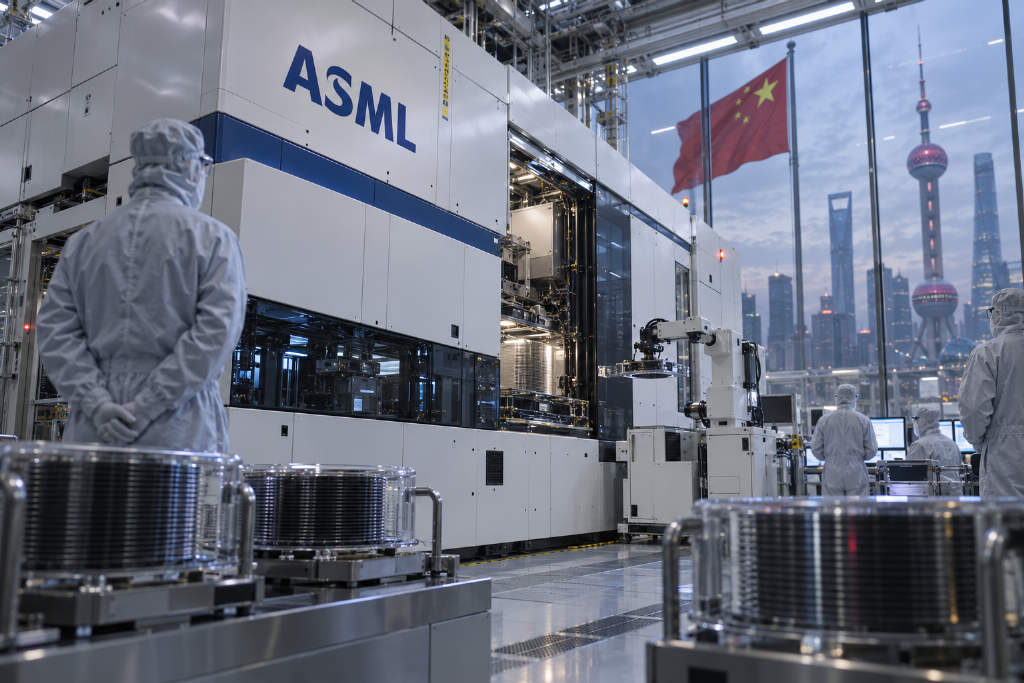
The Center for Technology Statecraft (CTS), a US think tank, released a report on Sept. 26 estimating that Chinese domestic fabs had accumulated about 343 immersion DUV lithography systems by the first quarter of 2026. Around 270 of those, the report says, are ASML’s NXT:1980i tools, which can still be exported to China with approval.
The report was written by CTS senior research fellow Nicholas Brown and director Saif M. Khan. Their recommendation is direct: the US should fully ban exports of immersion DUV equipment to China.
Report puts NXT:1980i systems at roughly 270 units
According to CTS, about 270 of the immersion DUV systems installed at Chinese domestic fabs are NXT:1980i machines, accounting for around 80% of the advanced models in the country’s domestic installed base. The rest include 22 NXT:2050i and six NXT:2100i systems imported between 2021 and 2023, before restrictions across China took effect in January 2024, plus about 45 older machines below the NXT:1980i generation. That brings the total to about 343 units.
The estimate does not include fabs in China operated by multinational companies.
The report says ASML’s NXT:1980i and NXT:1970i can support 7 nm logic production as well as HBM2e and HBM3 memory. It links those capabilities to AI chips including Huawei’s Ascend 910C and 950DT. Exports of those two models to China require Dutch licenses, but CTS says publicly available information points to large volumes of approved shipments. Older systems at or below the NXT:1965i level do not require licenses, and current Dutch servicing rules still allow ASML to maintain already installed machines in China.
CTS says imports accelerated after Dutch controls tightened
The report says China began importing the NXT:1980i in the late 2010s. It adds that imports accelerated sharply in 2023 after the Dutch government announced controls on more advanced models.
CTS also says existing evidence indicates that CXMT, described in the report as China’s main HBM manufacturer, has continued to obtain large numbers of immersion DUV systems in recent years. Hua Hong Semiconductor may also have spent years stockpiling equipment for a 7 nm advanced logic line, according to the report.
Report calls for broader restrictions and a servicing ban
The report recommends replacing current partial controls with a China-wide export ban covering immersion DUV systems made outside the US by ASML and Nikon. If Japan or the Netherlands does not cooperate, CTS says the US could use authorities including the Foreign Direct Product Rule, or FDPR, to impose the restrictions on its own.
It also calls for a ban on foreign personnel servicing immersion DUV tools used by advanced-process fabs in China, along with limits on key components such as Zeiss projection optics and ArF excimer laser sources.
Estimated impact on ASML service revenue
CTS estimates that if China maintains its 2024-2025 pace of NXT:1980i imports for another five to 10 years and deploys all of those tools into AI chip manufacturing, annual output could reach hundreds of millions of H100-equivalent chips. In some scenarios, the report says, that could approach or exceed output from the US and its allies.
The report also argues that China is unlikely to mass-produce immersion DUV systems capable of supporting 7 nm before the middle of the 2030s.
For ASML, CTS estimates that the main short-term hit would come from lost China service revenue of about $1 billion to $1.5 billion a year, equal to 3% to 4% of ASML’s 2025 revenue. The report also recommends exemptions for allied-company fabs in China, including Samsung’s Xi’an operations, SK hynix facilities in Wuxi and Dalian, and TSMC’s Nanjing fab, as long as they remain owned and operated by their parent companies.



