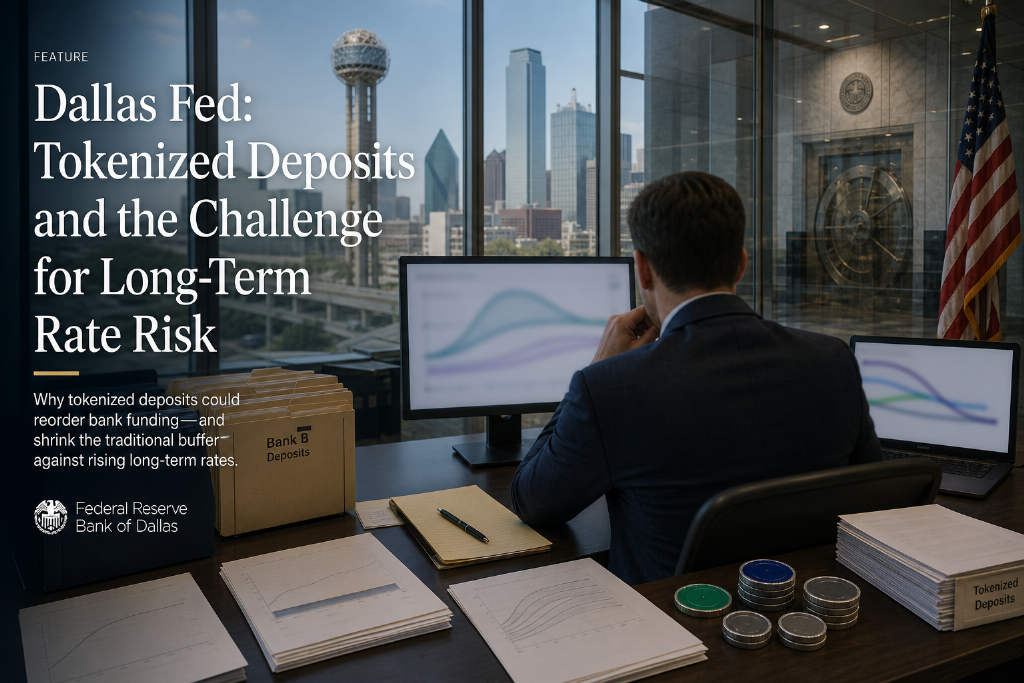
CoinDesk reported that two economists at the Federal Reserve Bank of Dallas modeled how tokenized deposits could affect US banks’ ability to absorb long-term interest-rate risk. In one scenario, if tokenized deposits make depositors 10% more sensitive to interest rates, US banks’ capacity to hold long-term rate risk could fall by about $700 billion. In a second scenario, if tokenization causes 10% of deposits to leave banks earlier, banks’ capacity to absorb interest-rate risk tied to long-term loans and securities could drop by about $580 billion. The estimates outline how changes in depositor behavior, rather than a direct balance-sheet shock alone, may alter banks’ role in carrying duration risk.
According to CoinDesk, two economists at the Federal Reserve Bank of Dallas estimated that US banks’ capacity to hold long-term interest-rate risk could decline by about $700 billion if tokenized deposits make depositors 10% more sensitive to interest rates.
In another scenario, if tokenization leads to 10% of deposits leaving banks earlier, lenders’ capacity to absorb interest-rate risk from long-term loans and securities could shrink by about $580 billion.
This article was originally published by Bit.Fan. For more cryptocurrency news and market insights, visit www.bit.fan. Disclaimer:
The market information, project data, and third-party content displayed on this platform are for industry information sharing only and do not constitute any form of investment advice or return commitment.
Cryptocurrency trading carries high risks. Users should fully assess their risk tolerance and make independent decisions. All profits, losses, and legal responsibilities are borne by the users themselves.