

Dan Koe has published another essay. Its title: The most lucrative AI business to start in 2027.
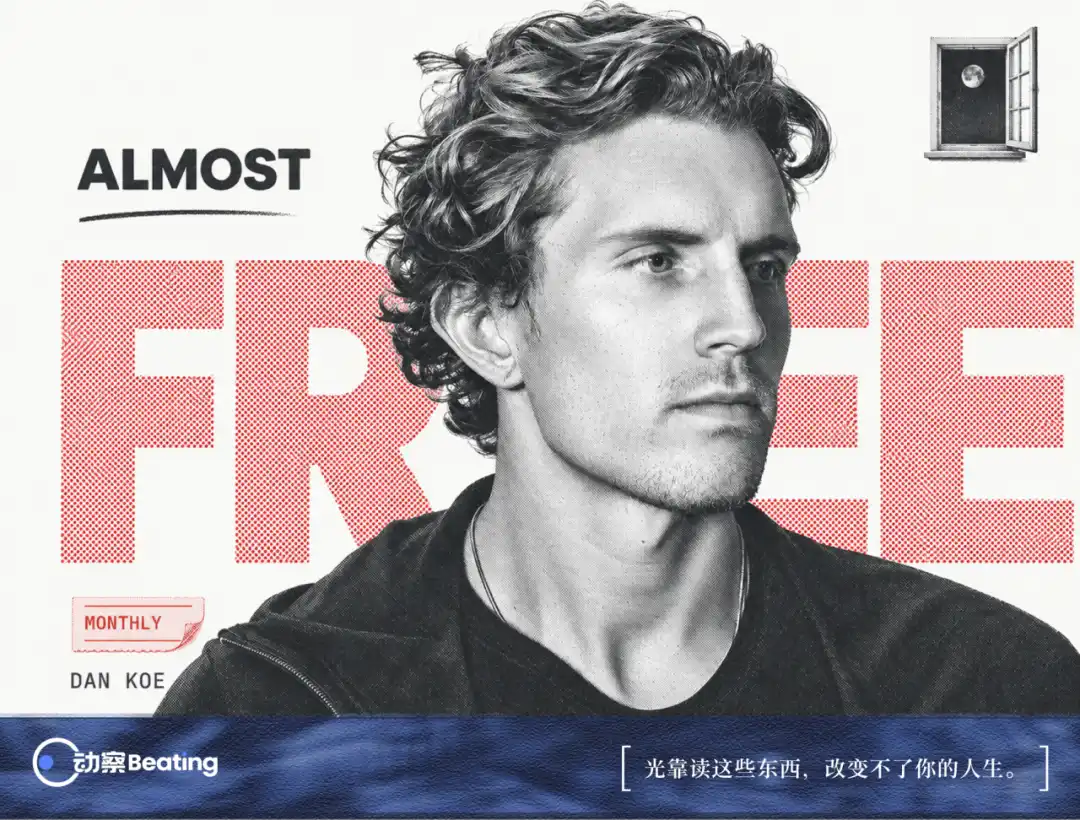
His answer is simple. The best AI business in 2027, he says, will be serving as a "one-person creative team" for other people. The job is to interview clients, use AI to break down their past hit content, and map out enough material to last six months. For a first client, Koe says charging $2,500 to $5,000 a month is realistic.
At the end of the article, he sells a $49 writing workshop.
It is the 27th article he has published this year. Nearly 10 months have passed since the post that pushed him far beyond his existing audience.
Born in 1996, Koe is an American creator who talks about personal growth and one-person businesses on X, YouTube, and Instagram. On Instagram alone, he has 1.7 million followers.
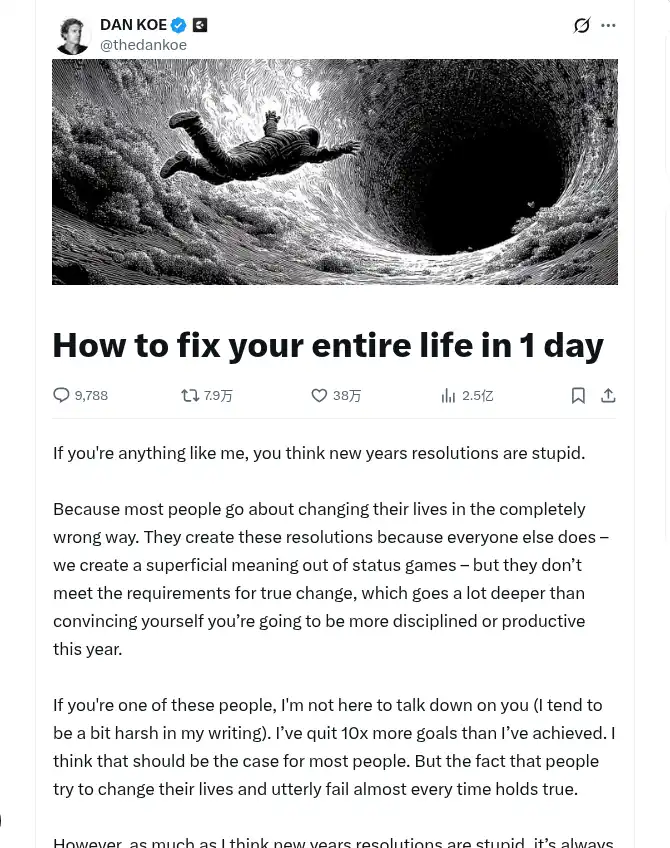
The post that broke him into a much wider audience was published on Jan. 12, 2026: How to fix your entire life in 1 day. According to the MarsBit article, it has generated 250 million impressions on X so far.
After that post took off, Chinese internet platforms quickly picked it up with bilingual reposts, long explainers, and "I followed this for 30 days"-style content. Koe started being described as a "godfather" of the one-person business model.
Since May 2021, he has published 262 newsletter posts totaling more than 800,000 English words. The MarsBit writer says they read them one by one.
His first newsletter post went out on May 12, 2021. The title was Why Self-Help Is Ruining Your Life.
In the English-speaking world, self-help is a defined category, spanning books, courses, and talks built around changing yourself. MarsBit places it close to the Chinese mix of success literature and motivational "chicken soup." Koe’s point in that first essay was that many people read this material only for the dopamine hit of reading it. He called that "mental masturbation," arguing that reading alone would not change a life.
Today, the bottom of that page carries links to his book and paid membership.
MarsBit frames the contradiction plainly: someone who began by criticizing self-help became, five years later, one of the most successful self-help writers of his era. The article asks what happened in between, why it happened in these five years, why it happened to him, and why so many people were ready for it.
From Mormon Sunday school to a new kind of preaching
Koe rarely talks directly about his family, but MarsBit says the fragments scattered across more than 200 essays are enough to sketch an outline.
He grew up in The Church of Jesus Christ of Latter-day Saints, commonly referred to as the Mormon church. On Sundays, he wore black slacks, a white shirt, and a tie from his father to church, where he sang "I Am a Child of God" in Sunday school.
Latter-day Saints carries an end-times meaning in the phrase "latter days." The church teaches that people can progress eternally until they become like God. MarsBit cites a line associated with the church’s fifth president, Lorenzo Snow: "As man now is, God once was; as God now is, man may be."
That doctrine did not persuade the child Koe once was.
He later wrote that he was highly judgmental as a kid and felt the people around him had been brainwashed. He would ask friends at church whether they really believed. They would recoil a little, he wrote, and their eyes would show a brief "glitch," as if their thoughts had snapped back to what their parents had taught them. Adults gave him roughly the same answer: "Just have faith."
He made a rule for himself. Go against everyone.
Before college, his parents divorced and money at home tightened. At 18, he was expected to choose a major he would stick with for 40 years. Years later, he opened one essay with a line MarsBit quotes directly: "I was lied to as a kid. I have a feeling you were too."
During five years at Arizona State University, he changed majors about five times and tried a string of internet businesses that died one after another. He sent 50 emails trying to build a Facebook ads agency and signed no clients. He spent $100 on ads for an online store selling rave clothing and sold one sequined bra.
At his lowest point, he was living with seven other men in one house, keeping rent down to roughly $300 to $400 a month, working odd jobs at a print shop, and carrying $8,000 in debt. After five years, he had no degree and tens of thousands of dollars in student loans. In his autobiography, MarsBit says, he used one word for that period: doomed.
The book that pulled him out was Eckhart Tolle’s The Power of Now.
He also left the church during those years, studied religion, read anti-religious books, and later turned to Ken Wilber and Spiral Dynamics, two systems that divide human consciousness into levels and describe upward movement through them, with God recast as "Source."
Out of options, he did something he would later tell other people not to do. He got a job.
At a web design company, he learned how an agency operated. After work, he took freelance projects building sales landing pages, or funnels, for clients. His pricing rose from $1,500 per job to $2,500 to $5,000. Once he had enough clients, he quit.
He later said his original dream was modest: being able to afford Chipotle for lunch every day.
MarsBit brings in William James here, citing the distinction in The Varieties of Religious Experience between the "once-born" and the "twice-born." The once-born move through life with natural optimism. The twice-born fall into despair first, then emerge through some saving force. They often become the most fervent missionaries.
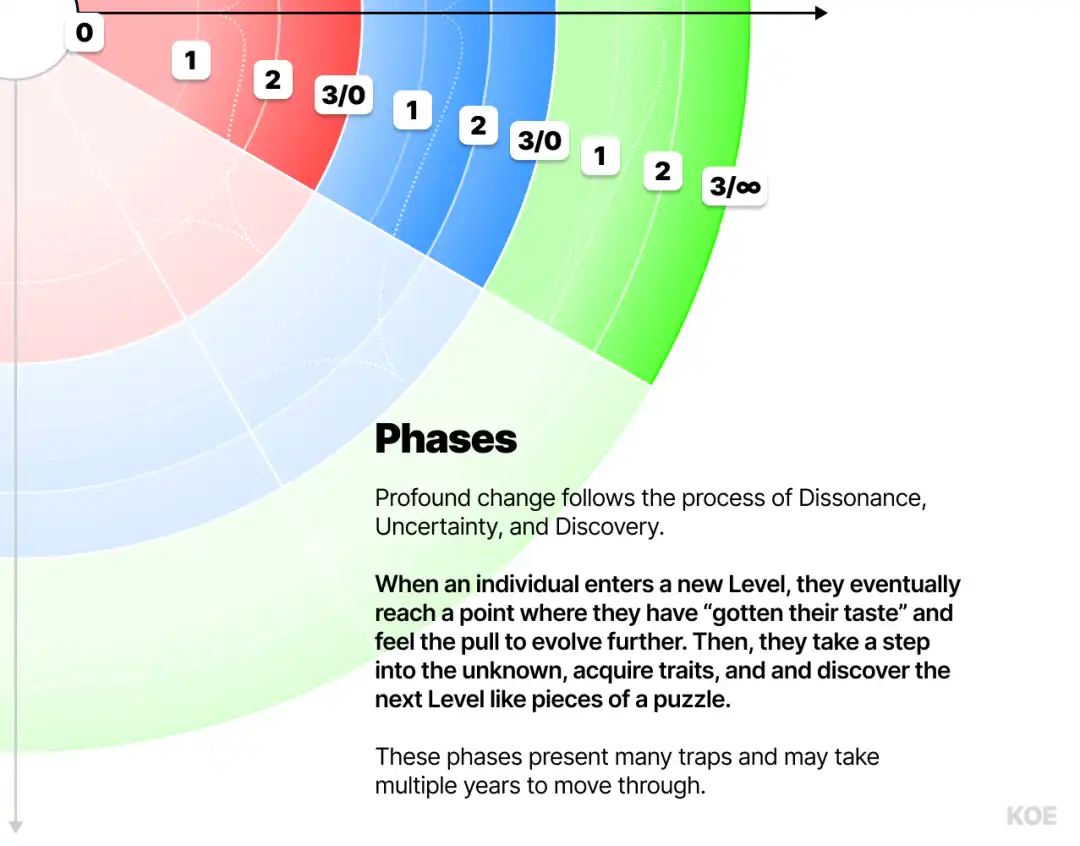
Koe later reduced life change to three stages: disorientation, uncertainty, and discovery. MarsBit says the 250 million-impression article was built to walk readers through all three in a single day: answer 15 questions in the morning, write an "anti-vision" describing the life you most do not want, and use that pain to push yourself forward.
The article translates that structure into another language: awareness of sin, crisis, grace. In other words, a conversion.
The timing was perfect, and he fused spirituality with business
Koe’s preaching, in MarsBit’s telling, began on Twitter in 2019.
The timing was unusually good. Months later, the pandemic arrived and pushed everyone toward screens. In November 2021, 4.5 million Americans quit their jobs in a single month, making the Great Resignation a defining story. Before that, Tim Ferriss’s The 4-Hour Workweek and Naval’s line about productizing yourself had already turned escape from office life into a generational fantasy.
Koe also had craft. His frameworks were clear, his sentences were short, his hooks were sharp, and his output was steady. He broke apart and recombined Tolle, Naval, Ferriss, and flow theory, then posted at high frequency during the years when Twitter’s algorithm was especially generous. When he had only a few hundred followers, he built his first course teaching freelancing and was making about $3,000 a month from it.
Income rose quickly. By his own account, he made $100,000 in 2020. In 2022, he hit $50,000 in monthly income for the first time. In August 2023, he wrote that at age 26 he had reached $1 million in liquid assets, "until I invested half of it into a new company."
As the money grew, so did the coherence of his worldview. MarsBit points to a February 2022 essay about psychedelic mushrooms as a key moment.
At the time, Koe was microdosing psilocybin once or twice a week. After one dose, he bought a pound of honeycomb at a farmers market and followed the chain of thought downward: how honey is made, how bees relate to plants, and eventually how a business could emerge from that kind of observation.
He called this the "iceberg of opportunity," divided into four layers: appreciation, understanding, mastery, and monetization. The first three carry the imprint of The Power of Now, with its emphasis on quieting mental noise and returning to childlike curiosity. The fourth came from his agency experience, where almost anything could be turned into income, then into a product, then into a one-person business.
In that framework, spirituality and commerce meet. One makes people believe. The other gets them to pay.
He later compressed the idea into a slogan: "Solve your own problems and sell the solution."
MarsBit argues that the line curls back on itself in his case. His original problem was how to make money online. The solution he sold was teaching other people how to make money online. Once buyers learned that lesson, the most obvious next step was to sell courses online themselves.
His language also hardened that same year.
In April 2022, some people mocked young buyers of online courses who wanted to "escape the matrix." In this corner of the internet, "the matrix" means the 9-to-5 system, a phrase popularized by influencer Andrew Tate, whom MarsBit identifies as notorious for misogynistic rhetoric.
Koe replied that he did not like Tate, but spending $50 to learn a time-tested monetizable skill was better than spending $40,000 on an outdated degree.
By July, he was writing that 95% of 9-to-5 jobs fit the definition of slavery. He closed one piece by echoing the line from the crucifixion: "Forgive them, for they know not what they do."
In November, he published Making Money Is Spiritual. There he listed what he called "unethical skills": sales, marketing, persuasion, hypnosis, influence, and "game," a pickup-community term for techniques used to attract the opposite sex. He added in parentheses that he taught all of these in his Digital Economics course, except hypnosis.
His justification was that if good people refuse to do business, bad people will take their place. Making money, he wrote, is a way of reversing entropy.
MarsBit places this beside Max Weber’s The Protestant Ethic and the Spirit of Capitalism. Weber described how Calvinists treated worldly success as a sign of grace, then built habits of discipline and accumulation that fed capitalism. In Koe’s version, MarsBit says, even that veil is gone. Success no longer needs to pretend to be a sign. Making money itself becomes the spiritual practice.
He sells not obscurity, but the feeling of accessible depth
Christian theology has a field called homiletics, the study of how to deliver a sermon that moves people.
MarsBit argues that Koe has his own version of it, visible even at the level of word choice. Across more than 800,000 words, "you" appears 29,212 times, while "we" appears only 3,290 times. The most common three-word phrase is "you don’t," used 1,346 times. "Most people" appears 766 times.
He rarely says "we." He speaks to "you."
On July 3, 2026, he published a tutorial saying the most lucrative skill of the 21st century was not AI but understanding human nature. MarsBit says he reduced the human mind to three tensions — survival, identity, and progress — and five levers: point out a threat, mirror identity, exclude some people, describe transformation, and offer a first step.
Those levers map neatly onto his own headlines. "You have about 36 months left" points to a threat. "If you have multiple interests" mirrors identity. "Why most people fail" excludes others. "Fix your entire life" describes transformation. "In 1 day" offers the first step.
Seven weeks later, he published another piece: Give me 20 minutes and I’ll make sure you can never be manipulated again.
MarsBit then invokes the old Chinese paradox of the spear and the shield. If someone teaches people how to manipulate and how not to be manipulated, what happens when his own spear meets his own shield?
His most-liked Substack post is called How to express yourself intelligently. In it, he says he was drawn as a child to people who "sounded smart," even though "most of the time I had no idea what they were saying." Much of his success, he wrote, came from saying valuable things in a way people wanted to hear.
MarsBit’s conclusion is blunt: he does not sell incomprehensible depth. He sells the feeling of depth that can be easily understood.
That feeling is produced through a system.
In October 2025, Koe described his workflow on an entrepreneurship podcast. He picked only validated topics, either his best-performing tweets or the highest-viewed videos in his niche. A prompt called "Viral Deconstructor" fed three hit pieces into a model, extracted structure, hooks, and psychological triggers, and produced a fill-in-the-blank template. Another prompt then interviewed him like a reporter, filled the template, and generated three versions at once.
The product line follows the market.
First, the topics. Per 10,000 English words, the term "AI" rose from less than once in 2023 to 35 times in 2026. "Focus" fell from 20 times in 2022 to 7. The man who wrote The Art of Focus talked less and less about focus. "One-person business" also dropped to roughly one or two mentions per 10,000 words. By the time Chinese internet users were calling him the godfather of the one-person business, he was barely using the phrase himself.
Then the headlines. Because his blog URLs were fixed at publication, later title changes left traces. One article was retitled AI can never replace real creators, while the URL still said "most creators will fail." Another became The 2-hour morning routine that changed my life, while the URL still read "the million-dollar morning routine."
Then the ideas — or more precisely, the same idea in different packaging.
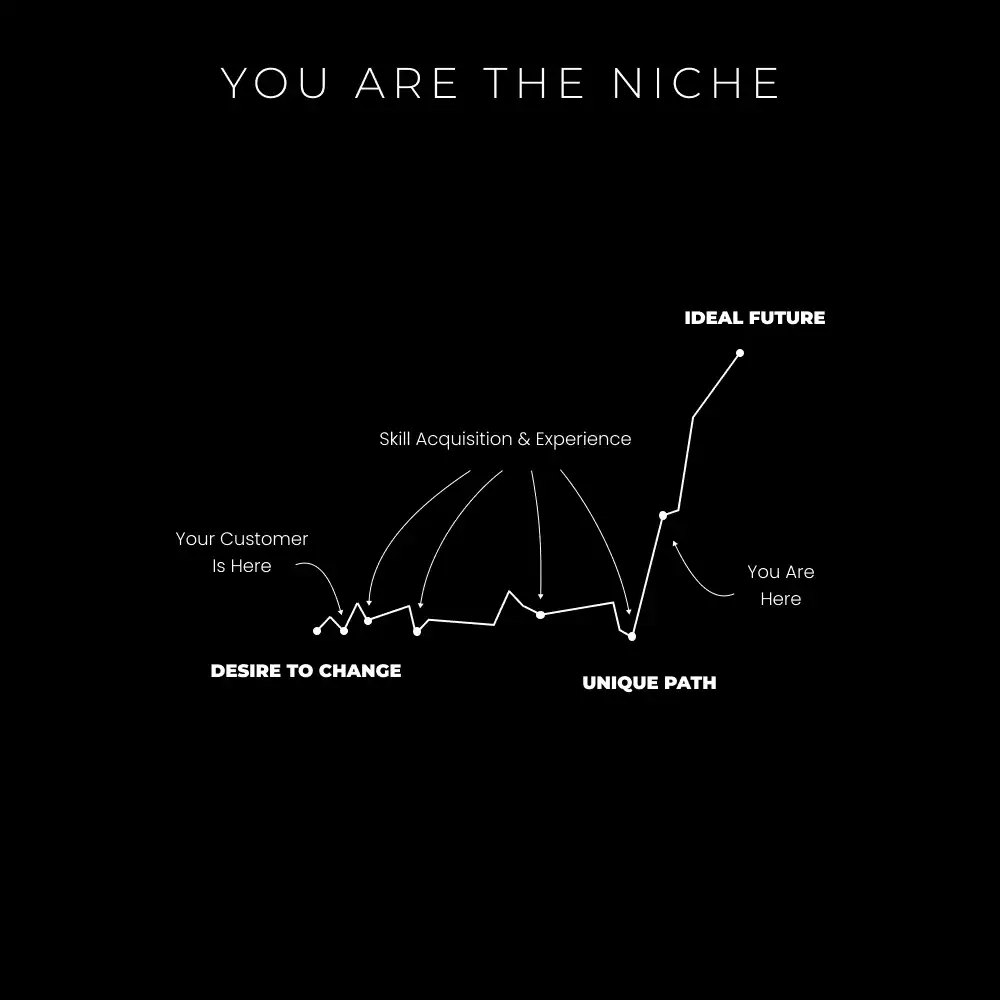
Content creators are often told to niche down. Koe spent five years saying the opposite: don’t pick a niche, you are the niche. MarsBit says he repeated that idea from 2022 to 2026 under at least six different titles.
The hook barely changed.
"99%" appears 91 times in his writing, and at least 11 headlines use either that number or "the top 1%." Be more productive than 99% of people. Get ahead of 99% of people. Use AI better than 99% of people.
MarsBit asks the obvious question: if every reader ends up ahead of 99% of people, where did the 99% go? Probably into his newsletter subscription list.
Time limits are another hook. In his headlines, life change takes one year, six months, 90 days, 30 days, two weeks, seven days, and finally one day.
There is also the death announcement hook. Personal brands, the internet, deep work, the 9-to-5, information products, and influencers all die at least once in his titles. In October 2026, he published The influencer is dead. The first half declared the influencer dead. The second half recommended his own software, Eden, and a 30-day creator course.
NPCs, the top 1%, and a ladder upward
Behind the rhetoric sits a full worldview.
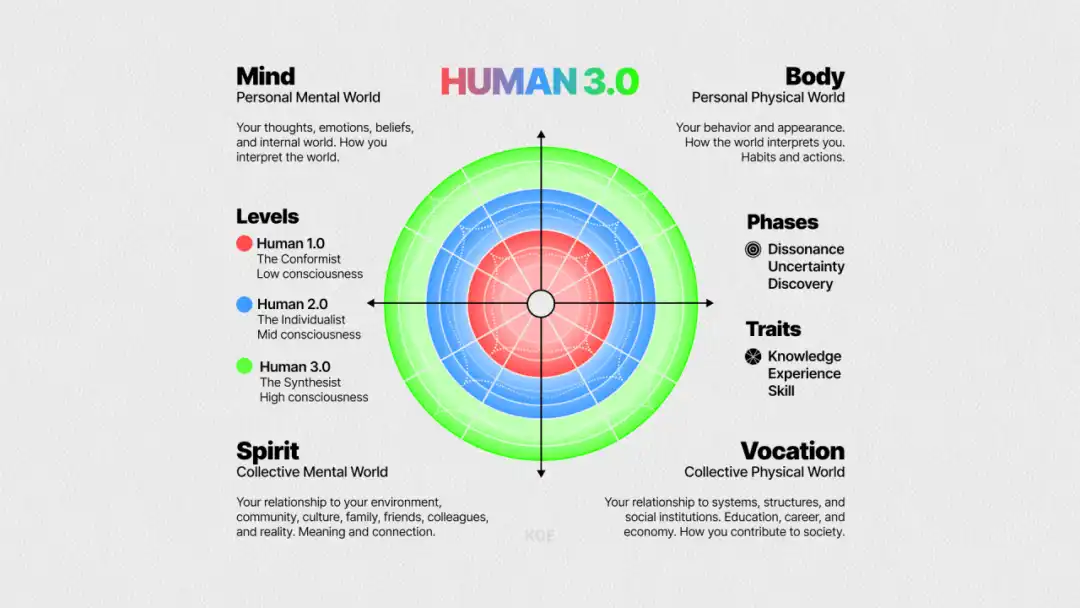
In August 2025, Koe released HUMAN 3.0, subtitled "a map to the top 1%." Life was divided into four quadrants — mind, body, spirit, and career — with three levels in each. In the mind quadrant, those levels had simpler names: NPC, player, creator.
NPC is one of his favorite terms. In You were not born an NPC, the first story he tells is about the "glitch" in the eyes of his church friends.
Three levels. One upward path. A summit only a few can reach. MarsBit notes that Latter-day Saint doctrine also divides heaven into three kingdoms. The article does not claim a deliberate one-to-one match, but it points to the structural resemblance.
In Weber’s account, Calvinists could never know for sure whether they were chosen by God, so they worked relentlessly and treated success as a sign of grace. MarsBit says readers of HUMAN 3.0 carry a similar anxiety. They cannot know whether they belong to the 1%, so they keep reading, learning, and subscribing.
Every purchase becomes a sign.
The NPC label does something else as well. It turns the people around you into scenery. Parents, coworkers, friends telling you not to quit — all become side characters in your main quest. On the analytics dashboard, the newly awakened "player" is just another conversion line.
In April 2026, Koe coined another term: Identity-Lifestyle Fit. He said it was the same thing startups mean by product-market fit, except the product is you and the market is your lifestyle.
Once the person becomes the product, the life they are living becomes a prison to escape.
MarsBit’s line here is sharp: content that teaches people to escape the algorithm is exactly the kind of content the algorithm loves to push.
In September 2026, Koe wrote You need to be delusional if you want to succeed. The old phrase he once rejected — "Just have faith" — had returned in new clothes, this time from his own mouth.
He sells readers the slogan of being yourself, while teaching them to study why other people went viral and let AI imitate the pattern. In February 2025, he also wrote The internet is dead. We killed it.
MarsBit’s answer is short: that may be exactly how it died.
Free content at the top, subscriptions and courses below
The Latter-day Saint church asks believers to pay a tenth of their income. MarsBit compares the creator economy’s monthly subscription model to a modern tithe.
Koe’s funnel is straightforward. Free tweets, videos, and essays sit at the top. Below them are paid layers: a $27-a-month community, a $150 writing course, and higher-ticket programs priced in the thousands.
In July 2023, creator Josh Walker asked 20 peers familiar with Koe what he was really selling. One answer was: "He’s selling dreams at scale."
Another said that for many people, reading Koe is a form of sophisticated procrastination: the reader feels fired up while reading, then changes nothing afterward.
In June 2024, Koe published The 3 stages of monetization (why most creators are actually broke). He drew a funnel in which 100% start, 1% persist, and only 1% of that 1% truly succeed. Why are the rest poor? His diagnosis was simple: skill issue.
In the same piece, he gave a concrete target. To replace a $56,000 annual salary, someone would need roughly $4,700 a month. At $150 per product, that means selling 31 units a month, about one a day. At a 2.5% landing-page conversion rate, that means 1,240 visitors a month.
Where do those 1,240 visitors come from? How many other people are chasing the same audience with the same template at the same time? MarsBit says the article did not address that.
Morning Consult found in 2023 that 57% of Gen Z Americans wanted to become influencers, and 30% were willing to spend their own money to do it. In a market where nearly a third of producers are willing to pay for entry, MarsBit suggests, the safest business model is not hard to identify.
In the Nov. 3 article, Koe also mentioned that another business guru, Alex Hormozi, spends more than $1 million a month paying creators to promote his paid community platform, Skool.
MarsBit sums that up in one line: the people selling shovels are advertising to the people selling shovels.
The article then reaches back to the California Gold Rush and the story of Samuel Brannan. According to the account MarsBit cites, Brannan bought up gold pans around San Francisco, ran through the streets with a vial of gold dust shouting that gold had been found, bought pans for 20 cents, sold them for $15, made $36,000 in nine weeks, and became California’s first millionaire.
Brannan, too, was a Latter-day Saint. Two years earlier, MarsBit notes, he had chartered a ship called the Brooklyn and brought a boatload of believers from New York around Cape Horn to what was then Yerba Buena, later San Francisco.
But the second half of the story matters. In 1889, Brannan died near San Diego nearly penniless, unable to cover funeral costs. His body reportedly sat in a morgue for more than a year, unclaimed.
Even shovels have a cycle.
Kortex burned about $3 million, and Eden still ran into the cost wall
Koe also tried a different path. He did not just sell content. He tried to build software.
In October 2023, he announced that he was putting every dollar into a new company called Kortex, a "revolutionary" writing tool. His pitch was blunt: say goodbye to second-brain tools like Notion and Obsidian.
In February 2024, he wrote that the Kortex team was made up entirely of contractors and creators and had no employees. In April, he published another post: My startup made $759.9K in 6 months (without launching).
The ending came later, from co-founder Matthew Ao.
In a January 2026 retrospective, Ao said the project began in July 2023, grew to around 12 people at its peak, and raised no outside funding. Monthly recurring revenue reached $60,000 at one point, but growth stalled and churn was high. Over two years, the company burned roughly $3 million.
Ao’s first reason was that users did not have a strong enough reason to leave Notion and Obsidian. Another was that the team built its own billing, deployment, and authentication systems before it had users. The authentication system alone consumed engineering time worth hundreds of thousands of dollars.
In November 2025, Koe posted a video titled Kortex: The $3M Mistake. The product was rebuilt and renamed Eden. During Black Friday weekend, Eden generated $250,000 in revenue. Ao added in his retrospective that this came from Koe’s audience and did not mean the company had found product-market fit.
The trouble did not stop there. Eden charged users a fixed monthly fee on the front end, but paid for API usage on the back end. When traffic surged, costs reportedly hit $1,000 every 30 minutes. At one point, the company had only two weeks of runway left and cut more than half the team.
MarsBit uses this to draw a line between two business models.
An article costs almost the same whether 10,000 people read it or 100 million do. AI software adds a compute bill with every additional user. Content businesses have near-zero marginal cost and near-zero moat. Software businesses have moats, but they also have costs.
MarsBit’s point is that a man who preached the one-person business model ran into a different reality the moment he tried to build something with real barriers to entry. Suddenly he needed more than a dozen people and millions of dollars, then stumbled over product, organization, and engineering like countless ordinary startups.
The article adds one more line: he never taught that part in his courses.
Now he is back with The most lucrative AI business to start in 2027, and the answer is content services for other people at $2,500 to $5,000 a month.
That is the same price range he charged for funnel work before quitting his job around 2019. In 2024, MarsBit notes, he had described this kind of service business as a "second 9-to-5."
Seven years later, the article says, he has come back to the starting point. This time the starting point is packaged as the destination.
Why the AI countdown sells so well now
Put Koe’s recent headlines in order and a countdown appears.
By the end of 2024, AGI will make you irrelevant. In May 2025, AI is coming for your job. In July, you have about 36 months left. On Dec. 31, you have about 24 months left to learn these skills. In January 2026, the message becomes: don’t waste the next two to three years, this is your last advantage.
The clock keeps shrinking.
MarsBit argues that this works especially well now because the sense of apocalypse is not entirely invented.
On April 30, 2026, writer Jasmine Sun published a New York Times opinion piece titled Silicon Valley Is Preparing for a Permanent Underclass. She wrote that people in their twenties in Silicon Valley half-joked that they had to get rich before a certain window closed, or else class mobility would freeze once AI took over labor.
Data points in the same direction. A Stanford paper titled Canaries in the Coal Mine found that among occupations most exposed to AI, employment for people aged 22 to 25 fell by 13% relative to others.
MarsBit then places Koe in a longer Chinese internet cycle: from Chen Anzhi and Rich Dad Poor Dad, to columns on financial freedom and personal-brand boot camps, to Li Yizhou’s 199-yuan AI course in 2023. According to Feigua data cited by the article, that course sold about 250,000 copies in a year, generating about 50 million yuan before it was removed across platforms in February 2024.
Discovery, canonization, reposting, course sales, decline, then the next figure. Naval went through it. Tim Ferriss went through it. This round, MarsBit says, belongs to Dan Koe.
Its conclusion is harsh and direct: there is no end to the supply of newcomers because each crop thinks it is the one holding the sickle. Apocalypse has always been one of the best sales tools.
Turning public problems into private self-optimization
Sociologist C. Wright Mills once gave a simple example. If one person in a city of 100,000 is unemployed, that is a personal trouble. If 15 million people are unemployed in a country with 50 million workers, that is a public issue, and the answer will not be found in any one person’s character.

MarsBit says Koe’s writing often performs the reverse move.
Public issues become private failures of identity, pain, or discipline. You have not upgraded your identity. Your anti-vision is not painful enough. You have not answered the 15 morning questions. In September 2025, he published What is wrong with people today? and traced social fragmentation to people "regressing to lower levels of consciousness." One subheading was titled "How people with very low intelligence think."
Byung-Chul Han wrote in The Burnout Society that modern people no longer mainly suffer from being exploited by others. They exploit themselves and mistake that for freedom. In a one-person business, the boss is you, the worker is you, and the supervisor is you. MarsBit argues that the one-person company often compresses the full risk of a company into a single body.
Koe, the article says, lives that logic himself.
Friends once planned for months to celebrate his birthday in Seattle. After a weekend in which he slept in and got nothing done, he wrote that he was furious. Back home, he disappeared, replied to no one, and turned down every invitation. Discipline, he said, made him happy.
Anthropologist Xiang Biao has a term for this condition: suspension. The mind hangs over an imagined future, detached from the life underfoot, and the nearby world disappears with it. The ideal Tuesday three years from now, the anti-vision five years from now, the 36-month window — life becomes a countdown sheet, and today is just the fare paid to reach some later day.
Still, the nearby world occasionally calls.
In August 2024, Koe wrote that his mother always asked what fun thing he had done over the weekend. He almost always answered, "Nothing, same as usual." She would tell him to get out more because he was still young. At the time, he thought maybe something was wrong with him.
In September 2025, he wrote that he had walked a lot, worked a lot, and gone to the gym many times that week. His mother told him to rest. He wrote back in the article that balance is for mediocre people.
In the 250 million-impression article, his mother again tells him to go out and have fun. He writes that he stopped himself from saying: if I were unhappy, why would I live like this?
There had been hesitation earlier.
In November 2021, in what MarsBit says was his third article, he wrote that during holiday visits home he could think only about what he was eating, how much money he had spent, and when he could get back to work. He could even imagine himself silently judging his family’s "normal person" behavior. Later that day, he wrote, he would make a point of being present with them.
For the next five years, MarsBit says, he spent most of his energy telling other people to wake up.
From the iron house to the matrix
MarsBit closes by reaching back to Lu Xun. In 1922, Lu Xun wrote of an iron house with no windows, impossible to destroy, where sleeping people would soon suffocate. If you shouted and woke a few of the lighter sleepers, would you really be helping them by forcing them to suffer an inescapable end consciously?
Lu Xun shouted anyway.
The next year, in a lecture titled What Happens After Nora Leaves Home, he said the deepest pain in life is waking from a dream and finding no road ahead. Dreamers are happy. If no road can yet be seen, perhaps the most urgent thing is not to wake them. Once Nora leaves, she either falls or returns, unless she has money in her pocket.
"Freedom cannot be bought with money, but it can be sold for money."
MarsBit’s final move is to say that the iron house has a new name now: the matrix.
And the people doing the waking no longer hesitate over whether they should shout, because shouting itself has become a business. They tell every newly awakened person that there is a window after all, right here: a subscription that costs a few dozen dollars a month, or a $49 workshop.
The article says this is like painting a moon into a lonely night sky, or drawing a large window onto the wall of the iron house.
Five years ago, in his first article, Koe wrote that reading this kind of material alone would not change your life.
At the bottom of his Nov. 3 article, The most lucrative AI business to start in 2027, there is still the same line that Substack automatically places beneath every post:
Ready for more?



