
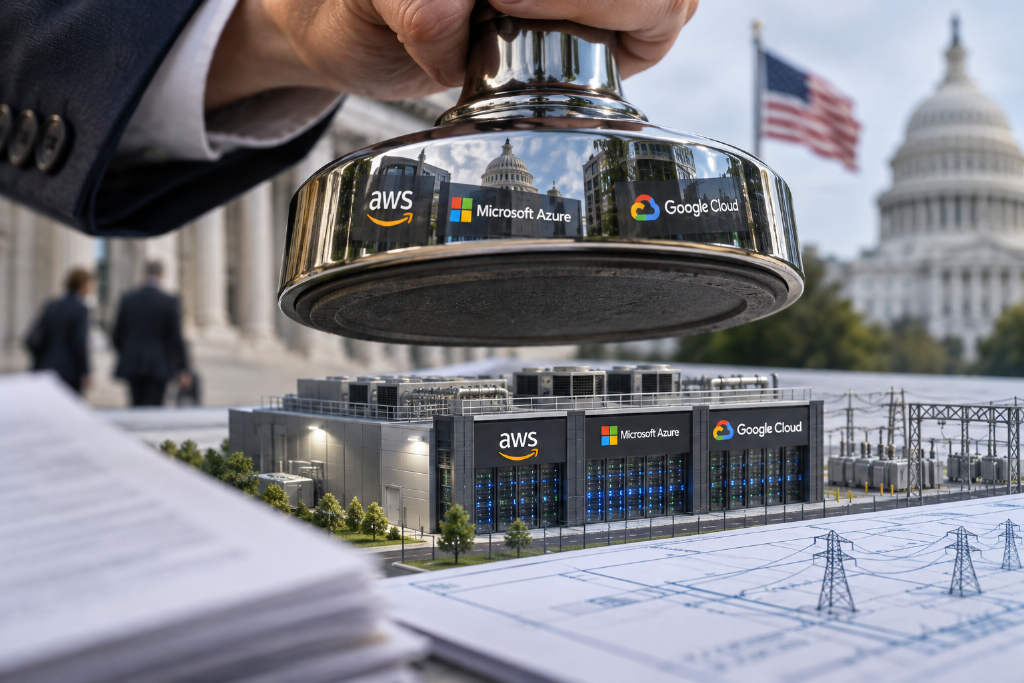
Amazon, Microsoft and Alphabet climbed on Nov. 4 even as expectations grew that data center regulation could tighten after the U.S. midterm elections. Amazon rose 7.1% intraday, Microsoft gained 7%, and Alphabet, Google’s parent, advanced 4.1%.
Two ideas appear to be driving that move. One is that tighter limits on new data center construction could curb future competition and reinforce the market position of the three largest cloud providers. The other is that a slower construction pace could temper capital spending and ease the pressure that AI infrastructure investment has put on free cash flow.
Existing capacity could become more valuable if new supply is constrained
The report said Democrats won control of both chambers of Congress and also prevailed in several key gubernatorial races, raising the odds of stricter limits on data center development. Some winning candidates had backed pauses on new projects until states and localities could assess the impact on power systems, water use and other infrastructure.
That matters because the policy shift could directly affect future supply. According to data cited by The Motley Fool, Texas, Ohio, Georgia and Arizona are major hubs for data center capacity scheduled to come online by 2028. Texas alone accounts for 41% of the related pipeline. Texas governor-elect Gina Hinojosa supports pausing construction until the state legislature completes a resource impact review.
At the local level, around 50 ballot measures tied to data centers were on the table across 10 states. Many sought either to block new projects or impose tighter controls. Some results were still pending when the report was published.
For companies that rely on adding new facilities to expand, tighter construction rules would make fresh capacity harder to secure. For Amazon, Microsoft and Alphabet, which already operate large data center networks, the same restrictions could help protect their current position.
The Motley Fool, citing Axios analysis, said the three companies control more than half of the 15 largest data centers in North America by capacity. That figure does not represent total market share, but it does show how much infrastructure they already have in place.
The mechanism is straightforward. If new construction is restricted, incremental supply falls. Potential challengers then have less room to catch up through rapid expansion, while existing facilities face less risk of being displaced by new capacity. As long as demand for cloud services and AI compute keeps growing, the three companies may be able to serve that demand with the capacity they already control.
That does not mean every company will be affected in the same way. Part of the market’s positive read on the three cloud groups comes from the idea that limits on new competition could strengthen their scale advantage. At the same time, their own projects would also face constraints, so the outcome still depends on how specific policies are implemented and where each company’s projects are located.
Slower buildouts could also ease pressure on cash flow
The second part of the argument centers on capital spending and free cash flow. Large technology companies have been pouring money into AI infrastructure, and investors have become more focused on whether cash generated by cloud operations can keep up with the spending required for expansion.
The figures in the report show why that question matters. Amazon reaffirmed expected 2026 capital spending of about $220 billion and reported roughly negative $42 billion in free cash flow. Alphabet maintained annual capital spending guidance of about $200 billion, while the report listed free cash flow at roughly negative $9 billion. Microsoft lowered its capex outlook to about $170 billion, and its free cash flow fell 27% to $18.6 billion, though it remained positive.
The report also noted that those annual capex expectations and the cash flow figures were not presented on a fully comparable reporting basis. Even so, they point to the same issue: AI buildouts are consuming large amounts of cash.
Free cash flow generally refers to operating cash flow minus capital expenditures. A company can still post revenue and profit growth while free cash flow declines, or even turns negative, if spending on servers, facilities and related infrastructure rises faster than the business generates cash.
If construction restrictions slow the pace of new projects, the timing of those payments could also move out. As long as existing operations continue to produce operating cash flow, companies could retain more cash in the near term.
That helps explain why some investors may welcome a moderate slowdown in expansion. Amazon, Microsoft and Alphabet already have large business franchises and large installed infrastructure bases. The market is betting they can keep generating revenue from what they have already built while reducing the immediate strain of new investment on cash flow.
Still, lower capex first changes cash flow, not current profit. If limited new capacity prevents companies from fulfilling demand, revenue would also take a hit. For the bullish case to work, the cash flow benefit from slower spending has to outweigh any drag on growth caused by tighter capacity.
What investors need to see next
Pershing Square founder Bill Ackman wrote in his quarterly shareholder letter that revenue growth at large cloud providers could exceed analyst expectations over the next few years. He also said that if growth falls short of that level, those companies may cut capital spending from current levels.
That points to two possible paths for improving cash flow. One is stronger business growth, with existing investment translating into more operating cash flow over time. The other is weaker-than-expected growth, followed by slower investment and lower cash outlays. In Ackman’s view, either path could reduce capital intensity and lift free cash flow meaningfully over the next several years.
Concerns about tighter data center regulation add an external constraint to the second path. Less new competition could help the three cloud providers defend their business, while slower expansion could reduce cash burn. Together, those two mechanisms offer one explanation for the share-price gains.
The next test is whether Amazon, Microsoft and Alphabet can slow spending without damaging cloud growth. If capex is only delayed, any improvement in cash flow may prove temporary. If existing facilities keep contributing more revenue while new investment becomes more restrained, the improvement in returns that investors are looking for could last longer.



