
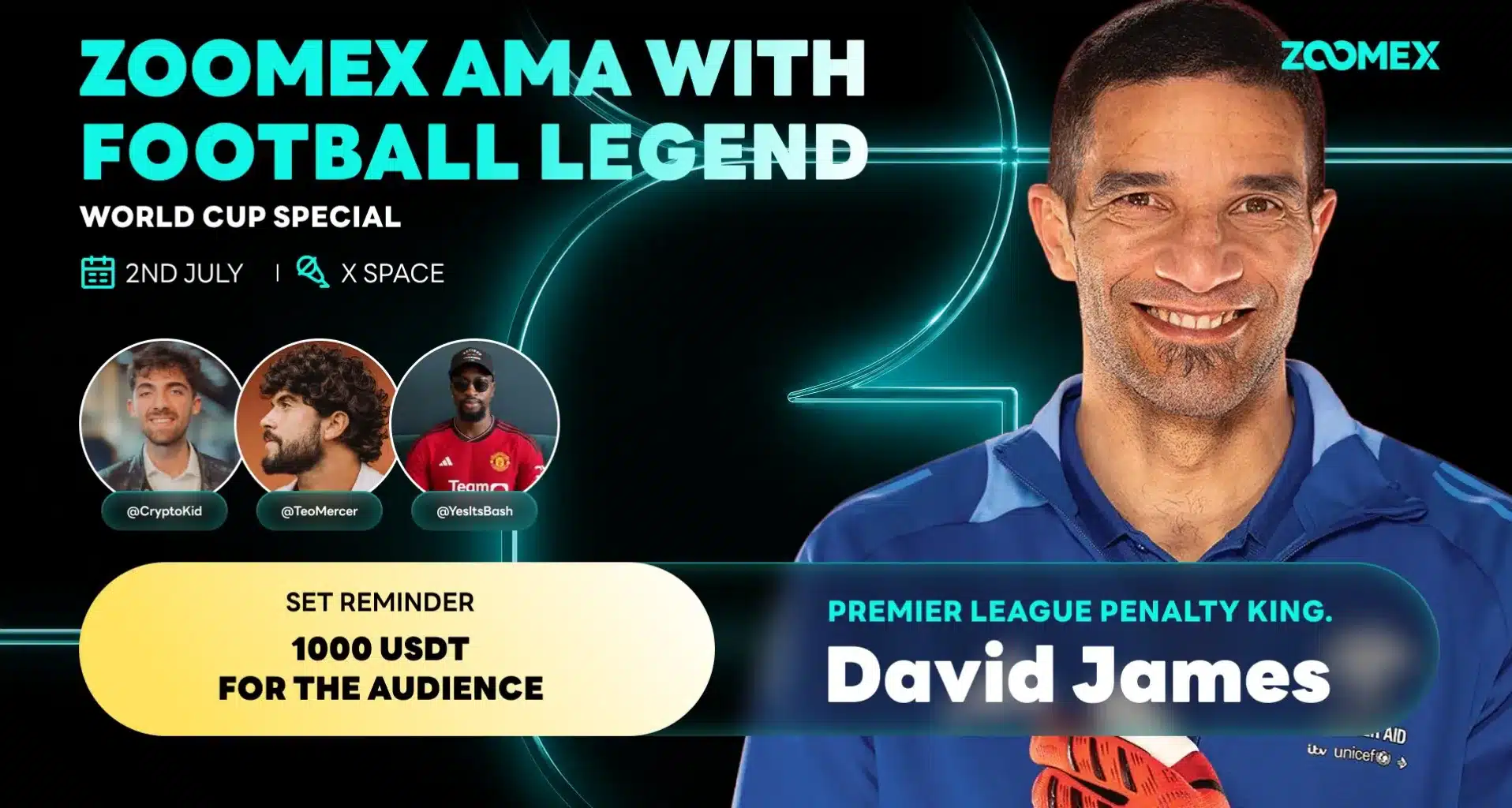
Former England goalkeeper David James brought an unexpected premise to Zoomex's third World Cup Edition X Space: the real pressure for a goalkeeper isn't the barrage of shots, but the silence between them. Joined by traders Crypto Kid, Farouk Bashar, and Theo Mercier, and hosted by Fernando Aranda, the session dug into the common architecture between goalkeeping and trading—a conversation tied to Zoomex's five-part charity pledge, which commits 1,000 USDT per episode plus 5,000 USDT if the guest's World Cup prediction holds. James picked England and nominated the UEFA Foundation.
Pressure Is Not the Shots; It's the Silence
James argued that when a goalkeeper faces constant action, the body stays warm. The real test comes when the team attacks without scoring and the ball suddenly goes the other way. Using England's win over Congo as an example, he noted the Congo keeper was exceptional for 60-70 minutes—until Harry Kane's header and a long-range thunderbolt sealed the game. “The best keepers accept goals but don't worry about the scoreline. They just say: that shot beat me, next one I save.” He was already looking ahead to facing Mexico at the Azteca, calling it “the best possible fixture before the final.”
Preparation Over Instinct in Penalties and Trading
The panel spent significant time on penalties, mapping the psychology onto trading systems. James described two modes: pure preparation—studying tendencies, run-up angle, foot placement, the drop of the non-kicking arm; and pure instinct, which can be wrong. “When I thought I was the best and dived the wrong way on instinct, I was wrong. The more information you have, the better your instinct gets.” Crypto Kid immediately connected: “Same in trading. More data means better predictive instinct.” Farouk asked whether penalty rituals are natural or rehearsed. James was clear: “I imagined the shootout, the crowd, even the Azteca noise. Jordan Pickford's antics—shouting, faces—are rehearsed, not spontaneous.” He broke down Morocco's Bono, who changed his penalty-saving foot movement from the last World Cup because opponents had studied him. “Your reputation becomes a variable: the striker thinks he knows you, but you've already changed.”
The Execution Behind Miraculous Saves—and Mistakes
Theo asked if James ever made a save he instantly knew was iconic. “Rarely. An experienced keeper can't jump higher than before. The Congo keeper's deflection save looked magical, but for me it was just training paying off: I trained that, and I'm glad I made it today.” The relationship with mistakes has evolved: twenty years ago an error lived in the mind as a ghost. Now, by the hydration break, coaches show you exactly what went wrong. “Errors become data, not ghosts.” Farouk mentioned Bielsa's half-time goalkeeper substitution. James, who once made a substitution after 20 minutes as a manager, said, “The sub isn't hard—the communication is. If the reasoning reaches the player, they move forward.”
Eight French Players Over 35 km/h and the Fragility of Zero Goals Conceded
James cited speed data: England has four players with top speeds above 35 km/h; France has eight, spread across defenders, wingers, and forwards. “Whoever faces France isn't guarding against a fast team—they're guarding against speed from anywhere.” He called Mexico and Spain's zero-goals-conceded record deceptive: “Not conceding can make you fear the first goal. Every other team has already adjusted to falling behind and recovering.” His standout individual performer so far: Cape Verde's 40-year-old goalkeeper, whose performance against Spain kept them in the tournament. “If not for that match, they'd be home.” He expects the round of 16 to reveal the best keeper, as group games were too lopsided. “Distribution quality will be the difference.” Asked which striker made him most nervous, James said he was never nervous—only disappointed—by Thierry Henry and Didier Drogba. “No matter how good I felt, when I left the pitch, one of them had usually scored.”