
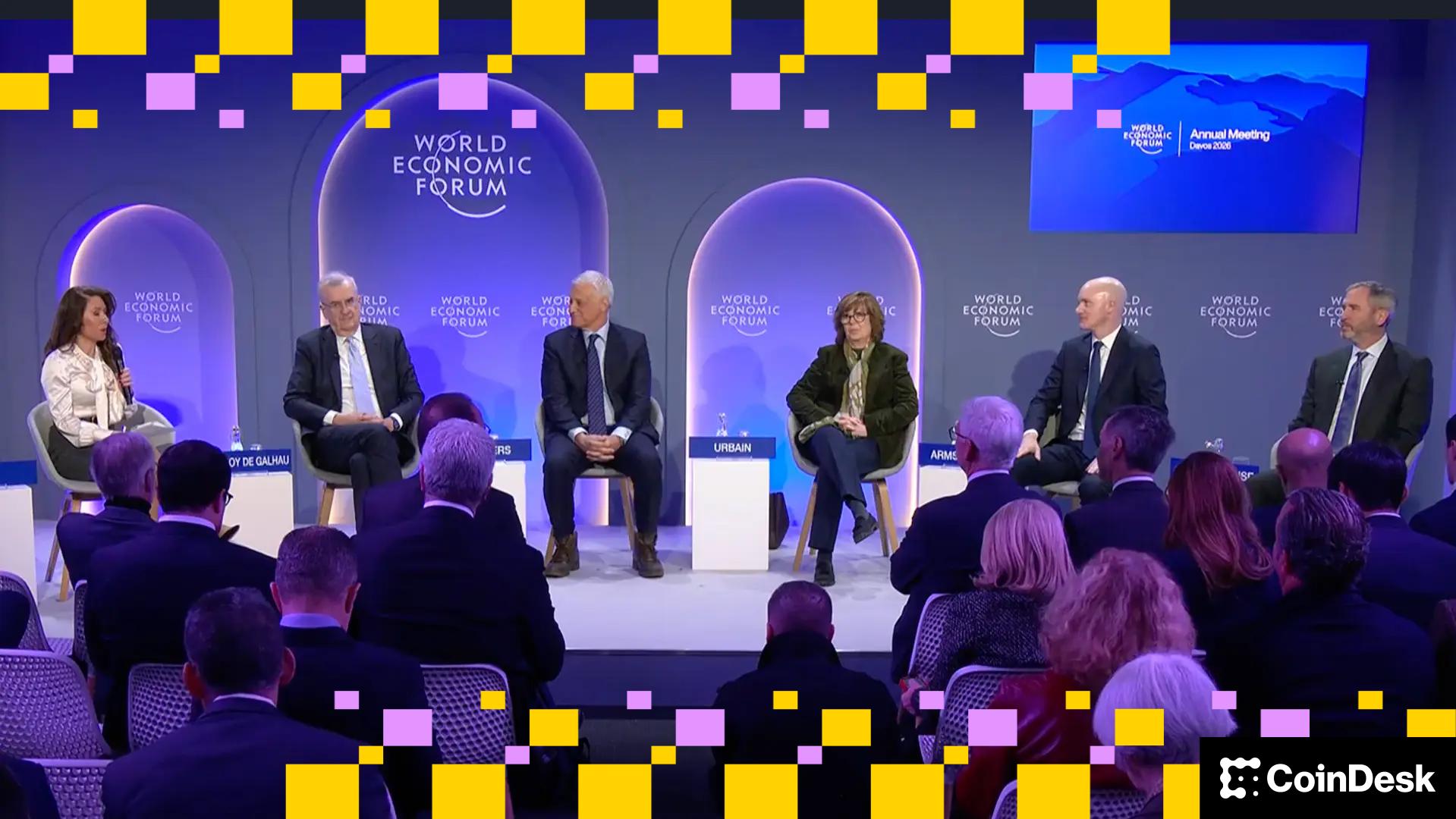
A World Economic Forum panel in Davos that was supposed to examine tokenization quickly shifted into a pointed argument over stablecoin rewards, bitcoin and U.S. crypto law. Coinbase CEO Brian Armstrong and Bank of France Governor François Villeroy de Galhau led the clash, exposing how far apart the crypto industry and central bankers remain on the design of digital money.
Armstrong pushes yield as a consumer and competition issue
The sharpest disagreement centered on whether fiat-pegged stablecoins should be allowed to pay interest or rewards to holders. Armstrong argued that the question is not technical. In his view, it is about consumer benefit and global competitiveness. He said rewards on stablecoins would put more money in consumers’ pockets, and he warned that banning yield for U.S.-regulated issuers would only strengthen offshore rivals that already exist.
Armstrong also pointed to China’s stated position that its central bank digital currency would pay interest. His message was direct: if regulated U.S. stablecoins are blocked from offering rewards while offshore products continue operating, competitive pressure will simply move outside the domestic regulatory perimeter.
French central bank chief rejects yield-bearing digital euro
Villeroy de Galhau did not move from his position. He treated interest-bearing private tokens as a systemic risk to traditional banking and rejected the idea that a central bank digital currency should compete on yield. Asked whether a digital euro should pay interest, he gave a blunt answer: no. He said the public purpose also includes preserving the stability of the financial system.
That exchange showed a clean split in priorities. Armstrong framed yield as a feature that can improve consumer outcomes and keep regulated markets competitive. Villeroy de Galhau framed it as a threat to financial stability, especially if private digital money starts drawing deposits away from banks.
Other panelists split on the value of yield
The panel also featured Standard Chartered CEO Bill Winters, Ripple CEO Brad Garlinghouse and Euroclear CEO Valérie Urbain, with CNBC Squawk Box co-anchor Karen Tso moderating. Garlinghouse took a softer line than Armstrong. He said competition is good and that a level playing field matters, while adding that Ripple does not have as much of a direct stake in that fight.
Winters leaned closer to the crypto side. Standard Chartered is already active in digital assets, and he argued that tokens become less compelling as a store of value if they do not carry yield. In his formulation, tokens will be used as a medium of exchange and as a store of value. Without yield, he said, the second use case looks much less attractive.
Debate spills into the CLARITY Act talks
The discussion then moved to Washington. Karen Tso suggested negotiations around the CLARITY Act had stalled after Coinbase recently withdrew its support. Armstrong pushed back on that description and said U.S. market structure legislation is still making good progress. He described the current moment as an active round of negotiation rather than a dead end.
He also explained why Coinbase stepped away from the session last week. Armstrong said the move was intended to prevent traditional finance gatekeepers from using legislation to block competition. He said Coinbase wants to make sure any U.S. crypto bill does not ban competition, and he accused banking lobbying groups in Washington of trying to tilt the process against rivals, adding that he has zero tolerance for that approach.
Garlinghouse agreed with the need for fairness in regulation, but he added a condition. A level playing field, he said, has to work both ways: crypto companies should face standards comparable to those applied to banks, and banks should also face standards comparable to those applied to crypto companies.
What began as a discussion on blockchain infrastructure ended up as a direct confrontation over yield, regulation and the competitive boundary between banks and crypto firms. The divide over stablecoins, bitcoin and digital currency design was on full display.