
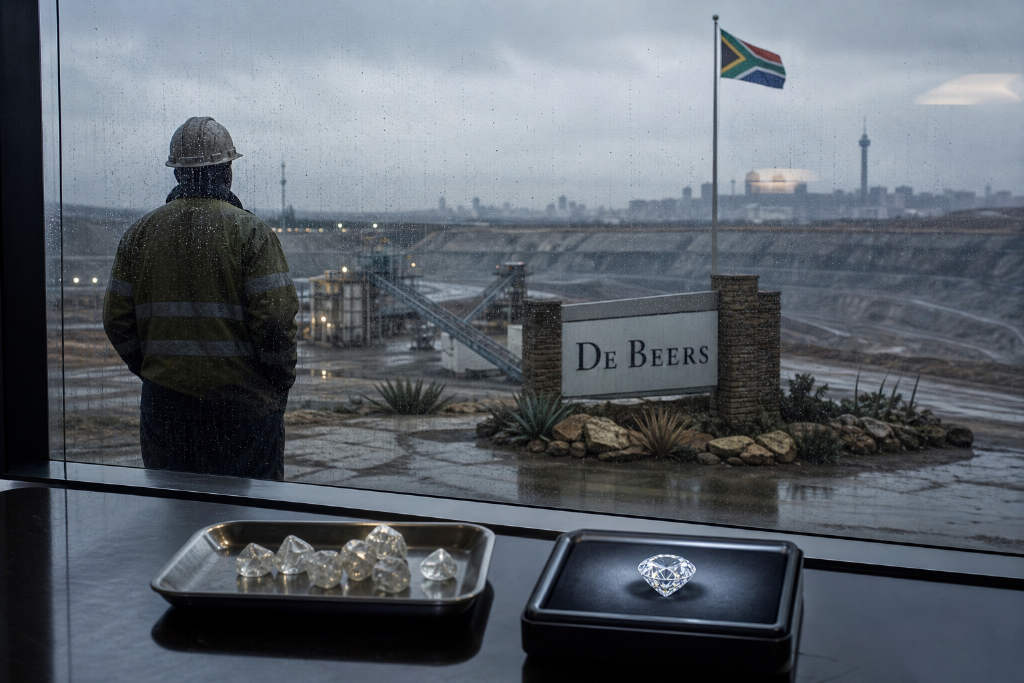
De Beers, the world’s largest diamond miner, said on July 13 that its flagship Venetia mine in South Africa will be shut for two years, despite earlier plans to keep the operation running until 2040. South Africa is also the company’s birthplace: De Beers was founded there in 1888 by Cecil John Rhodes and others.
Wall Street Journal reporter Alexandra Wexler, who traveled to the border town of Musina, wrote that a local mining union estimates more than 1,200 jobs could disappear because of the shutdown. In a border region where unemployment is above 40%, miners have few other options.
Lab-grown stones are challenging the old scarcity story
For more than a century, miners including De Beers built diamonds into a symbol of love and commitment through tight supply control and heavy advertising. That scarcity-based model is now under pressure from lab-grown diamonds.
According to the report, laboratories can now reproduce diamonds with the same carbon structure by simulating the high-temperature, high-pressure conditions found inside the Earth, at a cost of only a few hundred dollars. Paul Zimnisky, an independent diamond analyst in New York, said about 10 major diamond mines around the world have been suspended or closed over the past two years. Output is down about 25% from five years ago, yet prices have continued to slide.
The average price of a one-carat natural diamond has dropped to $3,415, nearly half the level seen a decade ago. Over the same period, the price of a one-carat lab-grown diamond fell 89% to $595.
De Beers increased marketing, but buyer preferences have shifted
Wexler reported that De Beers at one point tried to enter the lab-grown diamond jewelry market, but has since reversed course and returned to promoting the scarcity of natural stones. Last year, the company spent its biggest marketing budget in a decade to relaunch its advertising push. De Beers said sales of natural diamonds at independent jewelers in the United States rose 9% in the first quarter of this year.
But the broader market trend is moving the other way. The Knot Worldwide said in its 2026 Real Weddings Study that lab-grown diamonds made up 61% of center-stone purchases for engagement rings, up 239% from 2020. The report says couples are effectively voting with their wallets and walking away from the premium attached to natural diamonds.
Heavy spending at Venetia now sits against repeated writedowns
The shutdown also sharpens the financial cost of De Beers’ recent investment in Venetia. A few years ago, the company spent about $2.3 billion to convert the mine from an open-pit operation into an underground one, with the expectation that output could continue into the 2040s.
In February, Anglo American, which owns 85% of De Beers, cut the carrying value of its diamond business in half. The report said the $2.3 billion writedown was the third in three years. De Beers posted an adjusted after-tax loss of about $500 million last year.
Anglo American has been trying for more than two years to find a buyer for its stake in De Beers, without a final deal. Bloomberg reported in mid-July that Anglo had selected Global Diamond Consortium, led by former chief executive Gareth Penny, as the preferred bidder in a deal worth about $1 billion. Anglo’s chief executive later said the company was not in exclusive talks with any buyer. The Botswana government, which holds 15% and has a right of first refusal, remains a key variable.
For workers, the numbers translate into a livelihood crisis
For Venetia employees, the balance-sheet figures mean something immediate. Tinah Nemahunguni, a 37-year-old widow, has spent 13 years operating machinery at a diamond recovery plant. Her wages helped her build a house in Musina, support two children, and assist her brother, sister, and grandmother. She told Wexler, 「There is no bigger industry here.」
The report said other employers in the area are mostly commercial farms and wildlife lodges, where pay and benefits do not match those of a multinational company. 「This is the only job I have ever had that could support a whole household,」 she said. 「We are desperate.」
Another 37-year-old worker, Rasafa Mulaudzi, has worked at Venetia since 2015 and is building his first house. His monthly pay of about $2,150 supports his children, the two children left behind by his late brother, his parents, and three siblings who have not been able to find work. 「How am I supposed to survive?」 he said.
Tshilidzi Sikhwivhilu, local chair of the National Union of Mineworkers at Venetia, accused De Beers management of trying to present the shutdown as 「a sudden, unavoidable crisis,」 even though the company had long known the industry was under strain. He told Wexler that once these workers lose their jobs, 「there will be many people in the streets」 and even those who try to start small businesses will struggle to find customers with money to spend.
Hiring continues at a lab-grown diamond subsidiary
Nemahunguni said she saw openings on De Beers’ internal careers site for jobs at Element Six, the company’s UK subsidiary. Element Six makes lab-grown diamonds mainly for industrial use.
「They say there is no money, but they are still hiring,」 she said.