
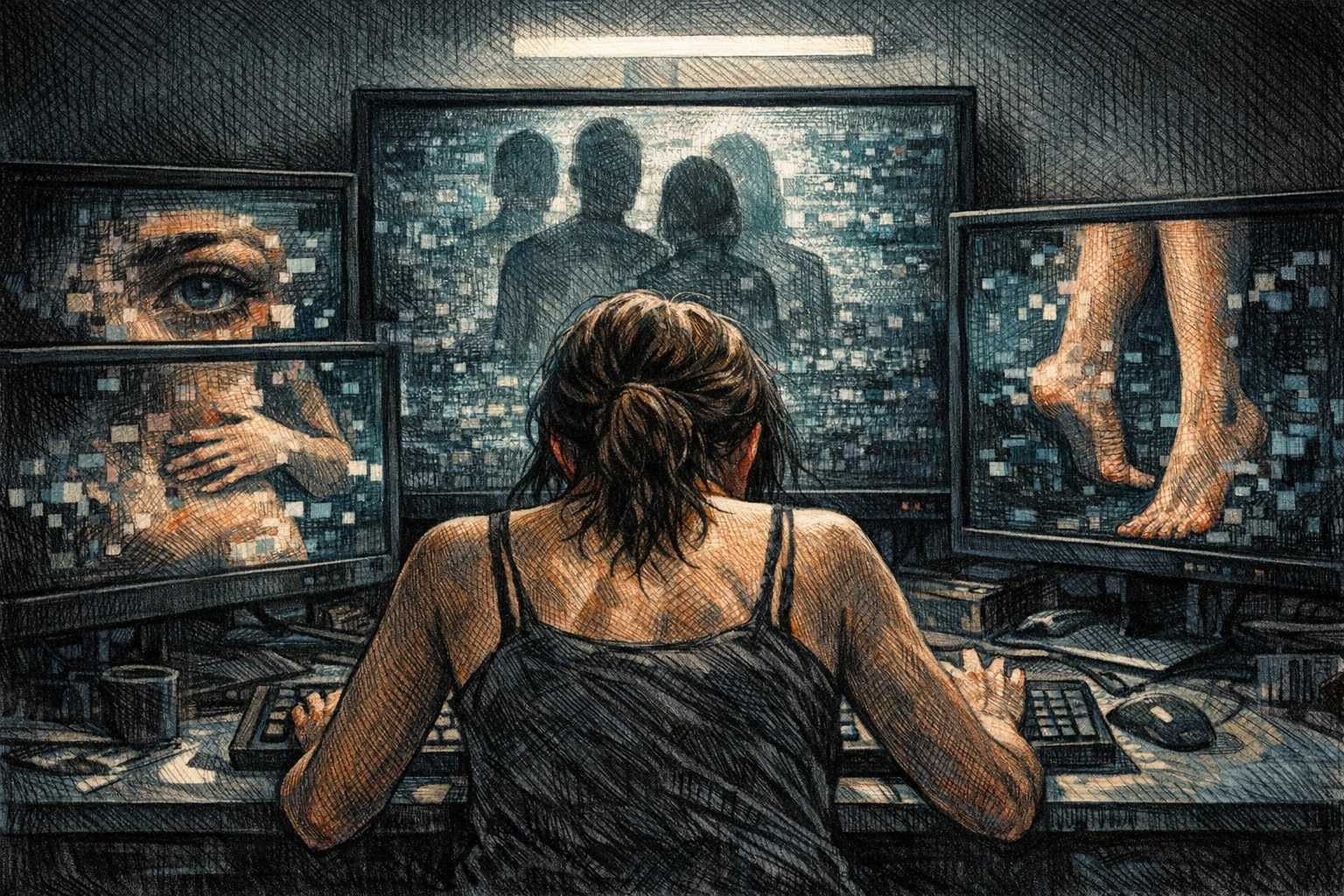
The core dispute around AI-generated porn has long centered on the face pasted into a fake video. The body underneath has received far less scrutiny. According to reporting cited from MIT Technology Review, a New York psychotherapist named Jennifer, then 37, used facial-recognition software in 2023 to search for adult videos she had made a decade earlier and found one she had never seen before. She recognized the setting as a shoot from 2013, but the face had been replaced. That, she realized, meant someone had used her body in a deepfake.
The issue no longer stops at editing a single clip. Adult performers’ bodies are increasingly treated as training material for systems designed to generate realistic nudity, body movement, and visual detail that looks human. The report says this happens without informed consent and is extremely hard to trace. It also points to nudify apps that can produce fake nude images from an ordinary clothed photo, adding that such tools have very likely relied on more than 10,000 TB of online adult content as training input.
From stolen scenes to model-scale training data
The term deepfake dates back to November 2017, when a Reddit user known as “deepfakes” inserted celebrity faces into porn videos featuring adult performers. Since then, performers’ bodies have remained one of the most heavily reused sources in this category. Attorney Corey Silverstein, who works in the adult industry, said this has been happening all along. What has changed is the scale and function of the material: bodies are no longer just reused in isolated videos, they may be feeding the systems that generate synthetic replacements.
UC Berkeley digital forensics expert Hany Farid described these tools as “black boxes.” His view, as quoted in the report, is that given how widespread adult content is online, it is a reasonable assumption that such material is being used in AI training. The problem has also moved into voice cloning and identity fraud. Performer Tanya Tate recently learned that a fan had spent $20,000 on sexual chats with an AI version of “her,” built by scammers. After several fans were deceived, some began accusing Tate herself and spreading false claims about her.
Old contracts mentioned future technology, not AI replicas
Many adult performers signed contracts years ago allowing publishers to use content through “any technology now known or later discovered.” At the time, that language was understood in the context of format shifts such as VHS to DVD. It did not anticipate AI systems training on existing material to create synthetic versions that could compete with, or replace, the original performer. MIT computer science PhD student Stephen Casper said performers who began working before the rise of AI could not realistically have consented in advance to those uses. Jennifer described the risk as something imposed retroactively.
Detection is also slipping behind the technology. Farid’s 2025 research found that test subjects identified AI-generated voices correctly only about 60% of the time, not much better than chance. At the same time, copyright enforcement company Takedown Piracy said it had removed 130 million infringing videos from Google alone using digital fingerprinting. Even if a video is altered or a face is swapped, the original source can still be detected in some cases.
A federal takedown law may create a new conflict
The report says the only US federal law aimed specifically at deepfakes is the Take It Down Act, which requires websites to remove non-consensual intimate imagery within 48 hours. Its stated purpose is victim protection. Eric Goldman, a law professor at Santa Clara University, warned that the mechanism could also be used against lawful adult content made with consent, because anyone could report it as NCII and pressure platforms to take it down first.
Goldman added that US law still does not clearly treat this type of violation as a privacy invasion because responsibility is hard to assign. The European Union, the UK, and Australia have announced restrictions on nudify apps, but the report notes that these services often reappear under different names after being removed. Performer Reba Rocket said AI “girls” will do anything a user wants and “they don’t say no,” a prospect she found especially disturbing if real people were used to train the models in the first place.