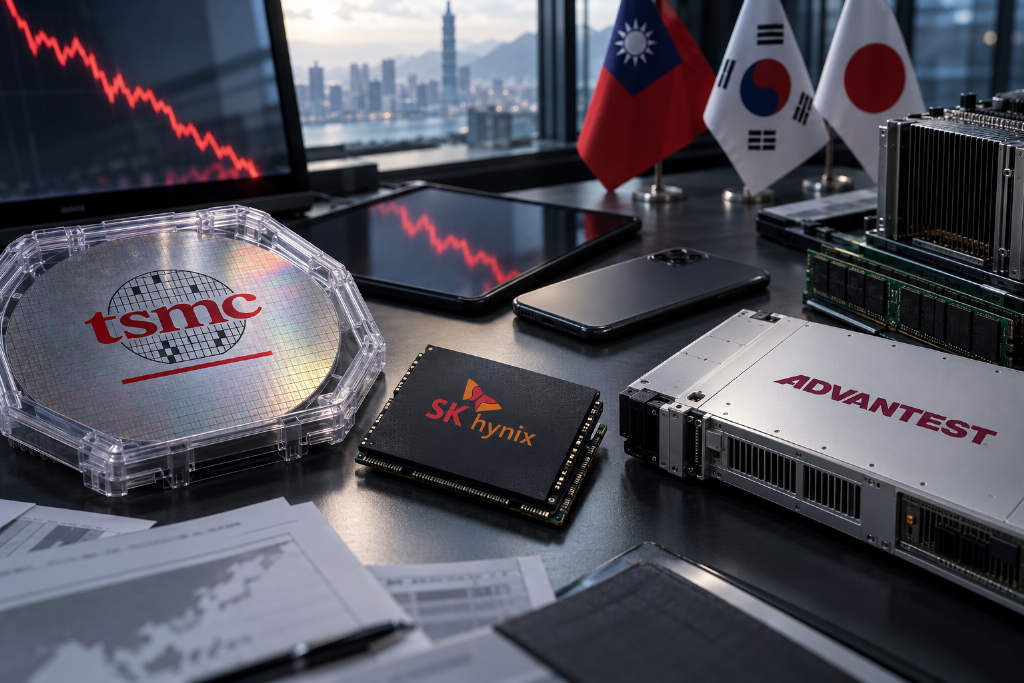
Asian semiconductor shares fell again on Monday, with the Bloomberg Asia chip stock index dropping more than 2% to its lowest level since July, according to Bloomberg. Taiwan Semiconductor Manufacturing Co. (TSMC), SK Hynix and Japan’s Advantest were among the biggest drags. Investors were focused on two pressure points. One was continued concern over funding for AI infrastructure in the United States, where questions have been raised about CoreWeave’s financing capacity and expectations for public listings by Anthropic and Nscale have cooled. The other was a weekend model update from China’s DeepSeek, which said its new release runs faster and uses fewer resources, prompting concern that lower storage requirements for AI models could weaken demand for chips. Broader regional markets also came under pressure, with South Korea’s Kospi, Japan’s Nikkei 225 and Taiwan’s weighted index all falling during Monday trading. Life Asset Management CEO Kang DaeKwun said uncertainty remains too high to judge when Korean equities may bottom, adding that funding for U.S. corporate AI projects is a key risk. This week’s earnings from Meta and Tesla are being watched as a gauge of whether AI capital spending is still holding up.
Asian semiconductor stocks stayed under pressure on Monday, with the Bloomberg Asia chip stock index falling more than 2% to its lowest level since July, according to Bloomberg. Taiwan Semiconductor Manufacturing Co. (TSMC), SK Hynix and Japan’s Advantest were the main drags on the index.
Two concerns hit the sector
Investors were weighing two separate risks. The first was continued stress around financing for AI infrastructure in the United States. CoreWeave’s ability to raise funding has come under scrutiny, while expectations for public listings by Anthropic and Nscale have also cooled.
The second was a weekend model update from China’s DeepSeek. The company said the new model runs faster and uses fewer resources, raising concern that AI models may require less storage capacity and that chip demand could be affected.
Regional benchmarks also fell
South Korea’s Kospi posted its biggest weekly drop last week since October 2008. On Monday, the index fell more than 3% at one point before recovering part of the loss. Japan’s Nikkei 225 dropped as much as 2.3%, while Taiwan’s weighted index fell 2%.
Market focus turns to U.S. tech earnings
Kang DaeKwun, chief executive officer of Life Asset Management, said uncertainty in the market is still too high to tell when South Korean equities may find a bottom. He said financing conditions for U.S. corporate AI projects remain one of the main risks.
Kang also said earnings at South Korean chipmakers still depend heavily on continued spending by U.S. companies on AI infrastructure. Results due this week from major technology companies including Meta and Tesla are expected to serve as an important window into the momentum of AI capital expenditure growth.
This article was originally published by Bit.Fan. For more cryptocurrency news and market insights, visit www.bit.fan. Disclaimer:
The market information, project data, and third-party content displayed on this platform are for industry information sharing only and do not constitute any form of investment advice or return commitment.
Cryptocurrency trading carries high risks. Users should fully assess their risk tolerance and make independent decisions. All profits, losses, and legal responsibilities are borne by the users themselves.