
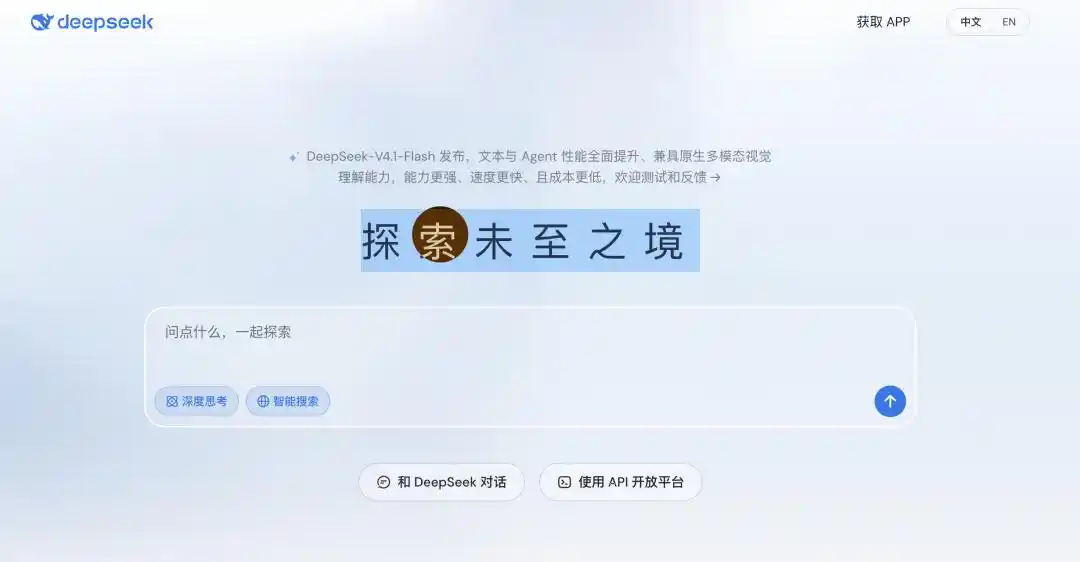
DeepSeek pushed through a packed round of product and organizational changes in September. Its web homepage was remade into a cleaner, chat-first interface carrying the slogan “Ask something, let’s explore together.” It also scrapped the Fast, Expert, and Image Recognition modes, folding everything into one model entry point. At about the same time, the company shipped DeepSeek V4.1 Flash, and DeepSeek Harness moved to v0.1.5.
The app is shifting too. The report says DeepSeek has quietly begun a small-scale rollout of voice conversations. Some users can tap the little speaker icon in the top-right corner, talk straight to the app, and get spoken answers back. There are four voice choices — Beike, Bailang, Haixing, and Anchao. Users can also cut in while the system is still replying.
A CFO appointment is said to be close
On Sept. 14, Phoenix Tech reported, citing multiple independent sources, that DeepSeek’s CFO is expected to join soon. The person believed to be nearest to the final pick is Yan Wentao, a partner at Hillhouse Venture Capital, who is reportedly already going through departure procedures.
Another source said leaders at several top domestic investment firms, including Wuyuan Capital, Sequoia Capital, and Longzhu Capital, had discussed the role with Liang Wenfeng. The report says the contest around this senior seat has stayed unusually opaque. A person close to DeepSeek also told Phoenix Tech that Liang wants the CFO to be someone born in the 1990s.
Top Chinese Tech Community also reported on Sept. 14 that Hillhouse’s post-1990 partner Yan Wentao may become DeepSeek’s CFO. Public information cited in that story says Yan was born in 1991, graduated from Fudan University, and is one of Hillhouse Venture Capital’s newer partners. Deals linked to his investment record include ByteDance, Zhipu, MiniMax, Xiaohongshu, Webull, and J&T.
Phoenix Tech said the selection process has been handled carefully. Yan is not the only one. Liang has also reached out to several senior figures at top domestic institutions. Some people in the industry quoted by the report see the role as attractive partly because of DeepSeek’s current place in AI, and partly because the company is moving further down the road toward capitalization.
Fundraising, IPO planning, and expansion are converging
Word of a renewed CFO search first appeared in July this year. The past two-plus months have also been described as DeepSeek’s busiest stretch for financing. Caijing reported that the company’s two latest funding rounds together exceeded RMB 100 billion. More recent market talk has said CITIC Securities has already started preparing for a STAR Market listing.
Phoenix Tech said it asked DeepSeek about the CFO appointment but had not received a reply by publication time. On the IPO question, the report said DeepSeek has never spoken publicly.
On Sept. 9, Reuters cited a person familiar with the matter as saying DeepSeek had chosen CITIC Securities to prepare for a STAR Market listing, with filing materials expected this year and, according to market talk cited in the story, a formal debut in 2027. On the policy front, the Shanghai Stock Exchange issued its “STAR Market Fifth Set Standard AI Special Guidance” on June 17 this year.
On financing, the report says DeepSeek completed its first external fundraising round since founding in June, raising more than RMB 50 billion, or about $7.4 billion, setting a new single-round record in China’s AI sector. Funding details disclosed by multiple media outlets were listed as follows: Liang Wenfeng contributed about RMB 20 billion, accounting for 40%; Tencent about RMB 10 billion; entities tied to CATL about RMB 5 billion; JD.com, NetEase, Monolith Lishi Capital, and IDG Capital about RMB 3 billion each; and the National AI Industry Investment Fund RMB 1 billion. Just over a month later, a second round started, targeting a pre-money valuation of about RMB 500 billion.
The report’s point is blunt: with two giant fundraising rounds, a possible STAR Market IPO, a 10,000-GPU-class computing center, and a team growing fast all landing at once, the CFO job is now far bigger than keeping the books. Funding rhythm, shareholder relations, capital allocation, and ecosystem planning are all on the table.
From restraint on consumer traffic to rebuilding an entry point
For the past three years, Liang Wenfeng has projected a fairly steady image: no rush to raise money, no deliberate push into consumer operations, no obsession with short-term monetization, and a fixed interest in AGI. In one internal exchange, he summed up that thinking with a simple line: “There are bigger watermelons ahead; what’s in front may only be sesame seeds.”
But Phoenix Tech says the signals have begun to change in recent months. DeepSeek still wants AGI. It is also trying, with more urgency now, to lock in something else: becoming one of China’s biggest AI entry points on the strength of its model capabilities.
At the start of 2025, one week after R1 was released, DeepSeek’s daily active users passed 20 million, and the peak at month-end went beyond 45 million. The app quickly climbed to No. 1 in the rankings. For any startup, the report says, that would have been the obvious moment to grab traffic and press monetization. Even then, DeepSeek and Liang stayed cautious about centralized traffic gateways.
In a July investor exchange that circulated widely, Liang kept returning to one word: “restraint.” He said that “restraint is a strategy.” The report says that meant the team had not originally planned to turn DeepSeek into the next super app and had not rushed into a fight for personal users. Phoenix Tech said it had previously learned that DeepSeek put only limited effort into the consumer side and, at one point, did not even want to spend much energy maintaining those users.
The logic then was simple enough: build the model well, and the rest follows. The report says that confidence came in part from financial support. High-Flyer Quant, the group behind DeepSeek, had around RMB 70 billion under management in 2025 and an average return rate of 56.6%, making it a steady source of funding. DeepSeek also stuck with open source and low pricing, calculating model fees based on recovering equipment costs in ten months, which gave developers and ordinary users low-cost access to top-tier models.
User scale changed the equation
More than a year later, the consumer picture looks different. QuestMobile data cited in the report shows that as of June 2026, DeepSeek had about 129 million monthly active users, ranking third among Chinese AI apps, behind Doubao at 382 million and Qianwen at 167 million. By July, DeepSeek’s MAU had dropped to 94.17 million, down 21.1% year over year.
Even so, user stickiness stayed high. The report says users opened DeepSeek 41.7 times per month on average, more than Qianwen. But in total user scale, rivals were slowly widening the distance.
The weight of distribution has been tested again and again over the past year. ByteDance used Doubao to place large models inside a mass-market traffic system. Alibaba tied Qianwen to e-commerce and cloud. Tencent used Hunyuan to connect into the WeChat ecosystem. In that setup, the gap in model capability has narrowed, while the gaps in users and use cases have become much harder to close. DeepSeek is now revisiting the lesson it once chose to avoid.
The limited launch of voice conversations on Sept. 12 was presented as one clear signal. The report says DeepSeek is no longer satisfied with staying inside a single text box. It is moving one step closer to more natural, higher-frequency, everyday interaction. Two-way voice. Interruption support. Four voice options. Classic consumer product decisions.
Hiring shifts toward engineering delivery and agents
Hiring is moving the same way. On the night of Sept. 7, Cui Tianyi, head of the DeepSeek Harness team, posted about 150 openings on social media in a single batch and called the hiring push “unprecedented.”
All 150 roles were concentrated in two areas: server-side development and R&D for elastic agent computing. The company was looking for senior backend engineers with two to 10 years of experience. There was not one AI research role on the list. Cui’s explanation was blunt: “Scale creates complexity, and complexity in turn requires greater scale.”
The report sets that against June, when hiring was framed around every department expanding by at least one times and product roles were added for the first time. By September, every one of the 150 openings was aimed at engineering execution. The center of gravity had moved from “building stronger models” to “supporting more users, more complex systems, and more complete products.” Whale Lab was cited as saying DeepSeek plans to expand its team to 1,000 this year.
AGI, distribution, and capital demands are meeting in one place
The report says DeepSeek’s turn should not be flattened into a simple label like “compromising for commercial reasons.” In its view, AGI and distribution do not cancel each other out.
Liang has described the path to AGI as four steps: chain of thought, or CoT; agents; continual learning; and finally embodied intelligence. He has also said, “The step we climbed last year was CoT. The step this year is Agent.” In that framing, the answer to distribution is built into the agent stage itself. At the CoT stage, a model can prove itself in papers and benchmarks. Once it reaches the agent stage, it needs to call tools, finish tasks for users, and move through the real digital world. That takes an entry point that can handle massive user traffic and real demand.
A person familiar with large-model training told Phoenix Tech that the old traffic logic has been reversed. Before, there had to be an app first, then traffic, then an entry point. Now, if the model is smart enough, it can pull in users on its own. The data users generate in real usage then decides how far the model can go in its next phase.
“The pretraining data for OpenAI and Anthropic is 80% the same, all public internet text,” the person told Phoenix Tech. “The real gap comes from the remaining 20% — the success and failure data generated by users in actual use.” In that telling, users writing code with Codex or Claude Code create the most authentic programming feedback. The platform that captures more real demand gets more of that scarce 20%, and the model can keep improving from there.
The same person also said distillation mainly keeps refining existing knowledge and cannot break the ceiling on intelligence. The real breakthroughs, in this view, come from reinforcement learning gradually pushing performance higher. The report ties DeepSeek-R1’s 2025 gains in mathematics and coding to reinforcement learning. Under that reading, big companies with distribution still find it hard to rebuild top base models, while DeepSeek, starting from model capability that has already been validated, may be in a more proactive position as it adds distribution.
Compute spending, public markets, and retention pressure
AGI is getting more expensive too. Bloomberg reported on Sept. 4 that DeepSeek plans to build a 1GW intelligent computing center in Ulanqab, Inner Mongolia, with total investment reaching several hundred billion yuan and Huawei Ascend chips slated mainly for inference. Compute clusters, chip purchases, and the race for top talent all demand enormous capital.
The report says DeepSeek’s two massive funding rounds solve for current ammunition, not the full length of the race. AGI is a long-distance contest with no clear finish line. So to keep capital flowing, access to public markets is presented as close to unavoidable. And the valuation public investors are willing to give will still rest on a commercialization story that can be told clearly. Distribution is described as the base of that story.
Talent churn adds more pressure. Over the past year, the report says, DeepSeek has almost turned into a training ground for larger tech companies. Core researcher Luo Fuli was poached by Xiaomi on a widely circulated compensation package said to be in the tens of millions of yuan annually. Guo Daya, a core contributor to V3 and R1, moved to ByteDance Seed. Wang Bingxuan, a key author of the first-generation large language model, joined Tencent Hunyuan. Liang has acknowledged that team stability is DeepSeek’s biggest risk, saying, “As long as I can maintain team stability, I will definitely be able to achieve AGI.” In that setting, fundraising and listing are seen as ways to give employee stock options clearer value, while a platform and entry point large enough can also help keep people in place.
The company’s reach is extending into embodied intelligence as well. In August this year, DeepSeek invested RMB 141 million in Unitree Robotics, securing a place in the “large model + embodied intelligence” track that matches the final step in Liang’s roadmap.
The next question for DeepSeek
The report ends by arguing that chasing distribution does not mean walking away from the choices that won DeepSeek respect in the first place. It still supports open source. It still prices its models around a ten-month cost recovery cycle. It still gives ordinary developers low-cost access to top-tier models.
Seen that way, a bigger, more usable entry point that can hold more scenarios is not the opposite of accessibility. It is an extension of it. A move from the developer’s toolbox into the daily routines of far more people.
If the CFO formally arrives, the question in front of Liang may become easier to say and harder to answer: how to turn a world-class AI lab into a world-class technology company. According to the report, the first demands technical altitude. The second also demands breadth of users, organizational depth, and patient capital. DeepSeek’s next stage, in that sense, is only just starting.
This article originated from the WeChat account of Phoenix Tech. Author: Phoenix Tech.