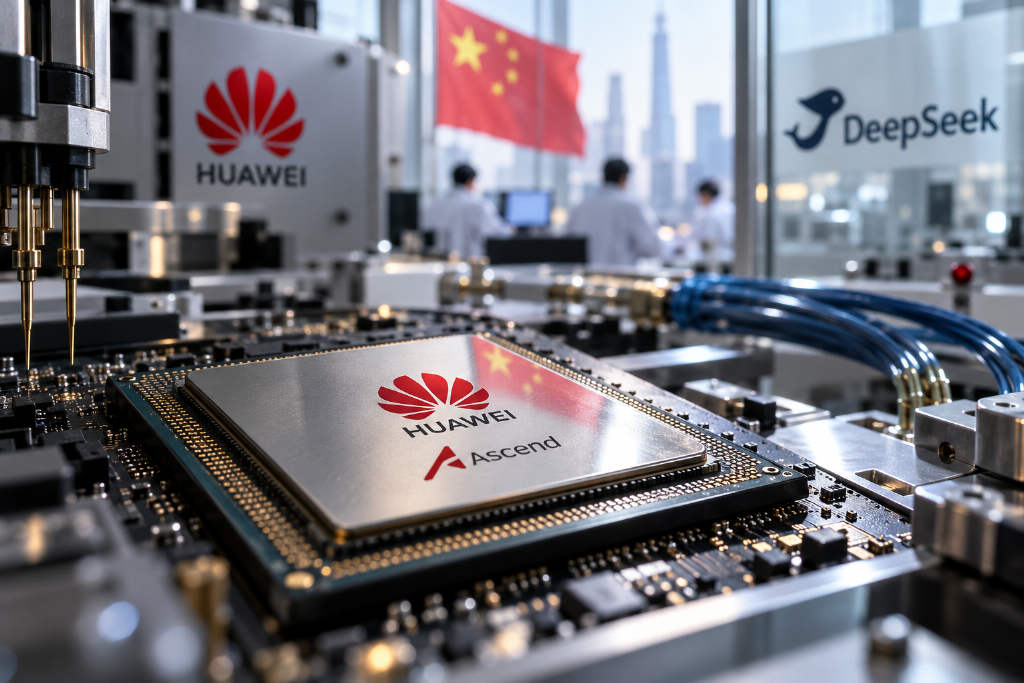
DeepSeek is working closely with Huawei on the design of a next-generation AI chip, according to The Information, in a move aimed at building AI models that do not depend on Nvidia computing power. People familiar with the matter said Huawei engineers have moved into DeepSeek’s office to study the company’s model architecture and algorithm requirements, while also testing how the chip handles data transfer and compression. The first chip targeted for adaptation is Ascend 950DT. The report said the effort comes as China pushes to reduce dependence on U.S. chips. Huawei’s Ascend 950DT is planned for release in 2027, but mass production could slip to 2028 because of Taiwan Semiconductor Manufacturing Co. fabrication constraints and U.S. export controls. To deal with chip shortages, DeepSeek is using the TileLang programming language to work around CUDA restrictions, while also trying to access restricted Nvidia Blackwell chips through third-party data centers. The company is also building out its chip team and has started testing clusters with more than 1,000 processors.
DeepSeek is in deep cooperation with Huawei to design a next-generation AI chip, according to The Information, with the project aimed at building models that do not rely on Nvidia computing power.
People familiar with the matter said Huawei engineers have moved into DeepSeek’s office to understand its model architecture and algorithm requirements. They are also testing how the chip handles data transfer and compression. The first chip being targeted for adaptation is the Ascend 950DT.
The report said the push comes as China seeks to reduce its dependence on U.S. chips. Huawei’s Ascend 950DT is scheduled for release in 2027, but mass production may be delayed until 2028 because of Taiwan Semiconductor Manufacturing Co. production constraints and U.S. export controls.
To address chip shortages, DeepSeek is using the TileLang programming language to work around CUDA restrictions. At the same time, it is still trying to obtain restricted Nvidia Blackwell chips through third-party data centers.
DeepSeek is also assembling a chip team and has already begun testing clusters with more than 1,000 processors.
This article was originally published by Bit.Fan. For more cryptocurrency news and market insights, visit www.bit.fan. Disclaimer:
The market information, project data, and third-party content displayed on this platform are for industry information sharing only and do not constitute any form of investment advice or return commitment.
Cryptocurrency trading carries high risks. Users should fully assess their risk tolerance and make independent decisions. All profits, losses, and legal responsibilities are borne by the users themselves.